
长期遵循无麸质饮食的麸质过敏患者的微量营养素膳食补充建议:综述。
Micronutrients Dietary Supplementation Advices for Celiac Patients on Long-Term Gluten-Free Diet with Good Compliance: A Review.
机构信息
IRCCS Mondino Foundation, 27100 Pavia, Italy.
Department of Public Health, Experimental and Forensic Medicine, University of Pavia, 27100 Pavia, Italy.
出版信息
Medicina (Kaunas). 2019 Jul 3;55(7):337. doi: 10.3390/medicina55070337.
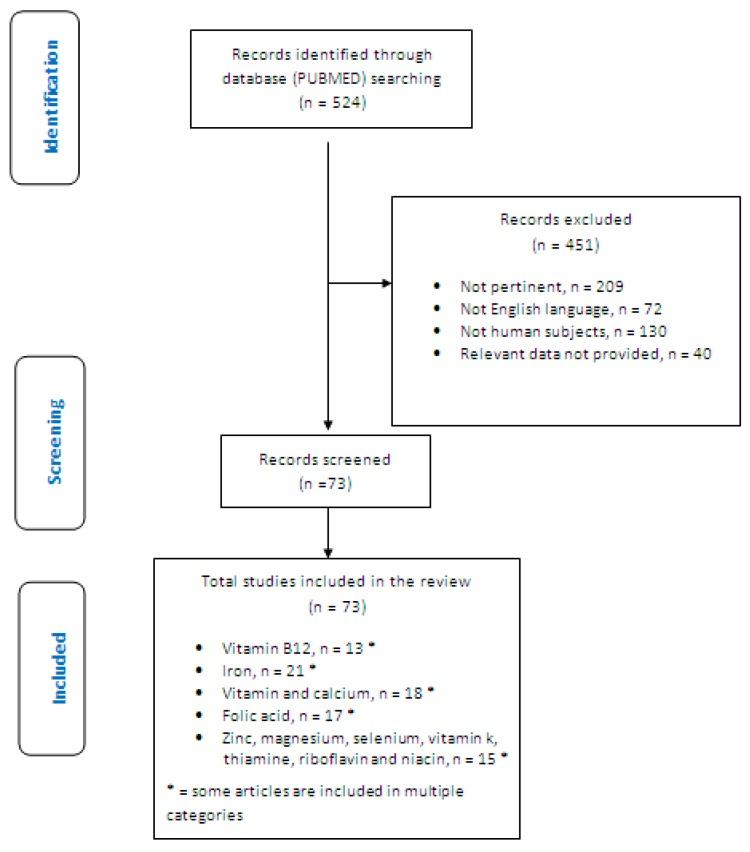
Often micronutrient deficiencies cannot be detected when patient is already following a long-term gluten-free diet with good compliance (LTGFDWGC). The aim of this narrative review is to evaluate the most recent literature that considers blood micronutrient deficiencies in LTGFDWGC subjects, in order to prepare dietary supplementation advice (DSA). A research strategy was planned on PubMed by defining the following keywords: celiac disease, vitamin B12, iron, folic acid, and vitamin D. This review included 73 studies. The few studies on micronutrient circulating levels in long-term gluten-free diet (LTGFD) patients over 2 years with good compliance demonstrated that deficiency was detected in up to: 30% of subjects for vitamin B12 (DSA: 1000 mcg/day until level is normal, then 500 mcg), 40% for iron (325 mg/day), 20% for folic acid (1 mg/day for 3 months, followed by 400-800 mcg/day), 25% for vitamin D (1000 UI/day or more-based serum level or 50,000 UI/week if level is <20 ng/mL), 40% for zinc (25-40 mg/day), 3.6% of children for calcium (1000-1500 mg/day), 20% for magnesium (200-300 mg/day); no data is available in adults for magnesium. If integration with diet is not enough, starting with supplements may be the correct way, after evaluating the initial blood level to determine the right dosage of supplementation.
当患者已经遵循长期无麸质饮食且依从性良好(LTGFDWGC)时,通常无法检测到微量营养素缺乏。本叙述性综述的目的是评估最近考虑 LTGFDWGC 受试者血液微量营养素缺乏的文献,以便为饮食补充提供建议(DSA)。我们在 PubMed 上计划了一项研究策略,通过定义以下关键字来确定研究范围:乳糜泻、维生素 B12、铁、叶酸和维生素 D。本综述纳入了 73 项研究。少数关于长期无麸质饮食(LTGFD)患者在依从性良好的情况下 2 年以上微量营养素循环水平的研究表明,在以下方面检测到缺乏:30%的维生素 B12(DSA:1000 mcg/天,直至水平正常,然后 500 mcg/天),40%的铁(325 mg/天),20%的叶酸(1 mg/天,持续 3 个月,然后 400-800 mcg/天),25%的维生素 D(1000 UI/天或更高-基于血清水平,或 50,000 UI/周,如果水平<20 ng/mL),40%的锌(25-40 mg/天),40%的儿童钙(1000-1500 mg/天),20%的镁(200-300 mg/天);成人镁无数据。如果与饮食的结合不足,在评估初始血液水平以确定适当的补充剂量后,开始补充剂可能是正确的方法。
 Zotero 插件