
使用结构化和非结构化电子健康记录检测未确诊患者中的可能痴呆病例。
Detection of probable dementia cases in undiagnosed patients using structured and unstructured electronic health records.
机构信息
George Washington University, 800 22nd St. NW, Science and Engineering Hall, Ste. #8390, Washington, DC, 20052, USA.
Washington DC VA Medical Center, 50 Irving St. NW, Washington, 20422, DC, USA.
出版信息
BMC Med Inform Decis Mak. 2019 Jul 9;19(1):128. doi: 10.1186/s12911-019-0846-4.
BACKGROUND
Dementia is underdiagnosed in both the general population and among Veterans. This underdiagnosis decreases quality of life, reduces opportunities for interventions, and increases health-care costs. New approaches are therefore necessary to facilitate the timely detection of dementia. This study seeks to identify cases of undiagnosed dementia by developing and validating a weakly supervised machine-learning approach that incorporates the analysis of both structured and unstructured electronic health record (EHR) data.
METHODS
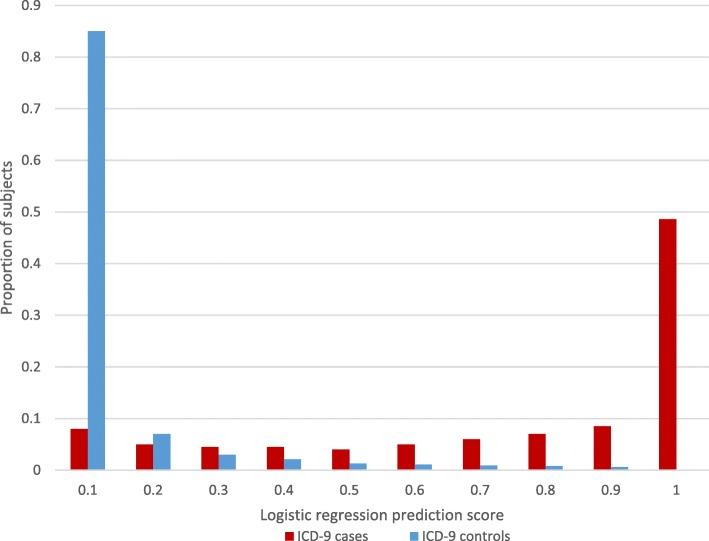
A topic modeling approach that included latent Dirichlet allocation, stable topic extraction, and random sampling was applied to VHA EHRs. Topic features from unstructured data and features from structured data were compared between Veterans with (n = 1861) and without (n = 9305) ICD-9 dementia codes. A logistic regression model was used to develop dementia prediction scores, and manual reviews were conducted to validate the machine-learning results.
RESULTS
A total of 853 features were identified (290 topics, 174 non-dementia ICD codes, 159 CPT codes, 59 medications, and 171 note types) for the development of logistic regression prediction scores. These scores were validated in a subset of Veterans without ICD-9 dementia codes (n = 120) by experts in dementia who performed manual record reviews and achieved a high level of inter-rater agreement. The manual reviews were used to develop a receiver of characteristic (ROC) curve with different thresholds for case detection, including a threshold of 0.061, which produced an optimal sensitivity (0.825) and specificity (0.832).
CONCLUSIONS
Dementia is underdiagnosed, and thus, ICD codes alone cannot serve as a gold standard for diagnosis. However, this study suggests that imperfect data (e.g., ICD codes in combination with other EHR features) can serve as a silver standard to develop a risk model, apply that model to patients without dementia codes, and then select a case-detection threshold. The study is one of the first to utilize both structured and unstructured EHRs to develop risk scores for the diagnosis of dementia.
背景
痴呆在普通人群和退伍军人中都存在诊断不足的情况。这种漏诊降低了生活质量,减少了干预的机会,并增加了医疗保健成本。因此,有必要采用新的方法来促进痴呆的及时发现。本研究旨在通过开发和验证一种弱监督机器学习方法来识别未确诊的痴呆病例,该方法结合了对结构化和非结构化电子健康记录(EHR)数据的分析。
方法
应用主题建模方法,包括潜在狄利克雷分配、稳定主题提取和随机抽样,对 VHA 的 EHR 进行分析。对有(n=1861)和没有(n=9305)ICD-9 痴呆代码的退伍军人的非结构化数据和结构化数据的主题特征进行比较。使用逻辑回归模型来开发痴呆预测评分,并进行人工审查以验证机器学习结果。
结果
共确定了 853 个特征(290 个主题、174 个非痴呆 ICD 代码、159 个 CPT 代码、59 种药物和 171 种记录类型)用于开发逻辑回归预测评分。这些评分在没有 ICD-9 痴呆代码的退伍军人的一个子集中进行了验证(n=120),由痴呆专家进行手动记录审查,达到了较高的组内一致性。这些人工审查用于为病例检测建立不同阈值的接收者操作特征(ROC)曲线,包括阈值为 0.061,该阈值产生了最佳的敏感性(0.825)和特异性(0.832)。
结论
痴呆症漏诊率高,因此,ICD 代码本身不能作为诊断的金标准。然而,本研究表明,不完美的数据(例如,ICD 代码与其他 EHR 特征相结合)可以作为一个银标准来开发风险模型,将该模型应用于没有痴呆代码的患者,然后选择病例检测阈值。该研究是首次利用结构化和非结构化 EHR 来开发痴呆诊断风险评分的研究之一。

 Zotero 插件