
阻断 TGF-β 信号转导增强抗肿瘤反应的同时,也伴随着 CD4CD25Foxp3 和 CD4CD25Foxp3 T 细胞功能活性的失调。
Blockade of TGF-β signaling to enhance the antitumor response is accompanied by dysregulation of the functional activity of CD4CD25Foxp3 and CD4CD25Foxp3 T cells.
机构信息
Earle A. Chiles Research Institute, Providence Cancer Center, Portland, OR, USA.
Veana Therapeutics, Inc., Portland, OR, USA.
出版信息
J Transl Med. 2019 Jul 9;17(1):219. doi: 10.1186/s12967-019-1967-3.
BACKGROUND
The pleiotropic cytokine, transforming growth factor (TGF)-β, and CD4CD25Foxp3 regulatory T cells (Tregs) play a critical role in actively suppressing antitumor immune responses. Evidence shows that TGF-β produced by tumor cells promotes tolerance via expansion of Tregs. Our group previously demonstrated that blockade of TGF-β signaling with a small molecule TGF-β receptor I antagonist (SM16) inhibited primary and metastatic tumor growth in a T cell dependent fashion. In the current study, we evaluated the effect of SM16 on Treg generation and function.
METHODS
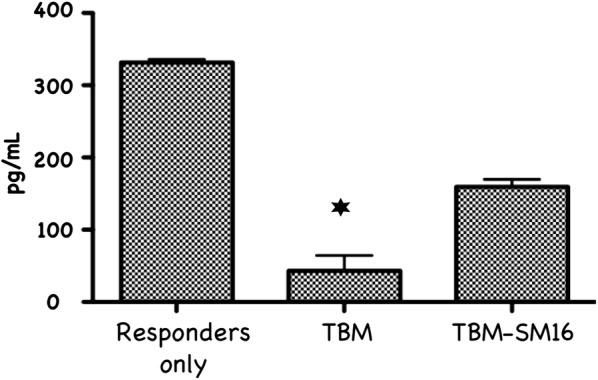
Using BALB/c, FoxP3eGFP and Rag mice, we performed FACS analysis to determine if SM16 blocked de novo TGF-β-induced Treg generation in vitro and in vivo. CD4 T cells from lymph node and spleen were isolated from control mice or mice maintained on SM16 diet, and flow cytometry analysis was used to detect the frequency of CD4CD25FoxP3 and CD4CD25FoxP3 T cells. In vitro suppression assays were used to determine the ability to suppress naive T cell proliferation in vitro of both CD4CD25FoxP3 and CD4CD25FoxP3 T cell sub-populations. We then examined whether SM16 diet exerted an inhibitory effect on primary tumor growth and correlated with changes in FoxP3expression. ELISA analysis was used to measure IFN-γ levels after 72 h co-culture of CD4CD25 T cells from tumor-bearing mice on control or SM16 diet with CD4CD25 T cells from naive donors.
RESULTS
SM16 abrogates TGF-β-induced Treg generation in vitro but does not prevent global homeostatic expansion of CD4 T cell sub-populations in vivo. Instead, SM16 treatment causes expansion of a population of CD4CD25Foxp3 Treg-like cells without significantly altering the overall frequency of Treg in lymphoreplete naive and tumor-bearing mice. Importantly, both the CD4CD25Foxp3 T cells and the CD4CD25Foxp3 Tregs in mice receiving SM16 diet exhibited diminished ability to suppress naive T cell proliferation in vitro compared to Treg from mice on control diet.
CONCLUSIONS
These findings suggest that blockade of TGF-β signaling is a potentially useful strategy for blunting Treg function to enhance the anti-tumor response. Our data further suggest that the overall dampening of Treg function may involve the expansion of a quiescent Treg precursor population, which is CD4CD25Foxp3.
背景
多功能细胞因子转化生长因子-β(TGF-β)和 CD4+CD25+Foxp3+调节性 T 细胞(Tregs)在主动抑制抗肿瘤免疫反应中发挥着关键作用。有证据表明,肿瘤细胞产生的 TGF-β 通过 Tregs 的扩增促进了耐受。我们的研究小组先前证明,使用小分子 TGF-β 受体 I 拮抗剂(SM16)阻断 TGF-β 信号通路可依赖 T 细胞抑制原发性和转移性肿瘤生长。在本研究中,我们评估了 SM16 对 Treg 生成和功能的影响。
方法
使用 BALB/c、FoxP3eGFP 和 Rag 小鼠,我们通过 FACS 分析来确定 SM16 是否能阻断体外和体内新产生的 TGF-β 诱导的 Treg 生成。从对照小鼠或接受 SM16 饮食的小鼠的淋巴结和脾脏中分离 CD4 T 细胞,并用流式细胞术分析检测 CD4+CD25+FoxP3+和 CD4+CD25+FoxP3+T 细胞的频率。我们还进行了体外抑制实验,以确定 CD4+CD25+FoxP3+和 CD4+CD25+FoxP3+T 细胞亚群体外抑制幼稚 T 细胞增殖的能力。然后,我们研究了 SM16 饮食是否对原发性肿瘤生长产生抑制作用,并与 FoxP3 表达的变化相关。在与肿瘤负荷小鼠的 CD4+CD25+T 细胞共培养 72 小时后,使用 ELISA 分析测量来自对照或 SM16 饮食的 CD4+CD25+T 细胞与来自幼稚供体的 CD4+CD25+T 细胞的 IFN-γ 水平。
结果
SM16 可阻断体外 TGF-β 诱导的 Treg 生成,但不会阻止体内 CD4 T 细胞亚群的整体稳态扩增。相反,SM16 治疗导致一群 CD4+CD25+Foxp3+Treg 样细胞的扩增,而不会显著改变淋巴丰富的幼稚和荷瘤小鼠中 Treg 的总体频率。重要的是,接受 SM16 饮食的小鼠中的 CD4+CD25+Foxp3+T 细胞和 CD4+CD25+Foxp3+Tregs 与对照饮食的小鼠中的 Treg 相比,体外抑制幼稚 T 细胞增殖的能力均降低。
结论
这些发现表明,阻断 TGF-β 信号通路可能是一种有前途的策略,可用于减弱 Treg 功能以增强抗肿瘤反应。我们的数据进一步表明,Treg 功能的整体抑制可能涉及静息 Treg 前体群的扩增,该群为 CD4+CD25+Foxp3+。


 Zotero 插件