
利用数学模型确定耐甲氧西林金黄色葡萄球菌菌血症持续存在的决定因素。
Identifying determinants of persistent MRSA bacteremia using mathematical modeling.
机构信息
Institute for Quantitative and Computational Biosciences, University of California, Los Angeles, California, United States of America.
Department of Microbiology, Immunology, and Molecular Genetics, University of California, Los Angeles, California, United States of America.
出版信息
PLoS Comput Biol. 2019 Jul 11;15(7):e1007087. doi: 10.1371/journal.pcbi.1007087. eCollection 2019 Jul.
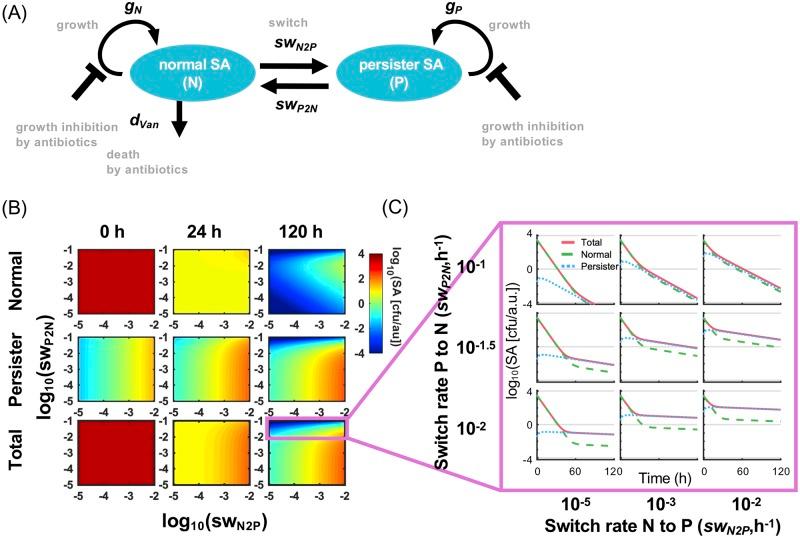
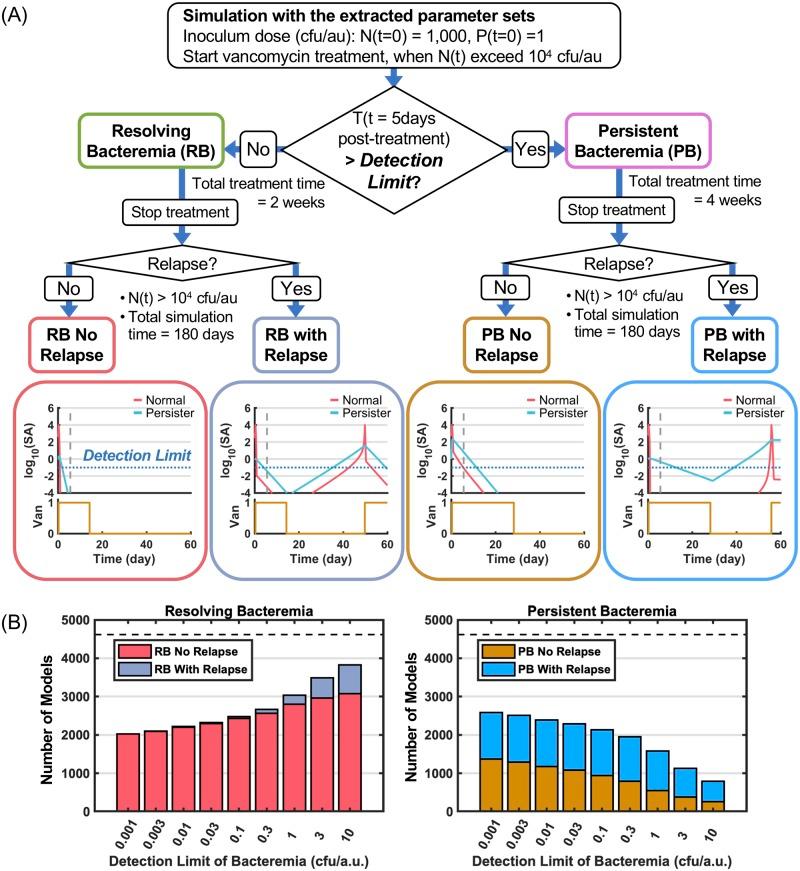
Persistent bacteremia caused by Staphylococcus aureus (SA), especially methicillin-resistant SA (MRSA), is a significant cause of morbidity and mortality. Despite susceptibility phenotypes in vitro, persistent MRSA strains fail to clear with appropriate anti-MRSA therapy during bacteremia in vivo. Thus, identifying the factors that cause such MRSA persistence is of direct and urgent clinical relevance. To address the dynamics of MRSA persistence in the face of host immunity and typical antibiotic regimens, we developed a mathematical model based on the overarching assumption that phenotypic heterogeneity is a hallmark of MRSA persistence. First, we applied an ensemble modeling approach and obtained parameter sets that satisfied the condition of a minimum inoculum dose to establish infection. Second, by simulating with the selected parameter sets under vancomycin therapy which follows clinical practices, we distinguished the models resulting in resolving or persistent bacteremia, based on the total SA exceeding a detection limit after five days of treatment. Third, to find key determinants that discriminate resolving and persistent bacteremia, we applied a machine learning approach and found that the immune clearance rate of persister cells is a key feature. But, fourth, when relapsing bacteremia was considered, the growth rate of persister cells was also found to be a key feature. Finally, we explored pharmacological strategies for persistent and relapsing bacteremia and found that a persister killer, but not a persister formation inhibitor, could provide for an effective cure the persistent bacteremia. Thus, to develop better clinical solutions for MRSA persistence and relapse, our modeling results indicate that we need to better understand the pathogen-host interactions of persister MRSAs in vivo.
金黄色葡萄球菌(SA)引起的持续性菌血症,尤其是耐甲氧西林金黄色葡萄球菌(MRSA),是发病率和死亡率的重要原因。尽管体外表现出敏感性表型,但在体内菌血症期间,持续的 MRSA 菌株未能通过适当的抗 MRSA 治疗清除。因此,确定导致这种 MRSA 持续存在的因素具有直接和紧迫的临床意义。为了解决宿主免疫和典型抗生素方案下 MRSA 持续存在的动力学问题,我们开发了一个基于以下总体假设的数学模型:表型异质性是 MRSA 持续存在的标志。首先,我们应用了一种集合建模方法,并获得了满足最小接种剂量条件以建立感染的参数集。其次,通过在遵循临床实践的万古霉素治疗下使用选定的参数集进行模拟,我们根据治疗五天后总 SA 超过检测限的情况,区分了导致解决或持续性菌血症的模型。第三,为了找到区分解决和持续性菌血症的关键决定因素,我们应用了机器学习方法,发现持久性细胞的免疫清除率是一个关键特征。但是,第四,当考虑复发性菌血症时,还发现了持久性细胞的生长率也是一个关键特征。最后,我们探讨了针对持续性和复发性菌血症的药物治疗策略,发现持久性杀伤剂,但不是持久性形成抑制剂,可以为持续性菌血症提供有效的治疗。因此,为了开发更好的治疗 MRSA 持续存在和复发的临床方案,我们的建模结果表明,我们需要更好地了解体内持久性 MRSA 的病原体-宿主相互作用。




 Zotero 插件