
回忆未来:针对不可预测的流感病毒的免疫记忆。
Recalling the Future: Immunological Memory Toward Unpredictable Influenza Viruses.
机构信息
Department of Microbiology and Immunology, Peter Doherty Institute for Infection and Immunity, University of Melbourne, Melbourne, VIC, Australia.
Research Center for Zoonosis Control, Hokkaido University, Sapporo, Japan.
出版信息
Front Immunol. 2019 Jul 2;10:1400. doi: 10.3389/fimmu.2019.01400. eCollection 2019.
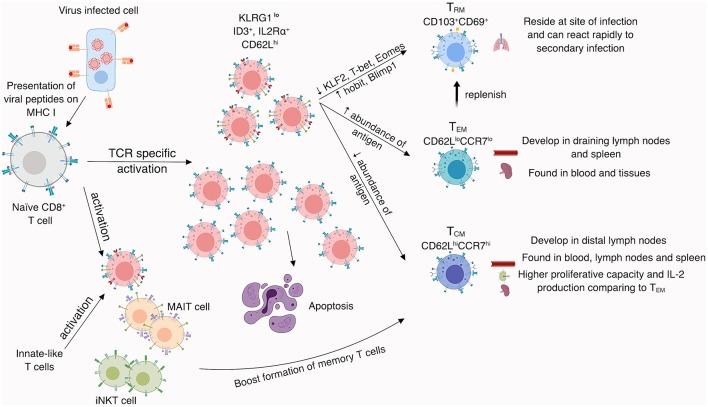
Persistent and durable immunological memory forms the basis of any successful vaccination protocol. Generation of pre-existing memory B cell and T cell pools is thus the key for maintaining protective immunity to seasonal, pandemic and avian influenza viruses. Long-lived antibody secreting cells (ASCs) are responsible for maintaining antibody levels in peripheral blood. Generated with CD4 T help after naïve B cell precursors encounter their cognate antigen, the linked processes of differentiation (including Ig class switching) and proliferation also give rise to memory B cells, which then can change rapidly to ASC status after subsequent influenza encounters. Given that influenza viruses evolve rapidly as a consequence of antibody-driven mutational change (antigenic drift), the current influenza vaccines need to be reformulated frequently and annual vaccination is recommended. Without that process of regular renewal, they provide little protection against "drifted" (particularly H3N2) variants and are mainly ineffective when a novel pandemic (2009 A/H1N1 "swine" flu) strain suddenly emerges. Such limitation of antibody-mediated protection might be circumvented, at least in part, by adding a novel vaccine component that promotes cross-reactive CD8 T cells specific for conserved viral peptides, presented by widely distributed HLA types. Such "memory" cytotoxic T lymphocytes (CTLs) can rapidly be recalled to CTL effector status. Here, we review how B cells and follicular T cells are elicited following influenza vaccination and how they survive into a long-term memory. We describe how CD8 CTL memory is established following influenza virus infection, and how a robust CTL recall response can lead to more rapid virus elimination by destroying virus-infected cells, and recovery. Exploiting long-term, cross-reactive CTL against the continuously evolving and unpredictable influenza viruses provides a possible mechanism for preventing a disastrous pandemic comparable to the 1918-1919 H1N1 "Spanish flu," which killed more than 50 million people worldwide.
持久而持久的免疫记忆是任何成功疫苗接种方案的基础。因此,产生预先存在的记忆 B 细胞和 T 细胞池是维持对季节性、大流行和禽流感病毒的保护性免疫的关键。长寿的抗体分泌细胞(ASCs)负责维持外周血中的抗体水平。幼稚 B 细胞前体遇到其同源抗原后,在 CD4 T 帮助下产生,分化(包括 Ig 类别转换)和增殖的连锁过程也产生记忆 B 细胞,随后在随后的流感接触后,这些细胞可以迅速转变为 ASC 状态。由于流感病毒作为抗体驱动的突变变化(抗原漂移)的结果迅速进化,因此当前的流感疫苗需要经常重新配制,并且建议每年接种疫苗。如果没有定期更新的过程,它们对“漂移”(特别是 H3N2)变体几乎没有保护作用,并且当新型大流行(2009 年 A/H1N1“猪”流感)株突然出现时,效果不佳。至少在一定程度上可以通过添加新的疫苗成分来规避抗体介导的保护的这种限制,该成分促进针对保守病毒肽的交叉反应性 CD8 T 细胞,这些肽由广泛分布的 HLA 类型呈递。这种“记忆”细胞毒性 T 淋巴细胞(CTL)可以迅速被召回至 CTL 效应状态。在这里,我们回顾了流感疫苗接种后 B 细胞和滤泡 T 细胞的激发方式,以及它们如何存活到长期记忆中。我们描述了流感病毒感染后如何建立 CD8 CTL 记忆,以及强大的 CTL 召回反应如何通过破坏病毒感染的细胞来更快地消除病毒并恢复。利用针对不断演变和不可预测的流感病毒的长期交叉反应性 CTL 提供了一种预防类似于 1918-1919 年 H1N1“西班牙流感”的灾难性大流行的可能机制,该流感在全球范围内造成超过 5000 万人死亡。

 Zotero 插件