
为什么一些韩国父母会犹豫给孩子接种疫苗?
Why do some Korean parents hesitate to vaccinate their children?
机构信息
Department of Preventive Medicine and Public Health, Ajou University School of Medicine, Suwon, Korea.
出版信息
Epidemiol Health. 2019;41:e2019031. doi: 10.4178/epih.e2019031. Epub 2019 Jul 9.
OBJECTIVES
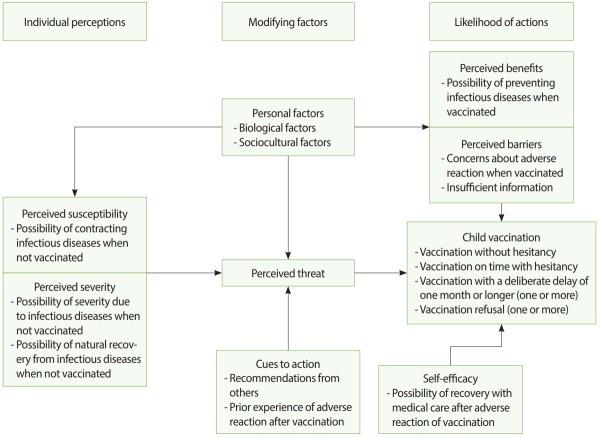
Vaccinations for infectious diseases are opposed despite their achievement, and this opposition has recently been revealed in Korea. However, research in Korea has not been vigorous. The authors studied why some Korean parents hesitate to vaccinate their children by applying the health belief model.
METHODS
Parents who hesitate to vaccinate and parents who do not were surveyed in alternative education preschools and elementary schools. They were classified into four types of hesitancy and statistically compared.
RESULTS
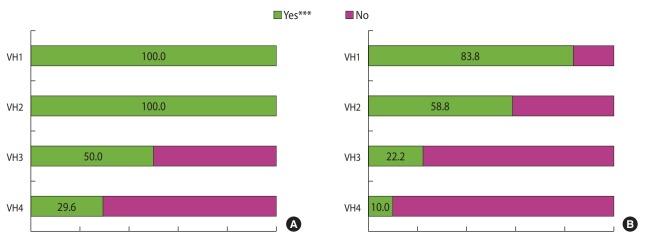
Among the 129 subjects, 43 vaccinated without hesitancy, 20 vaccinated on time with hesitancy, 32 vaccinated with a deliberate delay of one month or longer, and 34 did not vaccinate. Vaccination increased with an increase in the awareness that severe outcomes can occur when unvaccinated. Concerns about adverse reactions from vaccinations or direct/indirect experiences affected refusal. Furthermore, perceptions of the lack of meaningfulness of vaccinations, distrust of policy and safety management, influence of leaders or activists in joined organizations, and experts of Korean traditional or alternative medicine affected refusal. Explanations by doctors, text messages and mails from institutions, and concerns about disadvantages caused by not complying with government policies increased vaccination.
CONCLUSIONS
The reasons for vaccine hesitancy and acceptance were similar to the results of international research. Health authorities and professionals should communicate sufficiently and appropriately with hesitant parents and find ways to rationally resolve social conflicts. However, this sample was small and there is little Korean research, so more in-depth and diverse researchs are needed.
目的
尽管传染病疫苗接种取得了成效,但仍遭到反对,这种反对最近在韩国显现出来。然而,韩国的相关研究并不活跃。作者通过应用健康信念模型研究了为什么一些韩国父母对给孩子接种疫苗犹豫不决。
方法
在另类教育幼儿园和小学对犹豫不决的和不犹豫的父母进行了调查。他们被分为四种犹豫类型,并进行了统计学比较。
结果
在 129 名受试者中,43 名毫不犹豫地接种了疫苗,20 名按时接种但存在犹豫,32 名故意延迟一个月或更长时间接种,34 名未接种。当意识到未接种疫苗可能会导致严重后果时,接种率会增加。对接种疫苗后出现不良反应的担忧或直接/间接经历会影响是否接种疫苗。此外,对疫苗接种缺乏意义的看法、对政策和安全管理的不信任、加入组织的领导人或活动家的影响以及韩国传统或替代医学专家的影响,也会导致拒绝接种。医生的解释、机构的短信和邮件以及对不遵守政府政策可能带来不利影响的担忧,会增加接种疫苗的意愿。
结论
疫苗犹豫和接受的原因与国际研究结果相似。卫生当局和专业人员应与犹豫不决的父母进行充分和适当的沟通,并寻找合理解决社会冲突的方法。然而,该样本较小,且韩国的研究较少,因此需要进行更深入和多样化的研究。
 Zotero 插件