
在稳态七氟醚麻醉期间,神经肌肉阻滞逆转对脑电双频指数和额肌电图的影响:一项随机试验。
Effects of neuromuscular blockade reversal on bispectral index and frontal electromyogram during steady-state desflurane anesthesia: a randomized trial.
机构信息
Department of Anesthesiology and Pain Medicine, Samsung Medical Center, Sungkyunkwan University School of Medicine, Seoul, Korea.
Department of Anaesthesiology and Pain Medicine, Kangbuk Samsung Hospital, Sungkyunkwan University School of Medicine, Seoul, Korea.
出版信息
Sci Rep. 2019 Jul 19;9(1):10486. doi: 10.1038/s41598-019-47047-1.
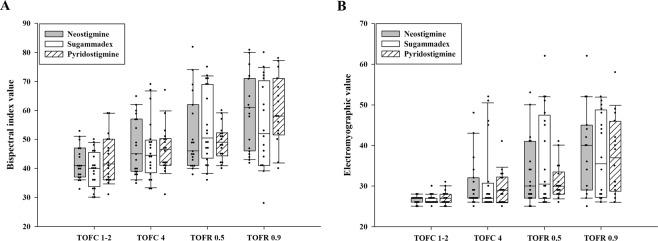
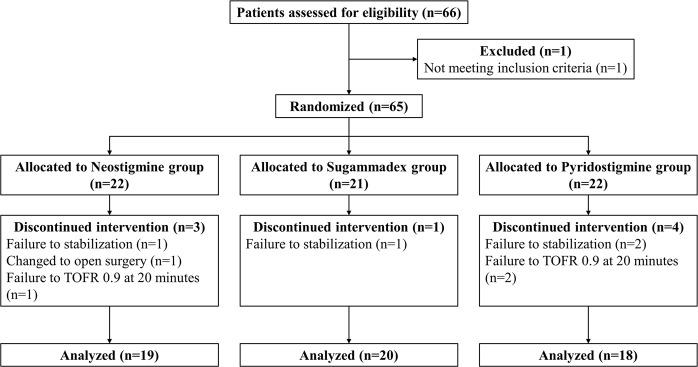
The degree of neuromuscular blockade reversal may affect bispectral index (BIS) value. One possible reason is that the reverse of neuromuscular blockade affects electromyographic (EMG) signals of fascial muscle. Another reason is, the afferentation theory, the reverse of neuromuscular blockade relieves block signals generated in muscle stretch receptors from accessing the brain through afferent nerve pathways and induces arousal. Inaccurate BIS value may lead to overdose of drugs or the risk of intraoperative awareness. We compared changes in BIS and EMG values according to neuromuscular blockade reversal agents under steady-state desflurane anesthesia. A total of 65 patients were randomly allocated to receive either neostigmine 0.05 mg/kg, sugammadex 4 mg/kg, or pyridostigmine 0.25 mg/kg for neuromuscular blockade reversal under stable desflurane anesthesia, and 57 patients completed the study. The primary outcome was change in BIS and EMG values before and after administration of neuromuscular blockade reversal agents (between train-of-four [TOF] count 1-2 and TOF ratio 0.9). The change in BIS and EMG values before and after administration of neuromuscular blockade reversal agents were statistically different in each group (BIS: Neostigmine group, P < 0.001; Sugammadex group, P < 0.001; Pyridostigmine group, P = 0.001; EMG: Neostigmine group, P = 0.001; Sugammadex group, P < 0.001; Pyridostigmine group, P = 0.001; respectively). The BIS and EMG values had a positive correlation (P < 0.001). Our results demonstrate that the EMG and BIS values have increased after neuromuscular blockade reversal under desflurane anesthesia regardless of the type of neuromuscular blockade reversal agent. BIS should be applied carefully to measure of depth of anesthesia after neuromuscular blockade reversal.
肌松程度的逆转可能会影响脑电双频指数(BIS)值。一种可能的原因是,神经肌肉阻滞的逆转会影响筋膜肌的肌电图(EMG)信号。另一个原因是,传入神经理论认为,神经肌肉阻滞的逆转会阻止肌肉拉伸感受器产生的阻滞信号通过传入神经通路进入大脑,并引起觉醒。不准确的 BIS 值可能导致药物过量或术中意识的风险。我们比较了在稳定的七氟醚麻醉下,根据神经肌肉阻滞逆转剂,BIS 和 EMG 值的变化。共有 65 名患者随机分为接受新斯的明 0.05mg/kg、舒更葡糖钠 4mg/kg 或吡咯烷酮 0.25mg/kg 进行神经肌肉阻滞逆转,57 名患者完成了研究。主要结局是神经肌肉阻滞逆转剂给药前后 BIS 和 EMG 值的变化(四成串计数 1-2 与四成串比 0.9 之间)。每组神经肌肉阻滞逆转前后 BIS 和 EMG 值的变化均有统计学差异(BIS:新斯的明组,P<0.001;舒更葡糖钠组,P<0.001;吡咯烷酮组,P=0.001;EMG:新斯的明组,P=0.001;舒更葡糖钠组,P<0.001;吡咯烷酮组,P=0.001;分别)。BIS 和 EMG 值呈正相关(P<0.001)。我们的结果表明,无论神经肌肉阻滞逆转剂的类型如何,七氟醚麻醉下神经肌肉阻滞逆转后,EMG 和 BIS 值均增加。BIS 应在神经肌肉阻滞逆转后仔细应用于麻醉深度的测量。
 Zotero 插件