
静脉液体复苏与脓毒症性内皮糖萼降解有关。
Intravenous fluid resuscitation is associated with septic endothelial glycocalyx degradation.
作者信息
Hippensteel Joseph A, Uchimido Ryo, Tyler Patrick D, Burke Ryan C, Han Xiaorui, Zhang Fuming, McMurtry Sarah A, Colbert James F, Lindsell Christopher J, Angus Derek C, Kellum John A, Yealy Donald M, Linhardt Robert J, Shapiro Nathan I, Schmidt Eric P
机构信息
Department of Medicine, University of Colorado Denver, Aurora, CO, USA.
Department of Emergency Medicine, Beth Israel Deaconess Medical Center, Boston, MA, USA.
出版信息
Crit Care. 2019 Jul 23;23(1):259. doi: 10.1186/s13054-019-2534-2.
BACKGROUND
Intravenous fluids, an essential component of sepsis resuscitation, may paradoxically worsen outcomes by exacerbating endothelial injury. Preclinical models suggest that fluid resuscitation degrades the endothelial glycocalyx, a heparan sulfate-enriched structure necessary for vascular homeostasis. We hypothesized that endothelial glycocalyx degradation is associated with the volume of intravenous fluids administered during early sepsis resuscitation.
METHODS
We used mass spectrometry to measure plasma heparan sulfate (a highly sensitive and specific index of systemic endothelial glycocalyx degradation) after 6 h of intravenous fluids in 56 septic shock patients, at presentation and after 24 h of intravenous fluids in 100 sepsis patients, and in two groups of non-infected patients. We compared plasma heparan sulfate concentrations between sepsis and non-sepsis patients, as well as between sepsis survivors and sepsis non-survivors. We used multivariable linear regression to model the association between volume of intravenous fluids and changes in plasma heparan sulfate.
RESULTS
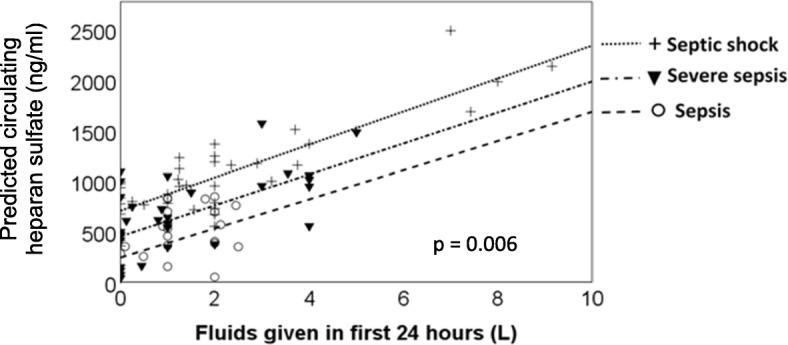
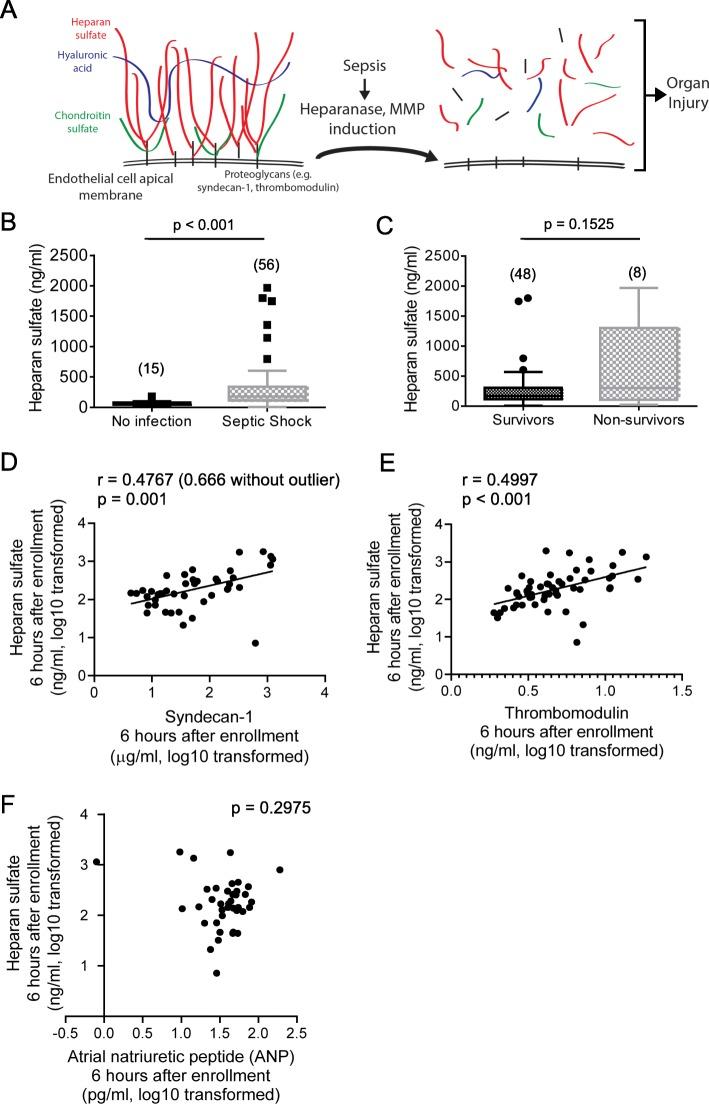
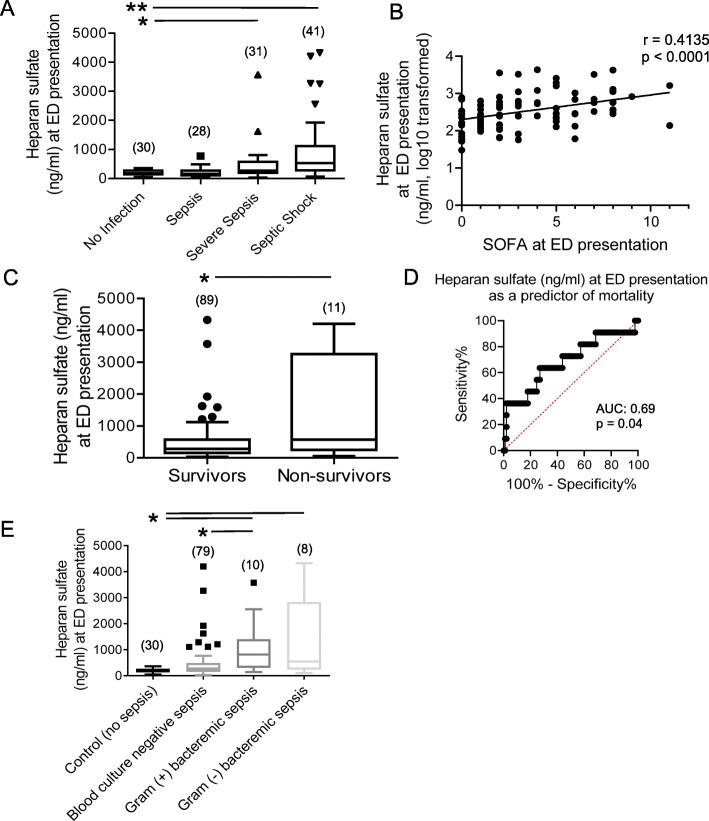
Consistent with previous studies, median plasma heparan sulfate was elevated in septic shock patients (118 [IQR, 113-341] ng/ml 6 h after presentation) compared to non-infected controls (61 [45-79] ng/ml), as well as in a second cohort of sepsis patients (283 [155-584] ng/ml) at emergency department presentation) compared to controls (177 [144-262] ng/ml). In the larger sepsis cohort, heparan sulfate predicted in-hospital mortality. In both cohorts, multivariable linear regression adjusting for age and severity of illness demonstrated a significant association between volume of intravenous fluids administered during resuscitation and plasma heparan sulfate. In the second cohort, independent of disease severity and age, each 1 l of intravenous fluids administered was associated with a 200 ng/ml increase in circulating heparan sulfate (p = 0.006) at 24 h after enrollment.
CONCLUSIONS
Glycocalyx degradation occurs in sepsis and septic shock and is associated with in-hospital mortality. The volume of intravenous fluids administered during sepsis resuscitation is independently associated with the degree of glycocalyx degradation. These findings suggest a potential mechanism by which intravenous fluid resuscitation strategies may induce iatrogenic endothelial injury.
背景
静脉输液是脓毒症复苏的重要组成部分,但可能会因加剧内皮损伤而反常地使预后恶化。临床前模型表明,液体复苏会破坏内皮糖萼,这是血管稳态所必需的富含硫酸乙酰肝素的结构。我们假设内皮糖萼降解与脓毒症早期复苏期间静脉输液的量有关。
方法
我们使用质谱法测量了56例感染性休克患者在静脉输液6小时后、100例脓毒症患者在静脉输液24小时后以及两组非感染患者血浆中硫酸乙酰肝素(全身内皮糖萼降解的高度敏感和特异指标)的水平。我们比较了脓毒症患者与非脓毒症患者之间以及脓毒症幸存者与脓毒症非幸存者之间的血浆硫酸乙酰肝素浓度。我们使用多变量线性回归来模拟静脉输液量与血浆硫酸乙酰肝素变化之间的关联。
结果
与先前的研究一致,感染性休克患者(就诊后6小时血浆硫酸乙酰肝素中位数为118[四分位间距,113 - 341] ng/ml)与非感染对照组(61[45 - 79] ng/ml)相比,以及在另一组脓毒症患者(急诊科就诊时为283[155 - 584] ng/ml)与对照组(1
 Zotero 插件