
AP-1转录因子作为癌症免疫反应的调节因子
AP-1 Transcription Factors as Regulators of Immune Responses in Cancer.
作者信息
Atsaves Vasileios, Leventaki Vasiliki, Rassidakis George Z, Claret Francois X
机构信息
Department of Oncology, Ludwig Institute for Cancer Research-Lausanne Branch, University of Lausanne, Épalinges, 1066 Lausanne, Switzerland.
Department of Pathology, Children's Hospital of Wisconsin & Medical College of Wisconsin, Medical College of Winsconsin, Milwaukee, WI 53226, USA.
出版信息
Cancers (Basel). 2019 Jul 23;11(7):1037. doi: 10.3390/cancers11071037.
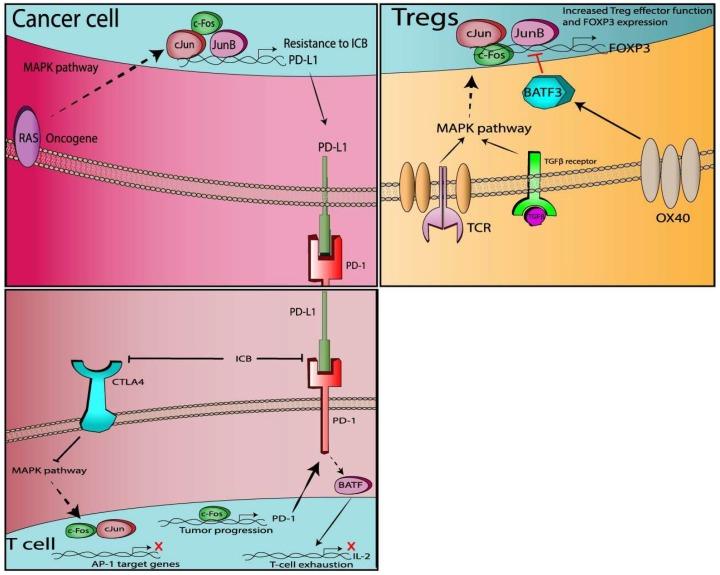
Immune check point blockade therapy has revolutionized the standard of cancer treatment and is credited with producing remarkable tumor remissions and increase in overall survival. This unprecedented clinical success however is feasible for a limited number of cancer patients due to resistance occurring before or during a course of immunotherapy, which is often associated with activation of oncogenic signaling pathways, co-inhibitory checkpoints upregulation or expansion of immunosuppressive regulatory T-cells (Tregs) in the tumor microenviroment (TME). Targeted therapy aiming to inactivate a signaling pathway such as the Mitogen Activated Protein Kinases (MAPKs) has recently received a lot of attention due to emerging data from preclinical studies indicating synergy with immune checkpoint blockade therapy. The dimeric transcription factor complex Activator Protein-1 (AP-1) is a group of proteins involved in a wide array of cell processes and a critical regulator of nuclear gene expression during T-cell activation. It is also one of the downstream targets of the MAPK signaling cascade. In this review, we will attempt to unravel the roles of AP-1 in the regulation of anti-tumor immune responses, with a focus on the regulation of immune checkpoints and Tregs, seeking to extract useful insights for more efficacious immunotherapy.
免疫检查点阻断疗法彻底改变了癌症治疗的标准,在产生显著的肿瘤缓解和提高总生存率方面备受赞誉。然而,由于在免疫治疗过程之前或期间出现耐药性,这种前所未有的临床成功仅适用于有限数量的癌症患者,而这通常与致癌信号通路的激活、共抑制检查点上调或肿瘤微环境(TME)中免疫抑制调节性T细胞(Tregs)的扩增有关。由于临床前研究的新数据表明其与免疫检查点阻断疗法具有协同作用,旨在使丝裂原活化蛋白激酶(MAPKs)等信号通路失活的靶向治疗最近受到了广泛关注。二聚体转录因子复合物激活蛋白-1(AP-1)是一组参与多种细胞过程的蛋白质,是T细胞激活过程中核基因表达的关键调节因子。它也是MAPK信号级联的下游靶点之一。在本综述中,我们将试图阐明AP-1在调节抗肿瘤免疫反应中的作用,重点是免疫检查点和Tregs的调节,以期为更有效的免疫治疗提取有用的见解。

 Zotero 插件