
接受纳武单抗治疗的晚期黑色素瘤、肾细胞癌或非小细胞肺癌患者的五年生存率及相关因素
Five-Year Survival and Correlates Among Patients With Advanced Melanoma, Renal Cell Carcinoma, or Non-Small Cell Lung Cancer Treated With Nivolumab.
作者信息
Topalian Suzanne L, Hodi F Stephen, Brahmer Julie R, Gettinger Scott N, Smith David C, McDermott David F, Powderly John D, Sosman Jeffrey A, Atkins Michael B, Leming Philip D, Spigel David R, Antonia Scott J, Drilon Alexander, Wolchok Jedd D, Carvajal Richard D, McHenry M Brent, Hosein Fareeda, Harbison Christopher T, Grosso Joseph F, Sznol Mario
机构信息
Department of Surgery, Sidney Kimmel Comprehensive Cancer Center, Johns Hopkins Bloomberg-Kimmel Institute for Cancer Immunotherapy, Baltimore, Maryland.
Department of Medical Oncology, Dana-Farber Cancer Institute, Boston, Massachusetts.
出版信息
JAMA Oncol. 2019 Oct 1;5(10):1411-1420. doi: 10.1001/jamaoncol.2019.2187.
IMPORTANCE
Nivolumab, a monoclonal antibody that inhibits programmed cell death 1, is approved by the US Food and Drug Administration for treating advanced melanoma, renal cell carcinoma (RCC), non-small cell lung cancer (NSCLC), and other malignancies. Data on long-term survival among patients receiving nivolumab are limited.
OBJECTIVES
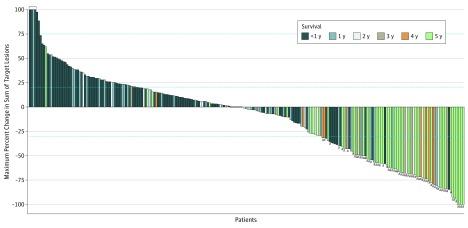
To analyze long-term overall survival (OS) among patients receiving nivolumab and identify clinical and laboratory measures associated with tumor regression and OS.
DESIGN, SETTING, AND PARTICIPANTS: This was a secondary analysis of the phase 1 CA209-003 trial (with expansion cohorts), which was conducted at 13 US medical centers and included 270 patients with advanced melanoma, RCC, or NSCLC who received nivolumab and were enrolled between October 30, 2008, and December 28, 2011. The analyses were either specified in the original protocol or included in subsequent protocol amendments that were implemented between 2008 and 2012. Statistical analysis was performed from October 30, 2008, to November 11, 2016.
INTERVENTION
In the CA209-003 trial, patients received nivolumab (0.1-10.0 mg/kg) every 2 weeks in 8-week cycles for up to 96 weeks, unless they developed progressive disease, achieved a complete response, experienced unacceptable toxic effects, or withdrew consent.
MAIN OUTCOMES AND MEASURES
Safety and activity of nivolumab; OS was a post hoc end point with a minimum follow-up of 58.3 months.
RESULTS
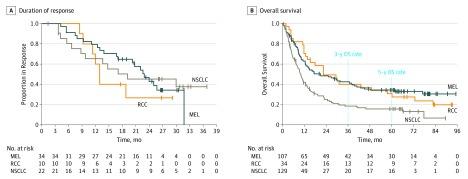
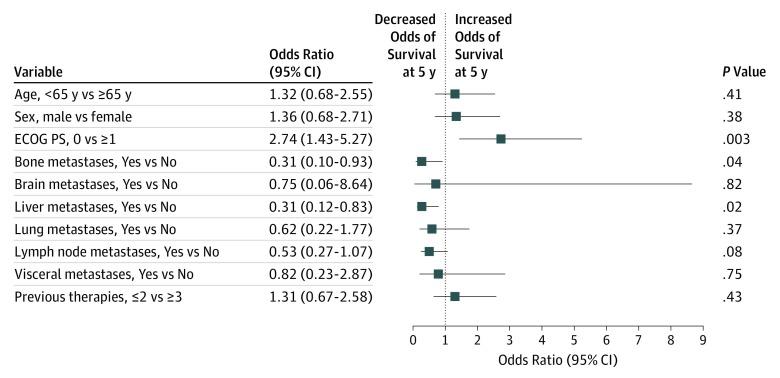
Of 270 patients included in this analysis, 107 (39.6%) had melanoma (72 [67.3%] male; median age, 61 [range, 29-85] years), 34 (12.6%) had RCC (26 [76.5%] male; median age, 58 [range, 35-74] years), and 129 (47.8%) had NSCLC (79 [61.2%] male; median age, 65 [range, 38-85] years). Overall survival curves showed estimated 5-year rates of 34.2% among patients with melanoma, 27.7% among patients with RCC, and 15.6% among patients with NSCLC. In a multivariable analysis, the presence of liver (odds ratio [OR], 0.31; 95% CI, 0.12-0.83; P = .02) or bone metastases (OR, 0.31; 95% CI, 0.10-0.93; P = .04) was independently associated with reduced likelihood of survival at 5 years, whereas an Eastern Cooperative Oncology Group performance status of 0 (OR, 2.74; 95% CI, 1.43-5.27; P = .003) was independently associated with an increased likelihood of 5-year survival. Overall survival was significantly longer among patients with treatment-related AEs of any grade (median, 19.8 months; 95% CI, 13.8-26.9 months) or grade 3 or more (median, 20.3 months; 95% CI, 12.5-44.9 months) compared with those without treatment-related AEs (median, 5.8 months; 95% CI, 4.6-7.8 months) (P < .001 for both comparisons based on hazard ratios).
CONCLUSIONS AND RELEVANCE
Nivolumab treatment was associated with long-term survival in a subset of heavily pretreated patients with advanced melanoma, RCC, or NSCLC. Characterizing factors associated with long-term survival may inform treatment approaches and strategies for future clinical trial development.
TRIAL REGISTRATION
ClinicalTrials.gov identifier: NCT00730639.
重要性
纳武单抗是一种抑制程序性细胞死亡1的单克隆抗体,已获美国食品药品监督管理局批准用于治疗晚期黑色素瘤、肾细胞癌(RCC)、非小细胞肺癌(NSCLC)及其他恶性肿瘤。关于接受纳武单抗治疗患者的长期生存数据有限。
目的
分析接受纳武单抗治疗患者的长期总生存期(OS),并确定与肿瘤消退和OS相关的临床及实验室指标。
设计、设置与参与者:这是对1期CA209 - 003试验(及扩展队列)的二次分析,该试验在美国13个医学中心开展,纳入了270例晚期黑色素瘤、RCC或NSCLC患者,这些患者接受了纳武单抗治疗,入组时间为2008年10月30日至2011年12月28日。分析内容在原方案中已有规定,或包含在2008年至2012年实施的后续方案修正案中。统计分析于2008年10月30日至2016年11月11日进行。
干预措施
在CA209 - 003试验中,患者每2周接受一次纳武单抗(0.1 - 10.0 mg/kg)治疗,每8周为一个周期,最长持续96周,除非出现疾病进展、达到完全缓解、出现不可接受的毒性作用或撤回同意。
主要结局与指标
纳武单抗的安全性和活性;OS是一个事后分析终点,最短随访时间为58.3个月。
结果
本分析纳入的270例患者中,107例(39.6%)为黑色素瘤患者(72例[67.3%]为男性;中位年龄61岁[范围29 - 85岁]),34例(12.6%)为RCC患者(26例[76.5%]为男性;中位年龄58岁[范围35 - 74岁]),129例(47.8%)为NSCLC患者(79例[61.2%]为男性;中位年龄65岁[范围38 - 85岁])。总生存曲线显示,黑色素瘤患者的估计5年生存率为34.2%,RCC患者为27.7%,NSCLC患者为15.6%。在多变量分析中,存在肝脏转移(比值比[OR],0.31;95%置信区间[CI],0.12 - 0.83;P = 0.02)或骨转移(OR,0.31;95% CI,0.10 - 0.93;P = 0.04)与5年生存可能性降低独立相关,而东部肿瘤协作组体能状态评分为0(OR,2.74;95% CI,1.43 - 5.27;P = 0.003)与5年生存可能性增加独立相关。与无治疗相关不良事件的患者相比,发生任何级别治疗相关不良事件(中位时间19.8个月;95% CI,13.8 - 26.9个月)或3级及以上治疗相关不良事件(中位时间20.3个月;95% CI,12.5 - 44.9个月)的患者总生存期显著更长(基于风险比的两项比较P均<0.001)。
结论与意义
纳武单抗治疗与部分接受过大量预处理的晚期黑色素瘤、RCC或NSCLC患者的长期生存相关。确定与长期生存相关的因素可能为未来临床试验开发的治疗方法和策略提供参考。
试验注册
ClinicalTrials.gov标识符:NCT00730639

 Zotero 插件