
中枢神经系统感染与…… (你提供的原文不完整,请补充完整以便准确翻译)
Central Nervous System Infection with .
作者信息
Riddell James, Wheat L Joseph
机构信息
Division of Infectious Diseases, University of Michigan Health System, 1500 E. Medical Center Drive, University Hospital South F4131, Ann Arbor, MI 48109, USA.
MiraVista Diagnostics, Indianapolis, IN 46241, USA.
出版信息
J Fungi (Basel). 2019 Jul 24;5(3):70. doi: 10.3390/jof5030070.
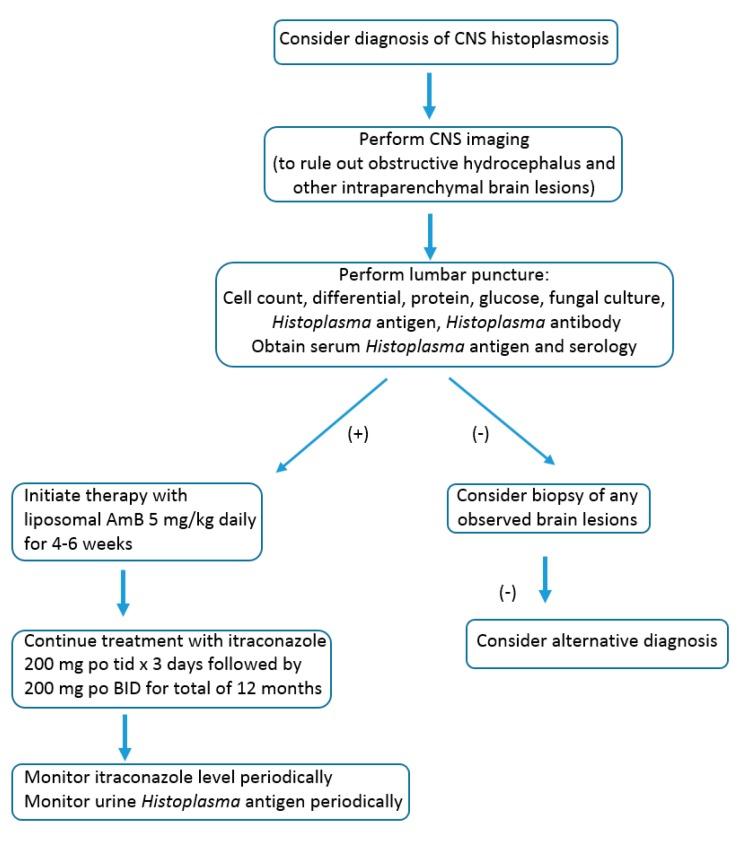
Histoplasmosis is an endemic fungal infection that may affect both immune compromised and non-immune compromised individuals. It is now recognized that the geographic range of this organism is larger than previously understood, placing more people at risk. Infection with may occur after inhalation of conidia that are aerosolized from the filamentous form of the organism in the environment. Clinical syndromes typically associated with histoplasmosis include acute or chronic pneumonia, chronic cavitary pulmonary infection, or mediastinal fibrosis or lymphadenitis. Disseminated infection can also occur, in which multiple organ systems are affected. In up to 10% of cases, infection of the central nervous system (CNS) with histoplasmosis may occur with or without disseminated infection. In this review, we discuss challenges related to the diagnosis of CNS histoplasmosis and appropriate treatment strategies that can lead to successful outcomes.
组织胞浆菌病是一种地方性真菌感染,可影响免疫功能受损和未受损的个体。现在人们认识到,这种病原体的地理分布范围比以前认为的更广,使更多人面临风险。吸入环境中该生物体丝状形式雾化产生的分生孢子后可能会发生感染。通常与组织胞浆菌病相关的临床综合征包括急性或慢性肺炎、慢性空洞性肺部感染、纵隔纤维化或淋巴结炎。也可能发生播散性感染,即多个器官系统受到影响。在高达10%的病例中,无论是否有播散性感染,都可能发生中枢神经系统(CNS)的组织胞浆菌感染。在本综述中,我们讨论了与中枢神经系统组织胞浆菌病诊断相关的挑战以及可带来成功治疗结果的适当治疗策略。
 Zotero 插件