
家族性 1 型糖尿病的特征:与受影响家庭成员关系对诊断时表型和基因型的影响。
Characteristics of familial type 1 diabetes: effects of the relationship to the affected family member on phenotype and genotype at diagnosis.
机构信息
Children's Hospital, University of Helsinki, P.O. Box 22, (Stenbäckinkatu 11), FI-00014, Helsinki, Finland.
Research Program for Clinical and Molecular Metabolism, Faculty of Medicine, University of Helsinki, Helsinki, Finland.
出版信息
Diabetologia. 2019 Nov;62(11):2025-2039. doi: 10.1007/s00125-019-4952-8. Epub 2019 Jul 25.
AIMS/HYPOTHESIS: In previous studies, the risk of developing familial type 1 diabetes has been reported to be more than two times higher in the offspring of affected fathers than in those of affected mothers. We tested the hypothesis that index children with an affected father may have a more aggressive disease process at diagnosis than those with other affected first-degree relatives.
METHODS
A cross-sectional, observational study was performed using the Finnish Pediatric Diabetes Register. Clinical and metabolic characteristics, beta cell autoantibodies and HLA class II genetics were analysed from index children in Finland diagnosed before the age of 15 years between January 2003 and December 2016. Information on the presence of type 1 diabetes in first-degree relatives was collected at diagnosis using a structured questionnaire.
RESULTS
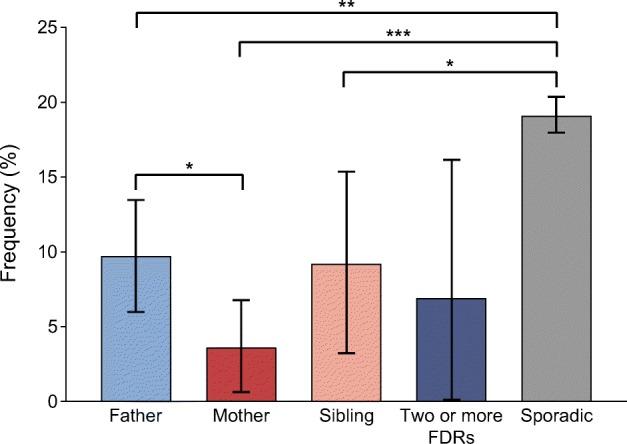
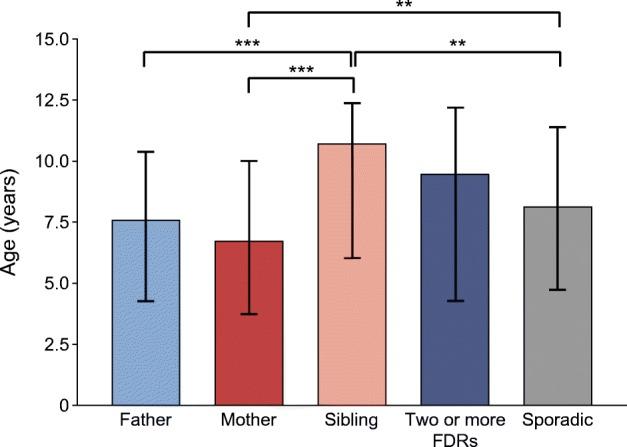
Out of 4993 newly diagnosed index children, 519 (10.4%) had familial type 1 diabetes. More than 5% (n = 253, 5.1%) had an affected father, 2.8% (n = 141) had an affected mother, 1.9% (n = 95) had an affected sibling and 0.6% (n = 30) had two or more affected family members. All clinical and metabolic variables were markedly poorer in children with sporadic vs familial diabetes. The index children with an affected father or mother were younger than those with an affected sibling (median age 7.59 vs 6.74 vs 10.73 years, respectively; p < 0.001). After age- and sex-adjusted analyses, index children with an affected father presented more often with ketoacidosis (9.7% vs 3.6%; p = 0.033) and had greater weight loss before diagnosis (3.2% vs 0%; p = 0.006) than those with an affected mother. Children with familial disease tested negative for all autoantibodies more often (3.5% vs 2.1%; p = 0.041) and had insulin autoantibodies more frequently (49.8% vs 42.2%; p = 0.004) than those with sporadic disease. Both major HLA risk haplotypes (DR3-DQ2 and DR4-DQ8) were more often lacking among children with sporadic vs familial disease (15.9% vs 11.2%; p = 0.006). The DR4-DQ8 haplotype was more frequent in the familial vs the sporadic group (75.7% vs 68.5%; p = 0.001) and especially among children with an affected father when compared with children with sporadic disease (77.5% vs 68.5%; p < 0.05). When comparing index children with affected parents diagnosed before or after the birth of the index child, a clear male preponderance was seen among the affected parents diagnosed before the birth of the index child (fathers 66.2% vs mothers 33.8%; p = 0.006), whereas the proportion of fathers and mothers was similar if type 1 diabetes was diagnosed after the birth of the index child.
CONCLUSIONS/INTERPRETATION: The more severe metabolic derangement at diagnosis in children with sporadic type 1 diabetes compared with those with familial type 1 diabetes was confirmed. The higher frequency of diabetic ketoacidosis and increased weight loss at diagnosis in index children with an affected father compared with an affected mother support the hypothesis that paternal type 1 diabetes is associated with more severe disease in the offspring than maternal diabetes. The sex difference seen between affected parents diagnosed before and after the birth of the index child supports the hypothesis that maternal insulin treatment protects against type 1 diabetes.
目的/假设:在之前的研究中,与受影响母亲的后代相比,受影响父亲的后代患 1 型糖尿病的风险高出两倍以上。我们检验了这样一个假设,即与其他一级亲属受影响的指数儿童相比,受影响父亲的指数儿童在诊断时可能具有更具侵袭性的疾病过程。
方法
使用芬兰儿科糖尿病登记处进行了一项横断面、观察性研究。对芬兰在 2003 年 1 月至 2016 年 12 月期间 15 岁以下确诊的索引儿童进行了临床和代谢特征、β细胞自身抗体和 HLA Ⅱ类遗传学分析。通过结构化问卷在诊断时收集一级亲属中 1 型糖尿病存在的信息。
结果
在新确诊的 4993 名索引儿童中,519 名(10.4%)患有家族性 1 型糖尿病。超过 5%(n=253,5.1%)有受影响的父亲,2.8%(n=141)有受影响的母亲,1.9%(n=95)有受影响的兄弟姐妹,0.6%(n=30)有两个或更多受影响的家庭成员。所有临床和代谢变量在散发型与家族性糖尿病患儿中均明显较差。与散发性糖尿病相比,有受影响父亲或母亲的指数儿童比有受影响兄弟姐妹的指数儿童更年轻(中位数年龄分别为 7.59 岁、6.74 岁和 10.73 岁;p<0.001)。在年龄和性别调整分析后,有受影响父亲的指数儿童更常出现酮症酸中毒(9.7%对 3.6%;p=0.033),并且在诊断前体重减轻更大(3.2%对 0%;p=0.006)。与散发型疾病相比,家族性疾病的儿童更常检测到所有自身抗体阴性(3.5%对 2.1%;p=0.041)和更频繁地出现胰岛素自身抗体(49.8%对 42.2%;p=0.004)。与散发型疾病相比,主要 HLA 风险单倍型(DR3-DQ2 和 DR4-DQ8)在家族性疾病中更常缺乏(15.9%对 11.2%;p=0.006)。DR4-DQ8 单倍型在家族性疾病中比散发型疾病更为常见(75.7%对 68.5%;p=0.001),尤其是在与散发型疾病相比时,有受影响父亲的指数儿童更为常见(77.5%对 68.5%;p<0.05)。当比较在索引儿童出生前或出生后被诊断为受影响的父母时,在索引儿童出生前被诊断为受影响的父母中明显存在男性优势(父亲 66.2%对母亲 33.8%;p=0.006),而如果在索引儿童出生后被诊断为 1 型糖尿病,则父亲和母亲的比例相似。
结论/解释:与散发型 1 型糖尿病相比,确诊时患有散发型 1 型糖尿病的儿童代谢紊乱更为严重。与受影响的母亲相比,受影响的父亲的指数儿童中糖尿病酮症酸中毒和体重减轻的发生率更高,这支持了这样一个假设,即与母亲的糖尿病相比,父亲的 1 型糖尿病与后代更严重的疾病有关。在出生前和出生后被诊断为受影响的父母之间观察到的性别差异支持了这样一个假设,即母亲的胰岛素治疗可预防 1 型糖尿病。

 Zotero 插件