
在慢性阻塞性肺疾病患者中,IFN-γ 产生的 Th17/Th1 细胞增加及其与肺功能和当前吸烟状况的关系。
Increased IFN-γ-producing Th17/Th1 cells and their association with lung function and current smoking status in patients with chronic obstructive pulmonary disease.
机构信息
Department 2 of Respiratory Medicine, Beijing Children's Hospital, Capital Medical University, National Center for Children's Health, Beijing, China.
Department of Respiratory Medicine, Beijing Tongren Hospital, Capital Medical University, Beijing, China.
出版信息
BMC Pulm Med. 2019 Jul 26;19(1):137. doi: 10.1186/s12890-019-0899-2.
BACKGROUND
Th17 cells are believed to be important proinflammatory cells in the pathogenesis of chronic obstructive pulmonary disease (COPD). Recent evidence demonstrates that Th17 cells display substantial developmental plasticity, giving rise to Th17/Th1 cells that secret both IL-17 and IFN-γ and are more pathogenic in inflammatory diseases. The aim of this study was to examine the distribution of circulating Th17/Th1 subpopulation and its association with disease severity in patients with COPD.
METHODS
Blood samples were obtained from 21 never-smokers, 31 smokers with normal lung function and 83 patients with COPD. The frequencies of Th17 cells and the Th17/Th1 subset were measured using flow cytometry. Plasma concentrations of IL-6, transforming growth factor (TGF)-β1 and IL-12 were determined by ELISA. The associations of Th17/Th1 cells with lung function and smoking were evaluated.
RESULTS
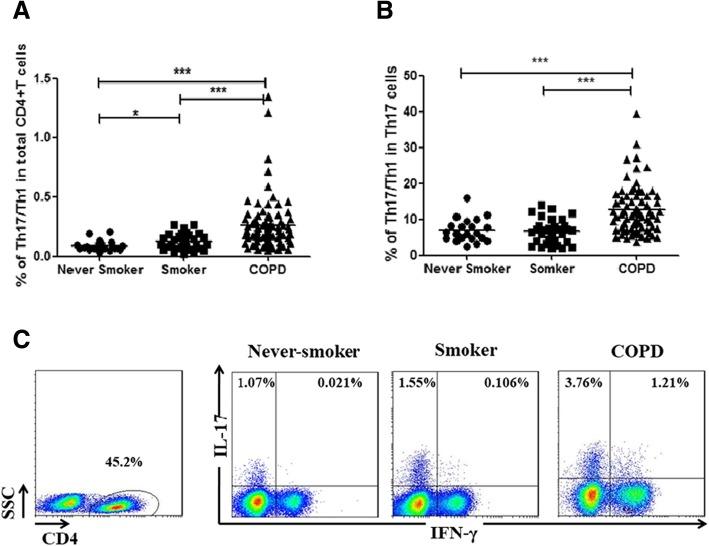
In peripheral blood, significantly increased proportions of Th17/Th1 cells among CD4 cells and Th17 cells were found in COPD patients compared with never-smokers and smokers with normal lung function. The percentages of Th17/Th1 cells showed correlations with forced expiratory volume in 1 (FEV) % predicted value (r = - 0.244, p < 0.05), and higher proportions of Th17/Th1 cells in GOLD stage IV patients compared with stage I patients. The percentages of Th17/Th1 cells were significantly higher in current smokers compared with ex-smoker COPD patients, and positively correlated with pack-years of smoking (r = 0.352, p < 0.01). The plasma concentrations of IL-6, TGF-β1 and IL-12 were significantly increased in patients with COPD compared with never-smokers and smokers with normal lung function.
CONCLUSION
Our results revealed correlations of proportions of IFN-γ-producing Th17/Th1 cells with lung function and smoking, suggesting that increased Th17/Th1 cells may play a role in COPD progression.
背景
Th17 细胞被认为是慢性阻塞性肺疾病(COPD)发病机制中的重要促炎细胞。最近的证据表明,Th17 细胞表现出显著的发育可塑性,产生既能分泌 IL-17 又能分泌 IFN-γ的 Th17/Th1 细胞,在炎症性疾病中更具致病性。本研究旨在探讨循环 Th17/Th1 亚群的分布及其与 COPD 患者疾病严重程度的关系。
方法
采集 21 名不吸烟者、31 名肺功能正常的吸烟者和 83 名 COPD 患者的血样。采用流式细胞术检测 Th17 细胞和 Th17/Th1 亚群的频率。通过 ELISA 法测定血浆 IL-6、转化生长因子(TGF)-β1 和 IL-12 浓度。评估 Th17/Th1 细胞与肺功能和吸烟的关系。
结果
与不吸烟者和肺功能正常的吸烟者相比,COPD 患者外周血 CD4 细胞中 Th17/Th1 细胞和 Th17 细胞的比例显著增加。Th17/Th1 细胞的百分比与用力呼气量(FEV)%预计值呈负相关(r=−0.244,p<0.05),且在 GOLD Ⅳ期患者中高于Ⅰ期患者。与 COPD 患者中的前吸烟者相比,当前吸烟者中 Th17/Th1 细胞的比例显著升高,且与吸烟包年呈正相关(r=0.352,p<0.01)。与不吸烟者和肺功能正常的吸烟者相比,COPD 患者的血浆 IL-6、TGF-β1 和 IL-12 浓度显著升高。
结论
本研究结果表明,IFN-γ产生的 Th17/Th1 细胞比例与肺功能和吸烟相关,提示 Th17/Th1 细胞增多可能在 COPD 进展中起作用。




 Zotero 插件