
出生体重与成人疾病之间的因果关联:来自孟德尔随机化分析的证据。
Causal Association Between Birth Weight and Adult Diseases: Evidence From a Mendelian Randomization Analysis.
作者信息
Zeng Ping, Zhou Xiang
机构信息
Department of Epidemiology and Biostatistics, Xuzhou Medical University, Xuzhou, Jiangsu, China.
Department of Biostatistics, University of Michigan, Ann Arbor, MI, United States.
出版信息
Front Genet. 2019 Jul 10;10:618. doi: 10.3389/fgene.2019.00618. eCollection 2019.
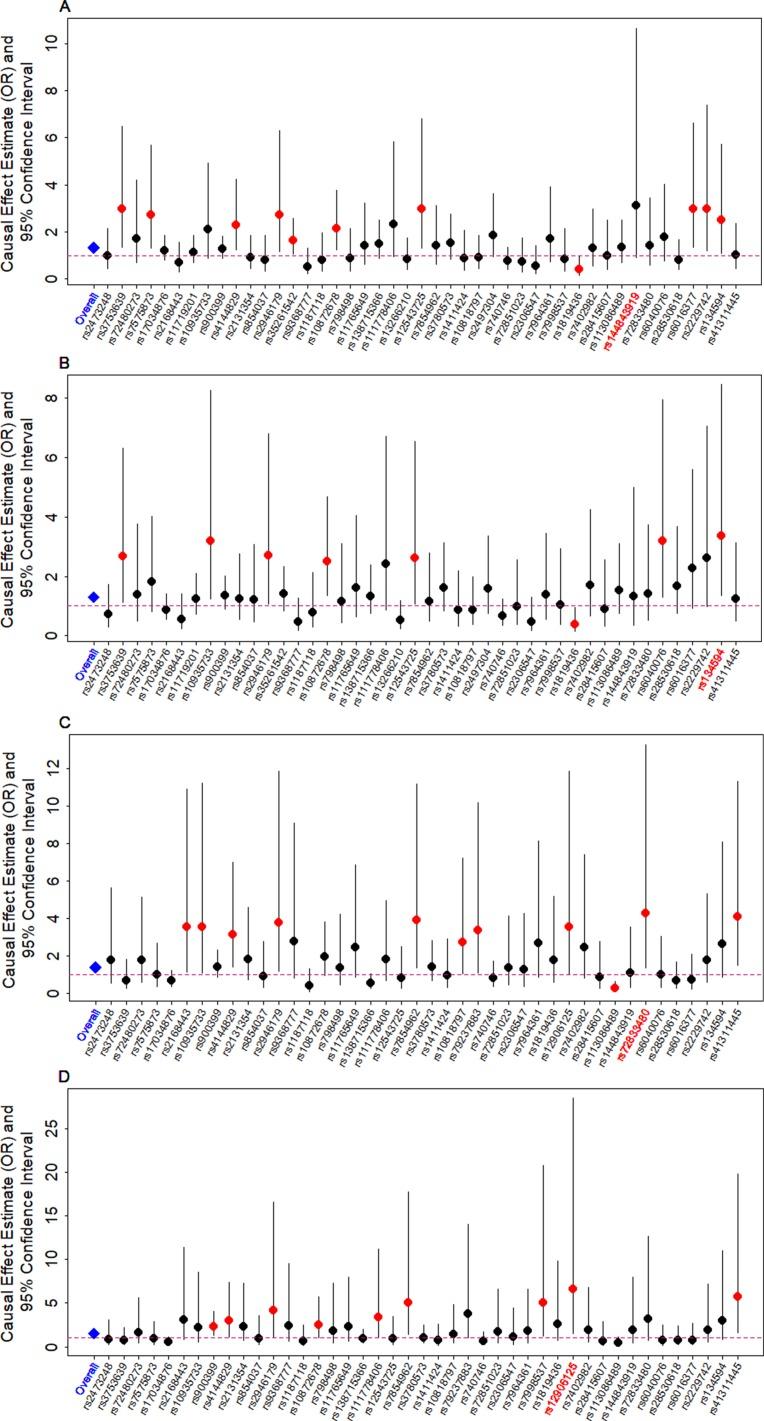
Birth weight has a profound long-term impact on individual's predisposition to various diseases at adulthood-a hypothesis commonly referred to as the fetal origins of adult diseases. However, it is not fully clear to what extent the fetal origins of adult diseases hypothesis holds and it is also not completely known what types of adult diseases are causally affected by birth weight. Mendelian randomization using multiple genetic instruments associated with birth weight was performed to explore the causal relationship between birth weight and adult diseases. The causal relationship between birth weight and 21 adult diseases as well as 38 other complex traits was examined based on data collected from 37 large-scale genome-wide association studies with up to 340,000 individuals of European ancestry. Causal effects of birth weight were estimated using inverse-variance weighted methods. The identified causal relationships between birth weight and adult diseases were further validated through extensive sensitivity analyses, bias calculation, and simulations. Among the 21 adult diseases, three were identified to be inversely causally affected by birth weight after the Bonferroni correction. The measurement unit of birth weight was defined as its standard deviation (i.e., 488 g), and one unit lower birth weight was causally related to an increased risk of coronary artery disease (CAD), myocardial infarction (MI), type 2 diabetes (T2D), and BMI-adjusted T2D, with the estimated odds ratios of 1.34 [95% confidence interval (CI) 1.17-1.53], 1.30 (95% CI 1.13-1.51), 1.41 (95% CI 1.15-1.73), and 1.54 (95% CI 1.25-1.89), respectively. All these identified causal associations were robust across various sensitivity analyses that guard against various confounding due to pleiotropy or maternal effects as well as reverse causation. In addition, analysis on 38 additional complex traits did not identify candidate traits that may mediate the causal association between birth weight and CAD/MI/T2D. The results suggest that lower birth weight is causally associated with an increased risk of CAD, MI, and T2D in later life, supporting the fetal origins of adult diseases hypothesis.
出生体重对个体成年后易患各种疾病具有深远的长期影响——这一假说通常被称为成人疾病的胎儿起源假说。然而,成人疾病的胎儿起源假说在多大程度上成立尚不完全清楚,出生体重因果影响哪些类型的成人疾病也不完全明确。利用与出生体重相关的多种遗传工具进行孟德尔随机化分析,以探究出生体重与成人疾病之间的因果关系。基于从37项大规模全基因组关联研究中收集的数据(涉及多达340,000名欧洲血统个体),研究了出生体重与21种成人疾病以及38种其他复杂性状之间的因果关系。使用逆方差加权法估计出生体重的因果效应。通过广泛的敏感性分析、偏倚计算和模拟,进一步验证了所确定的出生体重与成人疾病之间的因果关系。在21种成人疾病中,经Bonferroni校正后,有三种疾病被确定受到出生体重的反向因果影响。出生体重的测量单位定义为其标准差(即488克),出生体重每降低一个单位与冠状动脉疾病(CAD)、心肌梗死(MI)、2型糖尿病(T2D)和体重指数调整后的T2D风险增加存在因果关系,估计比值比分别为1.34 [95%置信区间(CI)1.17 - 1.53]、1.30(95% CI 1.13 - 1.51)、1.41(95% CI 1.15 - 1.73)和1.54(95% CI 1.25 - 1.89)。所有这些确定的因果关联在各种敏感性分析中均具有稳健性,这些分析可防范因多效性或母体效应以及反向因果关系导致的各种混杂因素。此外,对38种其他复杂性状的分析未发现可能介导出生体重与CAD/MI/T2D之间因果关联的候选性状。结果表明,较低的出生体重与成年后期CAD、MI和T2D风险增加存在因果关系,支持成人疾病的胎儿起源假说。


 Zotero 插件