
食品中的多胺
Polyamines in Food.
作者信息
Muñoz-Esparza Nelly C, Latorre-Moratalla M Luz, Comas-Basté Oriol, Toro-Funes Natalia, Veciana-Nogués M Teresa, Vidal-Carou M Carmen
机构信息
Department of Nutrition, Food Sciences and Gastronomy, Faculty of Pharmacy and Food Sciences, University of Barcelona (UB), Barcelona, Spain.
Research Institute of Nutrition and Food Safety of the University of Barcelona (INSA·UB), Barcelona, Spain.
出版信息
Front Nutr. 2019 Jul 11;6:108. doi: 10.3389/fnut.2019.00108. eCollection 2019.
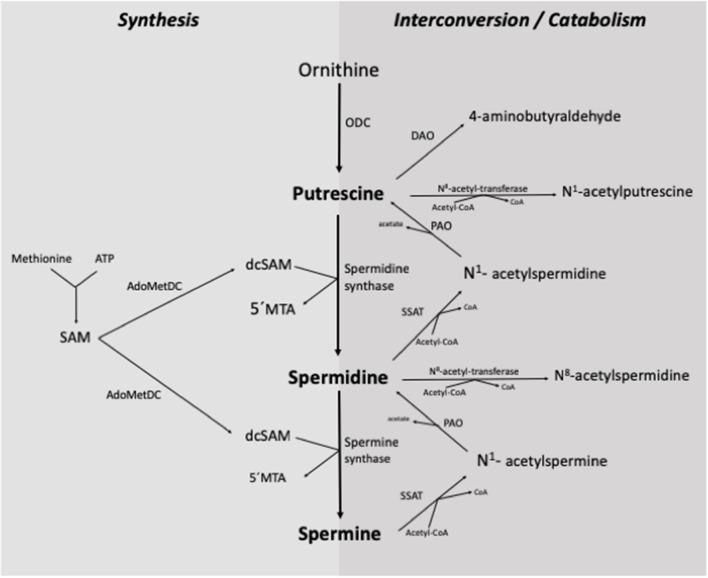
The polyamines spermine, spermidine, and putrescine are involved in various biological processes, notably in cell proliferation and differentiation, and also have antioxidant properties. Dietary polyamines have important implications in human health, mainly in the intestinal maturation and in the differentiation and development of immune system. The antioxidant and anti-inflammatory effect of polyamine can also play an important role in the prevention of chronic diseases such as cardiovascular diseases. In addition to endogenous synthesis, food is an important source of polyamines. Although there are no recommendations for polyamine daily intake, it is known that in stages of rapid cell growth (i.e., in the neonatal period), polyamine requirements are high. Additionally, synthesis of polyamines tends to decrease with age, which is why their dietary sources acquire a greater importance in an aging population. Polyamine daily intake differs among to the available estimations, probably due to different dietary patterns and methodologies of data collection. Polyamines can be found in all types of foods in a wide range of concentrations. Spermidine and spermine are naturally present in food whereas putrescine could also have a microbial origin. The main polyamine in plant-based products is spermidine, whereas spermine content is generally higher in animal-derived foods. This article reviews the main implications of polyamines for human health, as well as their content in food and breast milk and infant formula. In addition, the estimated levels of polyamines intake in different populations are provided.
多胺精胺、亚精胺和腐胺参与多种生物过程,尤其在细胞增殖和分化方面,并且还具有抗氧化特性。膳食多胺对人类健康具有重要意义,主要体现在肠道成熟以及免疫系统的分化和发育方面。多胺的抗氧化和抗炎作用在预防心血管疾病等慢性疾病中也可发挥重要作用。除内源性合成外,食物是多胺的重要来源。尽管目前尚无关于多胺每日摄入量的建议,但已知在细胞快速生长阶段(即新生儿期),多胺需求量较高。此外,多胺的合成往往会随着年龄增长而减少,这就是为什么它们的膳食来源在老龄化人群中变得更加重要。根据现有估计,多胺的每日摄入量有所不同,这可能是由于不同的饮食模式和数据收集方法所致。多胺可以在各种类型的食物中以广泛的浓度存在。亚精胺和精胺天然存在于食物中,而腐胺也可能有微生物来源。植物性产品中的主要多胺是亚精胺,而动物性食物中的精胺含量通常较高。本文综述了多胺对人类健康的主要影响,以及它们在食物、母乳和婴儿配方奶粉中的含量。此外,还提供了不同人群多胺摄入量的估计水平。

 Zotero 插件