
持续脓毒症中的免疫应答重置。
Immune Response Resetting in Ongoing Sepsis.
机构信息
Integrated Center for Pediatric OncoHaematological Research, State University of Campinas, Campinas 13083-888, Brazil;
Integrated Center for Pediatric OncoHaematological Research, State University of Campinas, Campinas 13083-888, Brazil.
出版信息
J Immunol. 2019 Sep 1;203(5):1298-1312. doi: 10.4049/jimmunol.1900104. Epub 2019 Jul 29.
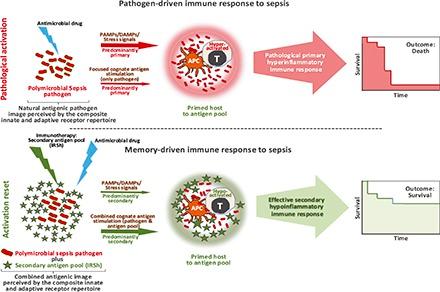
Cure of severe infections, sepsis, and septic shock with antimicrobial drugs is a challenge because morbidity and mortality in these conditions are essentially caused by improper immune response. We have tested the hypothesis that repeated reactivation of established memory to pathogens may reset unfavorable immune responses. We have chosen for this purpose a highly stringent mouse model of polymicrobial sepsis by cecum ligation and puncture. Five weeks after priming with a diverse Ag pool, high-grade sepsis was induced in C57BL/6j mice that was lethal in 24 h if left untreated. Antimicrobial drug (imipenem) alone rescued 9.7% of the animals from death, but >5-fold higher cure rate could be achieved by combining imipenem and two rechallenges with the Ag pool ( < 0.0001). Antigenic stimulation fine-tuned the immune response in sepsis by contracting the total CD3 T cell compartment in the spleen and disengaging the hyperactivation state in the memory T subsets, most notably CD8 T cells, while preserving the recovery of naive subsets. Quantitative proteomics/lipidomics analyses revealed that the combined treatment reverted the molecular signature of sepsis for cytokine storm, and deregulated inflammatory reaction and proapoptotic environment, as well as the lysophosphatidylcholine/phosphatidylcholine ratio. Our results showed the feasibility of resetting uncontrolled hyperinflammatory reactions into ordered hypoinflammatory responses by memory reactivation, thereby reducing morbidity and mortality in antibiotic-treated sepsis. This beneficial effect was not dependent on the generation of a pathogen-driven immune response itself but rather on the reactivation of memory to a diverse Ag pool that modulates the ongoing response.
用抗菌药物治愈严重感染、败血症和感染性休克是一个挑战,因为这些情况下的发病率和死亡率主要是由免疫反应不当引起的。我们已经测试了这样一个假设,即反复重新激活已建立的针对病原体的记忆可能会重置不利的免疫反应。为此,我们选择了一种高度严格的盲肠结扎和穿刺多微生物败血症小鼠模型。在用多种 Ag 池进行初次免疫 5 周后,C57BL/6j 小鼠会发生高级别的败血症,如果不治疗,24 小时内就会致命。抗菌药物(亚胺培南)单独使用可使 9.7%的动物免于死亡,但如果将亚胺培南与 Ag 池的两次再挑战相结合,则可使治愈率提高 5 倍以上(<0.0001)。抗原刺激通过收缩脾脏中总 CD3 T 细胞区室并使记忆 T 亚群(尤其是 CD8 T 细胞)的过度激活状态脱耦,从而微调败血症中的免疫反应,同时保持幼稚亚群的恢复。定量蛋白质组学/脂质组学分析表明,联合治疗可使败血症的分子特征恢复正常,从而逆转细胞因子风暴,并纠正失调的炎症反应和促凋亡环境,以及溶血磷脂酰胆碱/磷脂酰胆碱比值。我们的结果表明,通过记忆再激活将不受控制的过度炎症反应重置为有序的低炎症反应,从而降低抗生素治疗败血症的发病率和死亡率是可行的。这种有益的效果不依赖于病原体驱动的免疫反应本身的产生,而是依赖于对多样化 Ag 池的记忆再激活,从而调节正在进行的反应。
 Zotero 插件