
浆母细胞淋巴瘤:当前观点
Plasmablastic lymphoma: current perspectives.
作者信息
Lopez Andres, Abrisqueta Pau
机构信息
Lymphoma Unit, Department of Hematology, Vall d'Hebron University Hospital, Barcelona, Spain,
Department of Hematology, Vall d'Hebron Institute of Oncology, Vall d'Hebron University Hospital, Barcelona, Spain.
出版信息
Blood Lymphat Cancer. 2018 Oct 4;8:63-70. doi: 10.2147/BLCTT.S142814. eCollection 2018.
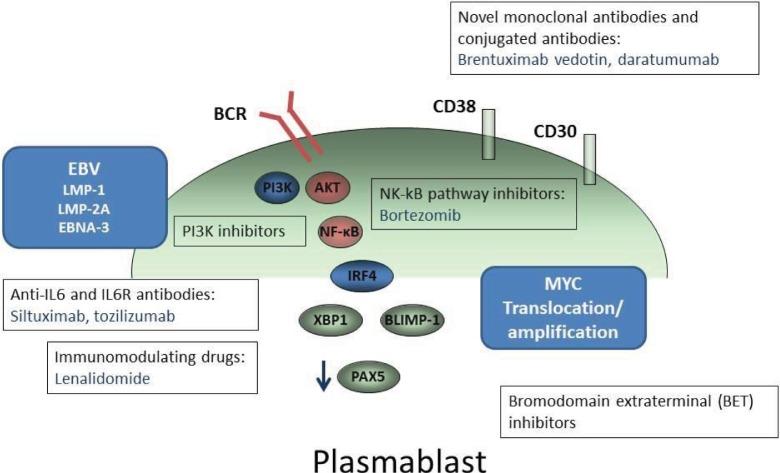
Plasmablastic lymphoma (PbL) is a rare and aggressive B-cell malignancy with large neoplastic cells, most of them resembling plasmablasts that have a CD20-negative phenotype. Although initially described as being associated with HIV, over the years it has also been identified in patients with solid organ transplant and immunocompetent patients. Little is known about molecular basis that drives PbL, and still its diagnosis remains challenging given its rarity. However, proper recognition of its clinical characteristics, localization, and morphological features can establish a correct diagnosis of PbL within the spectrum of CD20-negative large B-cell lymphomas (LBCLs). PbL is characterized by CD20 and PAX5 negativity together with the expression of CD38, CD138, MUM1/IRF4, Blimp1, and XBP1 plasmacytic differentiation markers. It is usually associated with Epstein-Barr virus infections, and gene rearrangements. PbL should be carefully differentiated from other CD20-negative B-cell neoplasms, ie, primary effusion lymphoma, anaplastic lymphoma kinase-positive (ALK) large B-cell lymphoma, and LBCL in human herpesvirus 8-associated multicentric Castleman disease. Despite our improved understanding of this disease, its prognosis remains dismal with short overall survival. There is no standard of care for this entity. Several chemotherapy combinations have been used with hardly any differences on its outcome. Thus, new approaches with the addition of novel molecules are needed to overcome its poor prognosis. Our current understanding and knowledge of PbL relies primarily on case reports and small case series. In this review, we revise through an extensive literature search, the clinical and biological characteristics of this entity, and the potential therapeutic options.
浆母细胞淋巴瘤(PbL)是一种罕见的侵袭性B细胞恶性肿瘤,其肿瘤细胞较大,多数类似于具有CD20阴性表型的浆母细胞。尽管最初被描述为与HIV相关,但多年来在实体器官移植患者和免疫功能正常的患者中也有发现。关于驱动PbL的分子基础知之甚少,而且由于其罕见性,其诊断仍然具有挑战性。然而,正确认识其临床特征、定位和形态学特征,可以在CD20阴性大B细胞淋巴瘤(LBCL)范围内对PbL做出正确诊断。PbL的特征是CD20和PAX5阴性,同时表达CD38、CD138、MUM1/IRF4、Blimp1和XBP1等浆细胞分化标志物。它通常与爱泼斯坦-巴尔病毒感染和基因重排有关。PbL应与其他CD20阴性B细胞肿瘤仔细鉴别,即原发性渗出性淋巴瘤、间变性淋巴瘤激酶阳性(ALK)大B细胞淋巴瘤以及人类疱疹病毒8相关多中心Castleman病中的LBCL。尽管我们对这种疾病的认识有所提高,但其预后仍然很差,总生存期较短。对于这个实体没有标准的治疗方法。已经使用了几种化疗方案,但对其结果几乎没有差异。因此,需要添加新分子的新方法来克服其不良预后。我们目前对PbL的理解和认识主要依赖于病例报告和小病例系列。在本综述中,我们通过广泛的文献检索,回顾了该实体的临床和生物学特征以及潜在的治疗选择。
 Zotero 插件