
尼可司汀-1 对大鼠蛛网膜下腔出血的神经保护作用可能是通过防止血脑屏障破坏和 RIP3 介导的坏死性凋亡来实现的。
The Neuroprotective Effects of Necrostatin-1 on Subarachnoid Hemorrhage in Rats Are Possibly Mediated by Preventing Blood-Brain Barrier Disruption and RIP3-Mediated Necroptosis.
机构信息
Department of Neurosurgery, Second Affiliated Hospital, School of Medicine, Zhejiang University, Hangzhou, China.
All the authors contributed equally to this article.
出版信息
Cell Transplant. 2019 Nov;28(11):1358-1372. doi: 10.1177/0963689719867285. Epub 2019 Aug 2.
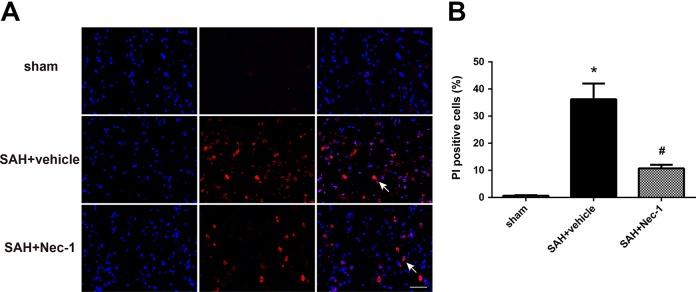
Despite the substantial efforts to elucidate the role of early brain injury in subarachnoid hemorrhage (SAH), an effective pharmaceutical therapy for patients with SAH continues to be unavailable. This study aims to reveal the role of necroptosis after SAH, and explore whether the disruption of the blood-brain barrier (BBB) and RIP3-mediated necroptosis following SAH in a rat SAH model are altered by necrostatin-1 via its selective inhibition of receptor-interacting protein kinase 1 (RIP1). Sixty-five rats were used in the experiments. The SAH model was established using endovascular perforation. Necrostatin-1 was intracerebroventricularly injected 1 h before SAH induction. The neuroprotective effects of necrostatin-1 were evaluated with multiple methods such as magnetic resonance imaging (MRI) scanning, immunohistochemistry, propidium iodide (PI) labeling, and western blotting. Pretreatment with necrostatin-1 attenuated brain swelling and reduced the lesion volume on T2 sequence and ventricular volume on MRI 72 h after SAH induction. Albumin leakage and the degradation of tight junction proteins were also ameliorated by necrostatin-1 administration. In addition, necrostatin-1 decreased the number of PI-positive cells in the basal cortex, reduced the levels of the RIP3 and MLKL proteins, and inhibited the production of the pro-inflammatory cytokines IL-1β, IL-6, and TNF-α. Based on the findings from the present study, the selective RIP1 inhibitor necrostatin-1 functioned as a neuroprotective agent after SAH by attenuating brain swelling and BBB disruption. Moreover, the necrostatin-1 pretreatment prevented SAH-induced necroptosis by suppressing the activity of the RIP3/MLKL signaling pathway. These results will provide insights into new drugs and pharmacological targets to manage SAH, which are worth further study.
尽管人们为阐明蛛网膜下腔出血(SAH)后早期脑损伤的作用做出了巨大努力,但仍缺乏有效的治疗 SAH 的药物。本研究旨在揭示 SAH 后坏死性凋亡的作用,并探讨在大鼠 SAH 模型中,SAH 后血脑屏障(BBB)的破坏和 RIP3 介导的坏死性凋亡是否通过其对受体相互作用蛋白激酶 1(RIP1)的选择性抑制而被 necrostatin-1 改变。本实验共使用了 65 只大鼠。通过血管内穿孔建立 SAH 模型。SAH 诱导前 1 小时通过侧脑室注射 necrostatin-1。通过磁共振成像(MRI)扫描、免疫组织化学、碘化丙啶(PI)标记和蛋白质印迹等多种方法评估 necrostatin-1 的神经保护作用。预处理 necrostatin-1 可减轻脑水肿,减少 T2 序列上的病变体积和 MRI 上的脑室体积,在 SAH 诱导后 72 小时。白蛋白渗漏和紧密连接蛋白的降解也得到了 necrostatin-1 给药的改善。此外,necrostatin-1 减少了基底皮质中 PI 阳性细胞的数量,降低了 RIP3 和 MLKL 蛋白的水平,并抑制了促炎细胞因子 IL-1β、IL-6 和 TNF-α的产生。基于本研究的结果,选择性 RIP1 抑制剂 necrostatin-1 通过减轻脑水肿和 BBB 破坏,在 SAH 后发挥神经保护作用。此外,necrostatin-1 预处理通过抑制 RIP3/MLKL 信号通路的活性,防止了 SAH 诱导的坏死性凋亡。这些结果将为管理 SAH 的新药和药理学靶点提供新的思路,值得进一步研究。



 Zotero 插件