
炎症在抑郁和疲劳中的作用。
The Role of Inflammation in Depression and Fatigue.
机构信息
Neuroscience and Mental Health Institute, University of Alberta, Edmonton, AB, Canada.
Division of Neurology, Department of Medicine, University of Alberta, Edmonton, AB, Canada.
出版信息
Front Immunol. 2019 Jul 19;10:1696. doi: 10.3389/fimmu.2019.01696. eCollection 2019.
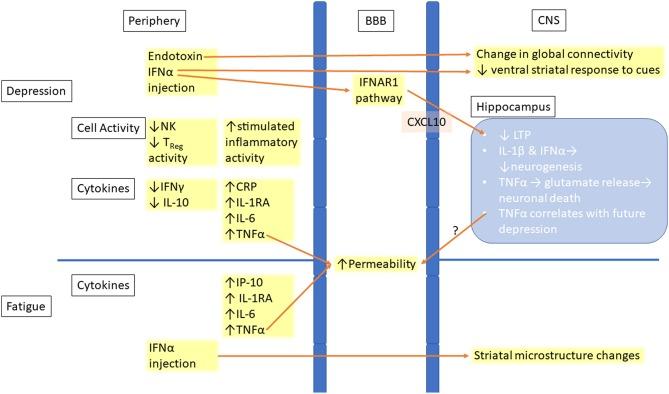
Depression and fatigue are conditions responsible for heavy global societal burden, especially in patients already suffering from chronic diseases. These symptoms have been identified by those affected as some of the most disabling symptoms which affect the quality of life and productivity of the individual. While many factors play a role in the development of depression and fatigue, both have been associated with increased inflammatory activation of the immune system affecting both the periphery and the central nervous system (CNS). This is further supported by the well-described association between diseases that involve immune activation and these symptoms in autoimmune disorders, such as multiple sclerosis and immune system activation in response to infections, like sepsis. Treatments for depression also support this immunopsychiatric link. Antidepressants have been shown to decrease inflammation, while higher levels of baseline inflammation predict lower treatment efficacy for most treatments. Those patients with higher initial immune activation may on the other hand be more responsive to treatments targeting immune pathways, which have been found to be effective in treating depression and fatigue in some cases. These results show strong support for the hypothesis that depression and fatigue are associated with an increased activation of the immune system which may serve as a valid target for treatment. Further studies should focus on the pathways involved in these symptoms and the development of treatments that target those pathways will help us to better understand these conditions and devise more targeted treatments.
抑郁和疲劳是导致全球社会负担沉重的疾病,尤其是在已经患有慢性疾病的患者中。这些症状被患者认为是最具致残性的症状之一,会影响个人的生活质量和生产力。尽管许多因素在抑郁和疲劳的发展中起作用,但两者都与免疫系统的炎症激活增加有关,影响外周和中枢神经系统(CNS)。这进一步得到了很好的描述,即涉及免疫激活的疾病与自身免疫性疾病中的这些症状有关,如多发性硬化症和感染(如败血症)引起的免疫系统激活。治疗抑郁的方法也支持这种免疫精神病学的联系。抗抑郁药已被证明可以减轻炎症,而基线炎症水平较高则预示着大多数治疗的疗效较低。另一方面,那些初始免疫激活较高的患者可能对针对免疫途径的治疗更敏感,这些治疗方法在某些情况下已被证明对治疗抑郁和疲劳有效。这些结果强烈支持这样一种假设,即抑郁和疲劳与免疫系统的过度激活有关,这可能是治疗的一个有效靶点。进一步的研究应集中在这些症状涉及的途径上,针对这些途径开发治疗方法将有助于我们更好地了解这些疾病,并制定更有针对性的治疗方法。
 Zotero 插件