
慢性肾脏病患者便秘与终末期肾病风险的相关性。
Association of Constipation with risk of end-stage renal disease in patients with chronic kidney disease.
机构信息
Department of Sport and Health Management, Da-Yeh University, Changhua, 515, Taiwan.
Department of Chinese Medicine, China Medical University Hospital, Taipei Branch, Taipei, 114, Taiwan.
出版信息
BMC Nephrol. 2019 Aug 5;20(1):304. doi: 10.1186/s12882-019-1481-0.
BACKGROUND
Chronic Kidney Disease (CKD) is a growing public health problem. Many risk factors were identified and interventions were applied accordingly, but the incidence of end-stage renal disease continued increasing. Some other risk factors may be ignored. Gut microbiota has been recognized as an important endogenous organ. The kidney-gut axis would contribute to gut dysbiosis, which might worsen CKD. Constipation, commonly seen in CKD, was one of the clinical presentation of gut dysbiosis. The clinical impact of constipation to CKD remains unknown. Our study aimed at assessing the risk of ESRD between CKD patients with and without constipation in a nationwide database.
METHODS
We identified newly diagnosed cases of CKD without constipation history before in 2000-2011 from the Taiwan National Health Insurance database. Subjects who developed constipation later formed constipation group. The others without constipation matched by propensity score formed non-constipation group. The incidence rates and hazards of ESRD in patients with and without constipation by the end of 2013 were compared by using Cox proportional hazard models with a time-dependent variable.
RESULTS
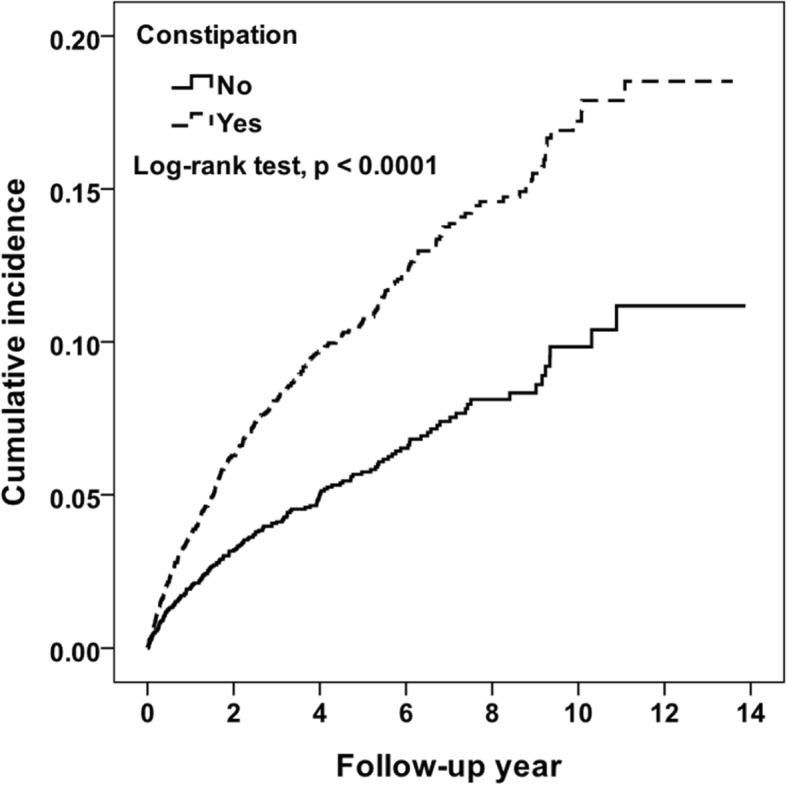
The incidences of ESRD per 1000 person-years were 22.9 for constipation group and 12.2 for non-constipation group, respectively. Cox proportional hazard models with a time-dependent variable revealed an adjusted hazard ratio of 1.90 (95% CI, 1.60-2.27). Compared to the CKD patients without constipation, adjusted hazard ratio for the CKD patients with laxatives < 33, 33-197 and ≥ 198 days per year were 0.45 (0.31-0.63), 1.85 (1.47-2.31) and 4.41 (3.61-5.39) respectively.
CONCLUSION
In a population of newly-diagnosed CKD patients, we observed that subjects with de novo constipation, as compared with non-constipation, have increased risk of developing ESRD. More severe constipation would increase the risk further.
背景
慢性肾脏病(CKD)是一个日益严重的公共卫生问题。许多风险因素已经被确定,并相应地进行了干预,但终末期肾病的发病率仍在持续上升。可能还有其他一些被忽视的风险因素。肠道微生物群已被认为是一个重要的内源性器官。肾脏-肠道轴可能导致肠道菌群失调,从而使 CKD 恶化。便秘是 CKD 的常见临床表现之一,也是肠道菌群失调的表现之一。便秘对 CKD 的临床影响尚不清楚。我们的研究旨在评估全国数据库中伴有和不伴有便秘的 CKD 患者发生终末期肾病的风险。
方法
我们从台湾全民健康保险数据库中确定了 2000-2011 年期间无便秘史的新诊断为 CKD 的病例。后来发生便秘的患者被归入便秘组。其余未发生便秘的患者按照倾向评分匹配为非便秘组。在 2013 年底,通过使用带有时间依赖性变量的 Cox 比例风险模型比较了便秘组和非便秘组患者的 ESRD 发生率和风险。
结果
便秘组和非便秘组的 ESRD 发生率分别为每 1000 人年 22.9 例和 12.2 例。带有时间依赖性变量的 Cox 比例风险模型显示,调整后的风险比为 1.90(95%CI,1.60-2.27)。与无便秘的 CKD 患者相比,便秘持续时间<33、33-197 和≥198 天/年的 CKD 患者的调整后风险比分别为 0.45(0.31-0.63)、1.85(1.47-2.31)和 4.41(3.61-5.39)。
结论
在一组新诊断的 CKD 患者中,我们观察到新发便秘患者与非便秘患者相比,发生 ESRD 的风险增加。便秘越严重,风险越高。

 Zotero 插件