
洛沙平治疗难治性化疗诱导的神经性疼痛患者:一项提前终止的初步研究显示有效但耐受性有限。
Loxapine for Treatment of Patients With Refractory, Chemotherapy-Induced Neuropathic Pain: A Prematurely Terminated Pilot Study Showing Efficacy But Limited Tolerability.
作者信息
Schmiedl Sven, Peters David, Schmalz Oliver, Mielke Anke, Rossmanith Tanja, Diop Shirin, Piefke Martina, Thürmann Petra, Schmidtko Achim
机构信息
Philipp Klee-Institute for Clinical Pharmacology, Helios University Hospital Wuppertal, Wuppertal, Germany.
Department of Clinical Pharmacology, School of Medicine, Faculty of Health, Witten/Herdecke University, Witten, Germany.
出版信息
Front Pharmacol. 2019 Jul 25;10:838. doi: 10.3389/fphar.2019.00838. eCollection 2019.
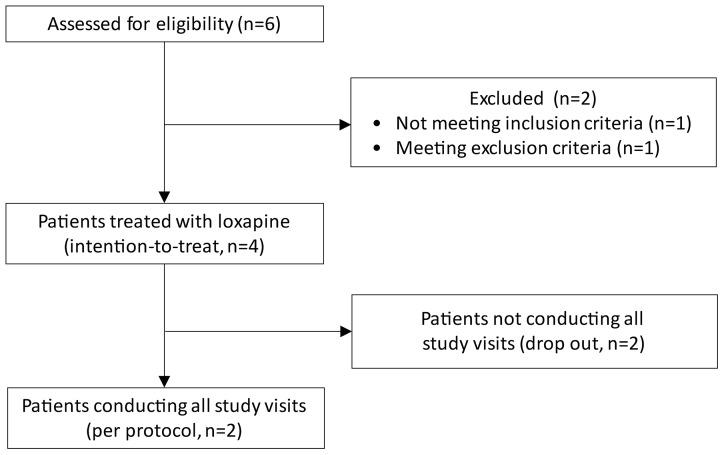
Neuropathic pain is a debilitating and commonly treatment-refractory condition requiring novel therapeutic options. Accumulating preclinical studies indicate that the potassium channel Slack (K1.1) contributes to the processing of neuropathic pain, and that Slack activators, when injected into mice, ameliorate pain-related hypersensitivity. However, whether Slack activation might reduce neuropathic pain in humans remains elusive. Here, we evaluated the tolerability and analgesic efficacy of loxapine, a first-generation antipsychotic drug and Slack activator, in neuropathic pain patients. We aimed to treat 12 patients with chronic chemotherapy-induced, treatment-refractory neuropathic pain (pain severity ≥ 4 units on an 11-point numerical rating scale) in a monocentric, open label, proof-of-principle study. Patients received loxapine orally as add-on analgesic in a dose-escalating manner (four treatment episodes for 14 days, daily dose: 20, 30, 40, or 60 mg loxapine) depending on tolerability and analgesic efficacy. Patient-reported outcomes of pain intensity and/or relief were recorded daily. After enrolling four patients, this study was prematurely terminated due to adverse events typically occurring with first-generation antipsychotic drugs that were reported by all patients. In two patients receiving loxapine for at least two treatment episodes, a clinically relevant analgesic effect was found at a daily dose of 20-30 mg of loxapine. Another two patients tolerated loxapine only for a few days. Together, our data further support the hypothesis that Slack activation might be a novel strategy for neuropathic pain therapy. However, loxapine is no valid treatment option for painful polyneuropathy due to profound dopamine and histamine receptor-related side effects. Clinical Trial Registration: www.ClinicalTrials.gov, identifier NCT02820519.
神经性疼痛是一种使人衰弱且通常难以治疗的疾病,需要新的治疗方法。越来越多的临床前研究表明,钾通道Slack(K1.1)参与神经性疼痛的处理,并且将Slack激活剂注射到小鼠体内时,可改善疼痛相关的超敏反应。然而,Slack激活是否能减轻人类的神经性疼痛仍不清楚。在此,我们评估了第一代抗精神病药物兼Slack激活剂洛沙平在神经性疼痛患者中的耐受性和镇痛效果。我们旨在进行一项单中心、开放标签、原理验证研究,治疗12例慢性化疗引起的、难治性神经性疼痛患者(疼痛严重程度在11点数字评分量表上≥4分)。根据耐受性和镇痛效果,患者以剂量递增的方式口服洛沙平作为附加镇痛药(四个治疗阶段,为期14天,每日剂量:20、30、40或60 mg洛沙平)。每天记录患者报告的疼痛强度和/或缓解情况。在招募了4名患者后,由于所有患者均报告了第一代抗精神病药物通常会出现的不良事件,该研究提前终止。在两名接受洛沙平治疗至少两个治疗阶段的患者中,发现每日剂量为20 - 30 mg洛沙平时有临床相关的镇痛效果。另外两名患者仅耐受了几天洛沙平。总体而言,我们的数据进一步支持了Slack激活可能是神经性疼痛治疗新策略的假设。然而,由于多巴胺和组胺受体相关的严重副作用,洛沙平不是治疗疼痛性多发性神经病的有效选择。临床试验注册:www.ClinicalTrials.gov,标识符NCT02820519。

 Zotero 插件