
从鲤鱼(Cyprinus carpio L.)分离出的嗜水气单胞菌的分子特征、致病性及用药方案
Molecular characteristics, pathogenicity and medication regimen of Aeromonas hydrophila isolated from common carp (Cyprinus carpio L.).
作者信息
Zhao Xian-Liang, Jin Zhao-Hui, DI Gui-Lan, Li Li, Kong Xiang-Hui
机构信息
College of Life Sciences, Henan Normal University, Xinxiang, Henan 453007, China.
College of Fisheries, Henan Normal University, Xinxiang, Henan 453007, China.
出版信息
J Vet Med Sci. 2019 Dec 26;81(12):1769-1775. doi: 10.1292/jvms.19-0025. Epub 2019 Aug 12.
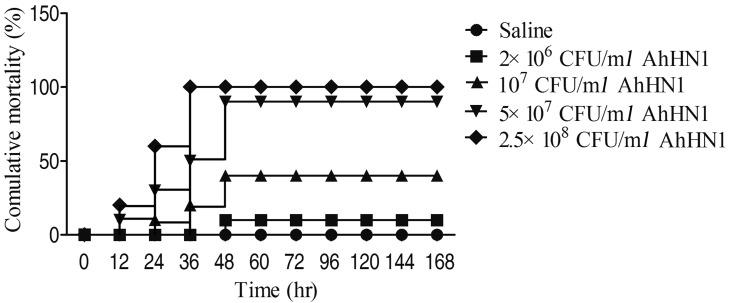
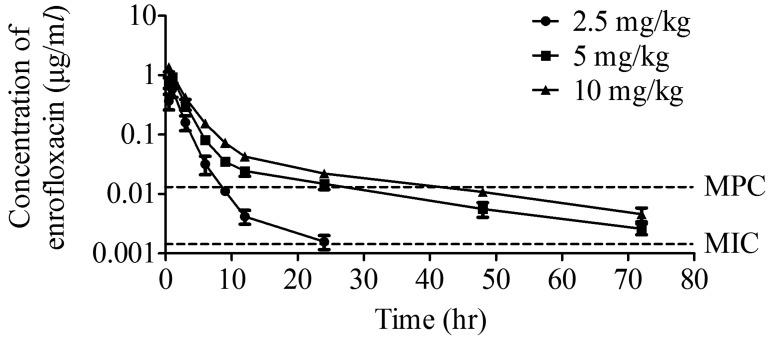
Aeromonas hydrophila causes disease in fish known as Motile Aeromonas Septicemia (MAS), also named as bacterial hemorrhagic septicemia. In this study, a pathogenic A. hydrophila strain was isolated from common carp Cyprinus carpio L., which were suffering from severe hemorrhagic septicemia. According to the phylogenetic analysis derived from 16S rDNA sequence, the isolate formed a single branch in the A. hydrophila group, named AhHN1. Artificial infection results indicated that AhHN1 showed strong pathogenicity in C. carpio and the LD was 1.38 × 10 CFU/fish, the clinical symptoms and pathological features of infected fish were similar to those observed in natural infections. The antimicrobial susceptibility testing revealed that AhHN1 resistance to more than 13 kinds of antimicrobial agents. However, the AhHN1 strain exhibited an extremely sensitivity to enrofloxacin, the in vitro activities of enrofloxacin were subsequently investigated and drug selection window (MSW) was 0.0016-0.0125 µg/ml. Pharmacokinetics data showed that plasma concentration of enrofloxacin was 0.0016, 0.0148 and 0.0282 µg/ml at 24 hr after orally administered with 2.5, 5 and 10 mg/kg enrofloxacin. Moreover, dosing once a day of 2.5, 5 and 10 mg/kg enrofloxacin, which the relative protection ratio (RPS) was amounted to 33.3, 66.7, and 83.3%, respectively. Therefore, 5 mg/kg enrofloxacin was considered to be the rational regimen for controlling AhHN1 infection in C. carpio in the countries where the use of enrofloxacin is permitted in aquaculture. The aim of this study was to establish a scientific medication regimen for the prevention and therapy of the mutidrug-resistant A. hydrophila infection.
嗜水气单胞菌可导致鱼类疾病,称为运动性气单胞菌败血症(MAS),也称为细菌性出血性败血症。在本研究中,从患有严重出血性败血症的鲤(Cyprinus carpio L.)中分离出一株致病性嗜水气单胞菌菌株。根据基于16S rDNA序列的系统发育分析,该分离株在嗜水气单胞菌群中形成一个单分支,命名为AhHN1。人工感染结果表明,AhHN1对鲤具有很强的致病性,半数致死量为1.38×10 CFU/鱼,感染鱼的临床症状和病理特征与自然感染中观察到的相似。药敏试验表明,AhHN1对13种以上抗菌药物耐药。然而,AhHN1菌株对恩诺沙星表现出极高的敏感性,随后研究了恩诺沙星的体外活性,药物选择窗(MSW)为0.0016 - 0.0125 µg/ml。药代动力学数据显示,口服2.5、5和10 mg/kg恩诺沙星后24小时,血浆中恩诺沙星浓度分别为0.0016、0.0148和0.0282 µg/ml。此外,每天一次给予2.5、5和10 mg/kg恩诺沙星,相对保护率(RPS)分别达到33.3%、66.7%和83.3%。因此,在水产养殖中允许使用恩诺沙星的国家,5 mg/kg恩诺沙星被认为是控制鲤中AhHN1感染的合理用药方案。本研究的目的是建立一种科学的用药方案,用于预防和治疗多重耐药嗜水气单胞菌感染。


 Zotero 插件