
家庭为基础的心脏康复单独治疗和与中心为基础的心脏康复联合治疗心力衰竭:系统评价和荟萃分析。
Home-Based Cardiac Rehabilitation Alone and Hybrid With Center-Based Cardiac Rehabilitation in Heart Failure: A Systematic Review and Meta-Analysis.
机构信息
Providence Veterans Affairs Medical Center Providence RI.
Center for Cardiac Fitness The Miriam Hospital Providence RI.
出版信息
J Am Heart Assoc. 2019 Aug 20;8(16):e012779. doi: 10.1161/JAHA.119.012779. Epub 2019 Aug 17.
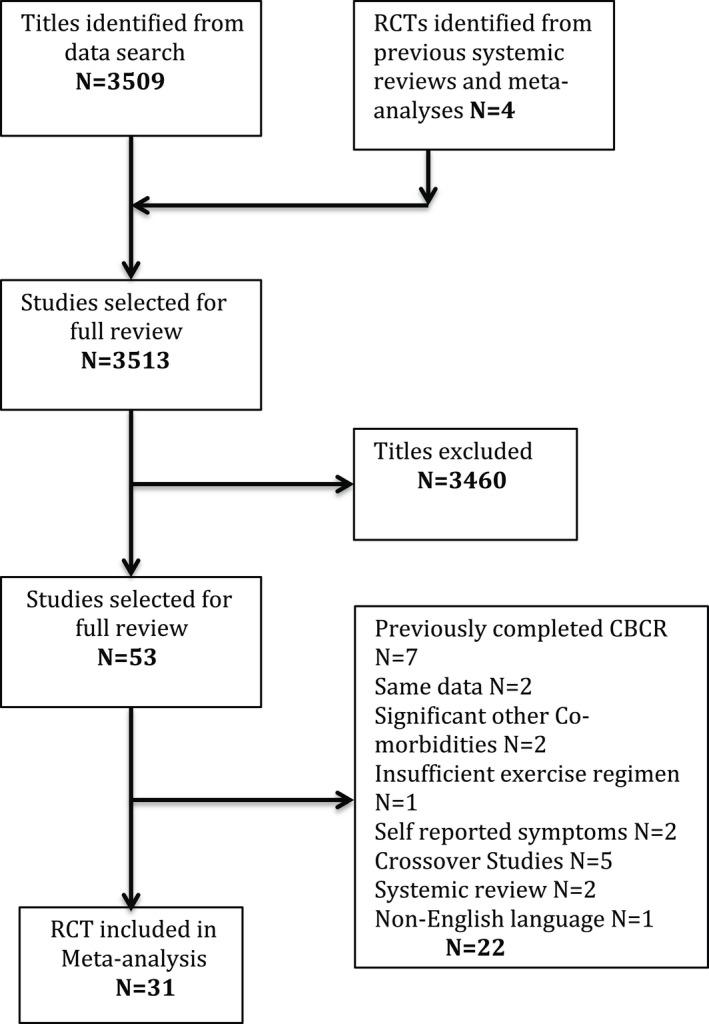
Background Center-based cardiac rehabilitation (CBCR) has been shown to improve outcomes in patients with heart failure (HF). Home-based cardiac rehabilitation (HBCR) can be an alternative to increase access for patients who cannot participate in CBCR. Hybrid cardiac rehabilitation (CR) combines short-term CBCR with HBCR, potentially allowing both flexibility and rigor. However, recent data comparing these initiatives have not been synthesized. Methods and Results We performed a meta-analysis to compare functional capacity and health-related quality of life (hr-QOL) outcomes in HF for (1) HBCR and usual care, (2) hybrid CR and usual care, and (3) HBCR and CBCR. A systematic search in 5 standard databases for randomized controlled trials was performed through January 31, 2019. Summary estimates were pooled using fixed- or random-effects (when I>50%) meta-analyses. Standardized mean differences (95% CI) were used for distinct hr-QOL tools. We identified 31 randomized controlled trials with a total of 1791 HF participants. Among 18 studies that compared HBCR and usual care, participants in HBCR had improvement of peak oxygen uptake (2.39 mL/kg per minute; 95% CI, 0.28-4.49) and hr-QOL (16 studies; standardized mean difference: 0.38; 95% CI, 0.19-0.57). Nine RCTs that compared hybrid CR with usual care showed that hybrid CR had greater improvements in peak oxygen uptake (9.72 mL/kg per minute; 95% CI, 5.12-14.33) but not in hr-QOL (2 studies; standardized mean difference: 0.67; 95% CI, -0.20 to 1.54). Five studies comparing HBCR with CBCR showed similar improvements in functional capacity (0.0 mL/kg per minute; 95% CI, -1.93 to 1.92) and hr-QOL (4 studies; standardized mean difference: 0.11; 95% CI, -0.12 to 0.34). Conclusions HBCR and hybrid CR significantly improved functional capacity, but only HBCR improved hr-QOL over usual care. However, both are potential alternatives for patients who are not suitable for CBCR.
背景
中心型心脏康复(CBCR)已被证明可改善心力衰竭(HF)患者的预后。家庭型心脏康复(HBCR)可以作为增加无法参加 CBCR 患者的参与度的替代方案。混合心脏康复(CR)将短期 CBCR 与 HBCR 相结合,具有灵活性和严格性。然而,最近比较这些方案的数据尚未综合。
方法和结果
我们进行了荟萃分析,以比较 HF 患者中(1)HBCR 和常规护理、(2)混合 CR 和常规护理以及(3)HBCR 和 CBCR 的功能能力和健康相关生活质量(hr-QOL)结果。通过 5 个标准数据库对截止到 2019 年 1 月 31 日的随机对照试验进行了系统检索。使用固定或随机效应(当 I>50%)荟萃分析汇总汇总估计值。使用标准化均数差(95%CI)来比较不同的 HR-QOL 工具。我们共纳入 31 项随机对照试验,共纳入 1791 名 HF 患者。在比较 HBCR 和常规护理的 18 项研究中,HBCR 组的峰值摄氧量(2.39 mL/kg/分钟;95%CI,0.28-4.49)和 HR-QOL(16 项研究;标准化均数差:0.38;95%CI,0.19-0.57)均有改善。9 项 RCT 比较混合 CR 和常规护理,结果显示混合 CR 在峰值摄氧量方面有更大的改善(9.72 mL/kg/分钟;95%CI,5.12-14.33),但 HR-QOL 无改善(2 项研究;标准化均数差:0.67;95%CI,-0.20 至 1.54)。5 项比较 HBCR 和 CBCR 的研究显示,功能能力(0.0 mL/kg/分钟;95%CI,-1.93 至 1.92)和 HR-QOL(4 项研究;标准化均数差:0.11;95%CI,-0.12 至 0.34)改善相似。
结论
HBCR 和混合 CR 显著改善了功能能力,但只有 HBCR 改善了常规护理之外的 HR-QOL。然而,对于不适合 CBCR 的患者,两者都是潜在的替代方案。



 Zotero 插件