
嵌合抗原受体工程 T(CAR-T)细胞和肿瘤特异性 T 细胞的生存时间延长是由抗程序性细胞死亡蛋白 1 单链可变片段产生的 CAR-T 细胞引起的。
Improved survival of chimeric antigen receptor-engineered T (CAR-T) and tumor-specific T cells caused by anti-programmed cell death protein 1 single-chain variable fragment-producing CAR-T cells.
机构信息
Department of Immunology, Yamaguchi University Graduate School of Medicine, Ube, Japan.
Department of Gastroenterological, Breast and Endocrine Surgery, Yamaguchi University Graduate School of Medicine, Ube, Japan.
出版信息
Cancer Sci. 2019 Oct;110(10):3079-3088. doi: 10.1111/cas.14169. Epub 2019 Sep 17.
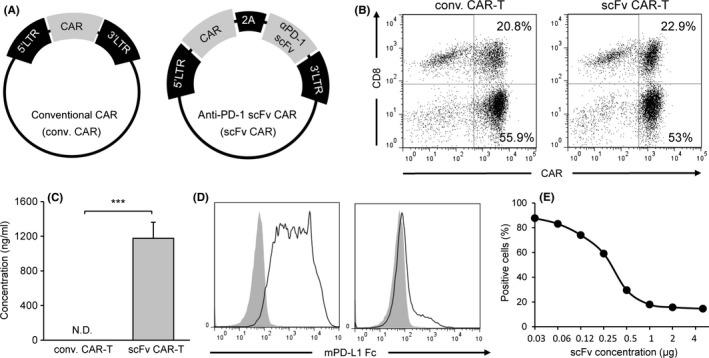
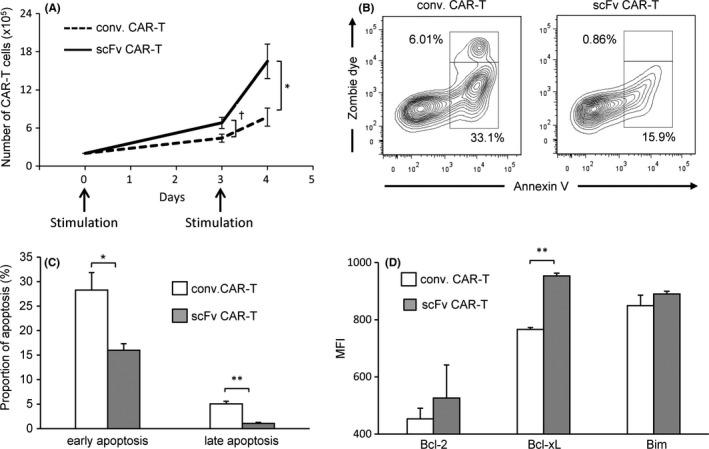
Chimeric antigen receptor-engineered T (CAR-T)-cell therapy holds significant promise for the treatment of hematological malignancies, especially for B-cell leukemia and lymphoma. However, its efficacy against non-hematological malignancies has been limited as a result of several biological problems characteristic of the tumor microenvironment of solid tumors. One of the main hurdles is the heterogeneous nature of tumor-associated antigens (TAA) expressed in solid tumors. Another hurdle is the inefficient activation and limited persistence of CAR-T cells, mainly as a result of T-cell exhaustion caused by immunosuppressive factors in the tumor microenvironment. In the present study, to address these problems, we engineered CAR-T cells to produce antagonistic anti-programmed cell death protein 1 (PD-1) single-chain variable fragment (scFv), by which PD-1-dependent inhibitory signals in CAR-T cells and adjacent tumor-specific non-CAR-T cells are attenuated. In mouse solid tumor models, PD-1 scFv-producing CAR-T cells induced potent therapeutic effects superior to those of conventional CAR-T cells, along with a significant reduction of apoptotic cell death not only in CAR-T cells themselves but also in TAA-specific T cells in the tumor tissue. In addition, the treatment with anti-PD-1 scFv-producing CAR-T cells resulted in an increased concentration of PD-1 scFv in tumor tissue but not in sera, suggesting an induction of less severe systemic immune-related adverse events. Hence, the present study developed anti-PD-1 scFv-producing CAR-T cell technology and explored its cellular mechanisms underlying potent antitumor efficacy.
嵌合抗原受体工程 T(CAR-T)细胞疗法在治疗血液恶性肿瘤方面具有巨大的潜力,特别是对于 B 细胞白血病和淋巴瘤。然而,由于实体瘤肿瘤微环境所具有的几个生物学问题,其对非血液恶性肿瘤的疗效受到限制。其中一个主要障碍是实体瘤中表达的肿瘤相关抗原(TAA)的异质性。另一个障碍是 CAR-T 细胞的激活效率低下和持续时间有限,主要是由于肿瘤微环境中的免疫抑制因子导致 T 细胞耗竭。在本研究中,为了解决这些问题,我们通过工程化 CAR-T 细胞产生拮抗型抗程序性细胞死亡蛋白 1(PD-1)单链可变片段(scFv),从而减弱 CAR-T 细胞和相邻肿瘤特异性非 CAR-T 细胞中 PD-1 依赖性抑制信号。在小鼠实体瘤模型中,与传统的 CAR-T 细胞相比,产生 PD-1 scFv 的 CAR-T 细胞诱导出更强的治疗效果,不仅 CAR-T 细胞本身,而且肿瘤组织中 TAA 特异性 T 细胞的凋亡细胞死亡也显著减少。此外,用抗 PD-1 scFv 产生的 CAR-T 细胞治疗导致肿瘤组织中 PD-1 scFv 浓度增加,但血清中浓度没有增加,表明诱导的全身免疫相关不良事件不太严重。因此,本研究开发了抗 PD-1 scFv 产生的 CAR-T 细胞技术,并探讨了其潜在的强大抗肿瘤疗效的细胞机制。



 Zotero 插件