
剪接体的 RNA 成分调节组织和癌症特异性的可变剪接。
RNA components of the spliceosome regulate tissue- and cancer-specific alternative splicing.
机构信息
Computational Biology Program, Public Health Sciences Division, Fred Hutchinson Cancer Research Center, Seattle, Washington 98109, USA.
Basic Sciences Division, Fred Hutchinson Cancer Research Center, Seattle, Washington 98109, USA.
出版信息
Genome Res. 2019 Oct;29(10):1591-1604. doi: 10.1101/gr.246678.118. Epub 2019 Aug 21.
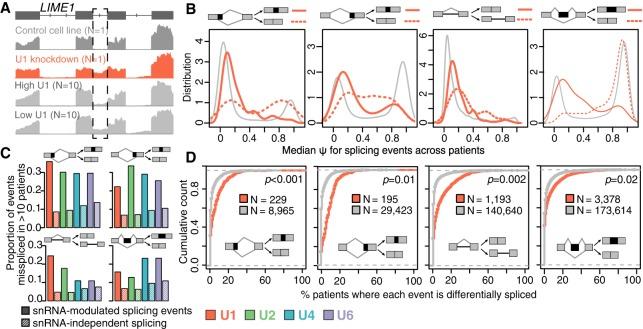
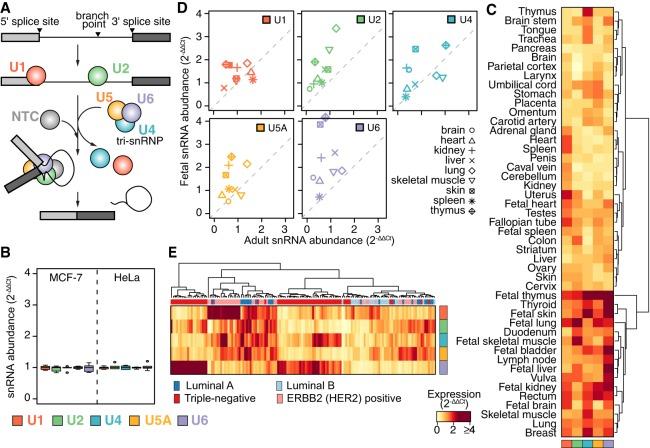
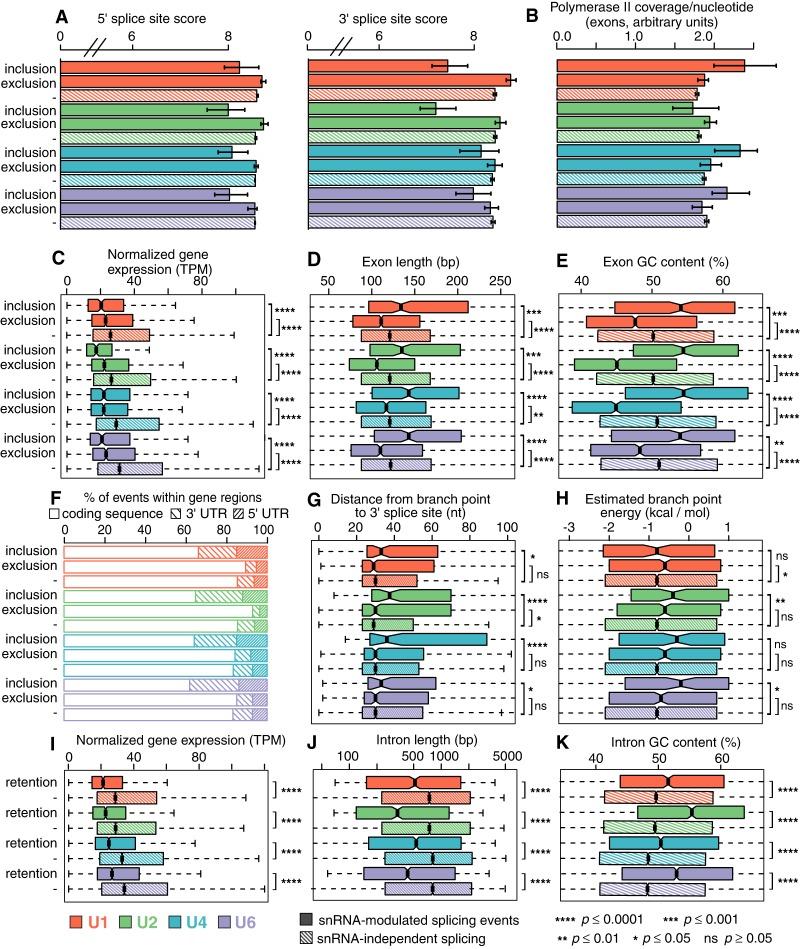
Alternative splicing of pre-mRNAs plays a pivotal role during the establishment and maintenance of human cell types. Characterizing the -acting regulatory proteins that control alternative splicing has therefore been the focus of much research. Recent work has established that even core protein components of the spliceosome, which are required for splicing to proceed, can nonetheless contribute to splicing regulation by modulating splice site choice. We here show that the RNA components of the spliceosome likewise influence alternative splicing decisions. Although these small nuclear RNAs (snRNAs), termed U1, U2, U4, U5, and U6 snRNA, are present in equal stoichiometry within the spliceosome, we found that their relative levels vary by an order of magnitude during development, across tissues, and across cancer samples. Physiologically relevant perturbation of individual snRNAs drove widespread gene-specific differences in alternative splicing but not transcriptome-wide splicing failure. Genes that were particularly sensitive to variations in snRNA abundance in a breast cancer cell line model were likewise preferentially misspliced within a clinically diverse cohort of invasive breast ductal carcinomas. As aberrant mRNA splicing is prevalent in many cancers, we propose that a full understanding of such dysregulated pre-mRNA processing requires study of snRNAs, as well as protein splicing factors. Together, our data show that the RNA components of the spliceosome are not merely basal factors, as has long been assumed. Instead, these noncoding RNAs constitute a previously uncharacterized layer of regulation of alternative splicing, and contribute to the establishment of global splicing programs in both healthy and malignant cells.
前体 mRNA 的可变剪接在人类细胞类型的建立和维持中起着关键作用。因此,鉴定控制可变剪接的顺式作用调控蛋白一直是许多研究的重点。最近的工作已经确定,即使是剪接体的核心蛋白成分(进行剪接所必需的),也可以通过调节剪接位点选择来参与剪接调控。我们在这里表明,剪接体的 RNA 成分同样会影响可变剪接决策。尽管这些小核 RNA(snRNA),称为 U1、U2、U4、U5 和 U6 snRNA,在剪接体中以等量存在,但我们发现它们的相对水平在发育过程中、在组织中以及在癌症样本中都有数量级的变化。对单个 snRNA 的生理相关扰动会导致广泛的基因特异性可变剪接差异,但不会导致转录组范围的剪接失败。在乳腺癌细胞系模型中,特别容易受到 snRNA 丰度变化影响的基因在临床多样化的浸润性乳腺癌导管癌队列中同样存在优先错配剪接。由于异常的 mRNA 剪接在许多癌症中很常见,我们提出,要全面了解这种失调的前体 mRNA 处理,需要研究 snRNA 以及蛋白质剪接因子。总的来说,我们的数据表明,剪接体的 RNA 成分不仅仅是如长期以来假设的那样是基本因子。相反,这些非编码 RNA 构成了可变剪接调控的一个以前未被描述的层次,并有助于在健康和恶性细胞中建立全局剪接程序。


 Zotero 插件