
莫桑比克马普托市居民对抗生素使用的知识、态度和实践。
Knowledge, attitudes and practices regarding antibiotic use in Maputo City, Mozambique.
机构信息
National Institute of Health, Ministry of Health, Maputo, Mozambique.
Community Health Department, Faculty of Medicine, Eduardo Mondlane University, Maputo, Mozambique.
出版信息
PLoS One. 2019 Aug 22;14(8):e0221452. doi: 10.1371/journal.pone.0221452. eCollection 2019.
BACKGROUND
Irrational use of antibiotics is a major driver of antimicrobial resistance (AMR) worldwide. Sub-Saharan Africa, where the risk of spread of AMR is highest, lacks data on the knowledge, attitudes and practices regarding antibiotic prescription and use. This is the first study in Mozambique to address this gap.
METHODS
A cross-sectional study was conducted in 2016 in 1091 adults (age ≥18 years) living in five districts in peri-urban areas of Maputo City. Three stage cluster sampling was used to select the households. A semi-structured questionnaire was used to collect information on the knowledge, attitudes and practices regarding antibiotics and their use and socio-demographic data.
RESULTS
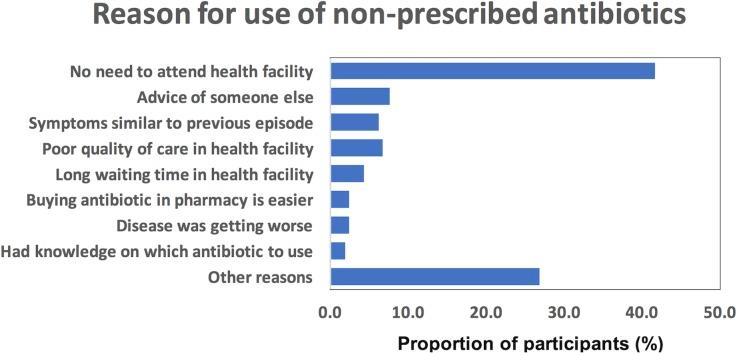
Of the 1091 participants, 20.9% (228/1091) had used non-prescribed antibiotics. Most of the non-prescribed antibiotics were purchased in pharmacies (199/228; 87.3%). The proportion of use of non-prescribed antibiotics was higher in those who purchased from informal markets (82.6%; 14/17) and home stores (66.7%; 12/18), compared to pharmacies (24.6%; 199/810) (p = 0.000). Variables significantly associated with use of non-prescribed antibiotics were male gender (p = 0.004), living in the Central A (p<0.001), Aeroporto B (p<0.001) or 25 de Junho (p<0.001) neighborhoods, purchase of antibiotics in informal markets (p<0.002) or obtaining from home stores (p = 0.026), not completing the course (p<0.001) and having poor knowledge on the use of antibiotics (p<0.001). Main reasons for use of non-prescribed antibiotics were a perception that there was no need to attend a health facility (26.8%), followed by someone else's advice (7.7%), symptoms similar to a previous episode (6.2%) and poor quality of care in health facilities (6.7%).
CONCLUSIONS
Our study shows for the first time that knowledge regarding antibiotics is poor in Maputo City. Purchase of non-prescribed antibiotics is a common practice and most are sold in pharmacies, indicating deficient inspection. Interventions to reinforce adherence by pharmacies to current legislation for dispensing antibiotics, combined with community education are urgently needed.
背景
抗生素的不合理使用是全球抗生素耐药性(AMR)的主要驱动因素。撒哈拉以南非洲地区 AMR 传播风险最高,但缺乏有关抗生素处方和使用方面的知识、态度和实践的数据。这是莫桑比克首次针对这一空白开展的研究。
方法
2016 年,在马普托市五个郊区地区的 1091 名成年人(年龄≥18 岁)中进行了一项横断面研究。采用三阶段聚类抽样选择家庭。使用半结构式问卷收集有关抗生素及其使用的知识、态度和实践以及社会人口学数据。
结果
在 1091 名参与者中,20.9%(228/1091)使用了未经处方的抗生素。未经处方的抗生素大多是在药房购买的(199/228;87.3%)。与在药房购买相比,从非正规市场(82.6%;14/17)和家庭商店(66.7%;12/18)购买非处方抗生素的比例更高(24.6%;199/810)(p=0.000)。与使用非处方抗生素相关的变量有男性(p=0.004)、居住在中央 A(p<0.001)、Aeroporto B(p<0.001)或 25 de Junho(p<0.001)社区、在非正规市场购买抗生素(p<0.002)或从家庭商店获得(p=0.026)、未完成疗程(p<0.001)和对抗生素使用的知识较差(p<0.001)。使用非处方抗生素的主要原因是认为没有必要去医疗机构就诊(26.8%),其次是他人的建议(7.7%)、症状与以前的发作相似(6.2%)和医疗机构的医疗质量差(6.7%)。
结论
我们的研究首次表明,马普托市对抗生素的知识很差。购买非处方抗生素是一种常见做法,而且大多数都是在药房销售的,这表明监管不力。迫切需要采取措施,加强药房遵守现行抗生素配药法规的力度,并开展社区教育。
 Zotero 插件