
细胞聚类促进支持转移定植的代谢转换。
Cell Clustering Promotes a Metabolic Switch that Supports Metastatic Colonization.
机构信息
The Francis Crick Institute, 1 Midland Road, London NW1 1AT, UK.
The Francis Crick Institute, 1 Midland Road, London NW1 1AT, UK.
出版信息
Cell Metab. 2019 Oct 1;30(4):720-734.e5. doi: 10.1016/j.cmet.2019.07.014. Epub 2019 Aug 22.
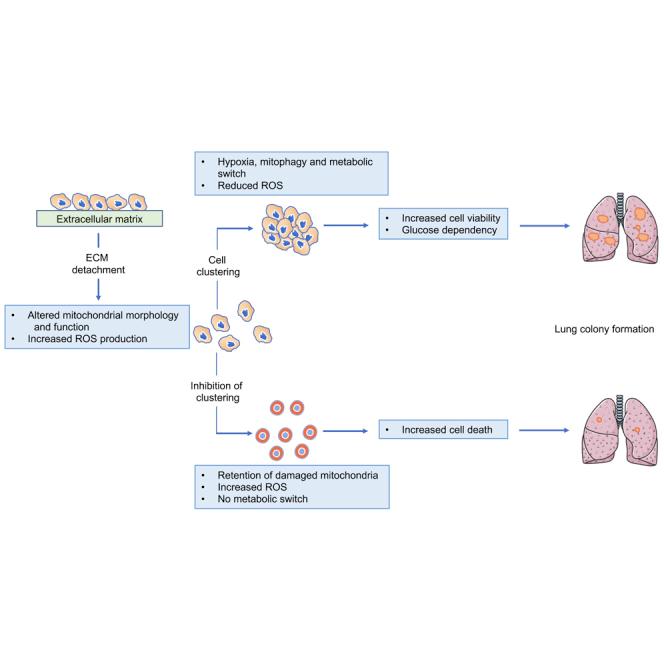
Cancer metastasis depends on cell survival following loss of extracellular matrix attachment and dissemination through the circulation. The metastatic spread can be enhanced by the clustering of detached cancer cells and increased antioxidant defense. Here, we link these responses by describing how cell clustering limits reactive oxygen species (ROS). Loss of attachment causes mitochondrial perturbations and increased ROS production. The formation of cell clusters induces a hypoxic environment that drives hypoxia-inducible factor 1-alpha (Hif1α)-mediated mitophagy, clearing damaged mitochondria and limiting ROS. However, hypoxia and reduced mitochondrial capacity promote dependence on glycolysis for ATP production that is supported by cytosolic reductive metabolism. Preventing this metabolic adaptation or disruption of cell clusters results in ROS accumulation, cell death, and a reduction of metastatic capacity in vivo. Our results provide a mechanistic explanation for the role of cell clustering in supporting survival during extracellular matrix detachment and metastatic spread and may point to targetable vulnerabilities.
癌症转移取决于细胞在失去细胞外基质附着后的存活以及通过循环系统的扩散。分离的癌细胞的聚集和抗氧化防御的增加可以增强转移的扩散。在这里,我们通过描述细胞聚集如何限制活性氧(ROS)来将这些反应联系起来。失去附着会导致线粒体扰动和增加 ROS 的产生。细胞簇的形成诱导缺氧环境,从而驱动缺氧诱导因子 1-α(Hif1α)介导的线粒体自噬,清除受损的线粒体并限制 ROS。然而,缺氧和减少的线粒体能力促进了对糖酵解产生 ATP 的依赖,这种依赖由细胞质还原代谢提供支持。防止这种代谢适应或细胞簇的破坏会导致 ROS 积累、细胞死亡,并降低体内的转移能力。我们的研究结果为细胞聚集在支持细胞外基质脱落和转移扩散过程中的存活中所起的作用提供了一种机制解释,并可能指出了可靶向的弱点。



 Zotero 插件