
电纺支架限制了气道上皮的再生潜力。
Electrospun scaffolds limit the regenerative potential of the airway epithelium.
作者信息
Schwartz Cynthia M, Stack Jacob, Hill Cynthia L, Lallier Scott W, Chiang Tendy, Johnson Jed, Reynolds Susan D
机构信息
College of Medicine The Ohio State University Columbus Ohio U.S.A.
Center for Perinatal Research Nationwide Children's Hospital Columbus Ohio U.S.A.
出版信息
Laryngoscope Investig Otolaryngol. 2019 Jul 16;4(4):446-454. doi: 10.1002/lio2.289. eCollection 2019 Aug.
OBJECTIVE
Significant morbidity and mortality are associated with clinical use of synthetic tissue-engineered tracheal grafts (TETG). Our previous work focused on an electrospun polyethylene terephthalate and polyurethane (PET/PU) TETG that was tested in sheep using a long-segment tracheal defect model. We reported that graft stenosis and limited epithelialization contributed to graft failure. The present study determined if the epithelialization defect could be attributed to: 1) postsurgical depletion of native airway basal stem/progenitor cells; 2) an inability of the PET/PU-TETG to support epithelial migration; or 3) compromised basal stem/progenitor cell proliferation within the PET/PU environment.
STUDY DESIGN
Experimental.
METHODS
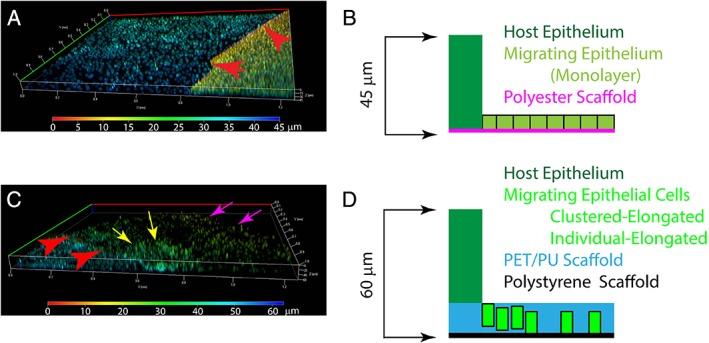
Basal stem/progenitor cell frequency in sheep that underwent TETG implantation was determined using the clone-forming cell frequency (CFCF) method. A novel migration model that mimics epithelial migration toward an acellular scaffold was developed and used to compare epithelial migration toward a control polyester scaffold and the PET/PU scaffold. Basal stem/progenitor cell proliferation within the PET/PU scaffold was evaluated using the CFCF assay, doubling-time analysis, and mitotic cell quantification.
RESULTS
We report that TETG implantation did not decrease basal stem/progenitor cell frequency. In contrast, we find that epithelial migration toward the PET/PU scaffold was significantly less extensive than migration toward a polyester scaffold and that the PET/PU scaffold did not support basal stem/progenitor cell proliferation.
CONCLUSIONS
We conclude that epithelialization of a PET/PU scaffold is compromised by poor migration of native tissue-derived epithelial cells and by a lack of basal stem/progenitor cell proliferation within the scaffold.
LEVEL OF EVIDENCE
NA.
目的
合成组织工程气管移植物(TETG)的临床应用伴随着显著的发病率和死亡率。我们之前的工作聚焦于一种电纺聚对苯二甲酸乙二酯和聚氨酯(PET/PU)TETG,其在绵羊的长节段气管缺损模型中进行了测试。我们报告称移植物狭窄和有限的上皮化导致了移植物失败。本研究确定上皮化缺陷是否可归因于:1)手术后备气管基底干/祖细胞的消耗;2)PET/PU-TETG无法支持上皮迁移;或3)PET/PU环境中基底干/祖细胞增殖受损。
研究设计
实验性研究。
方法
采用克隆形成细胞频率(CFCF)法测定接受TETG植入的绵羊中基底干/祖细胞频率。开发了一种模拟上皮细胞向无细胞支架迁移的新型迁移模型,并用于比较上皮细胞向对照聚酯支架和PET/PU支架的迁移情况。使用CFCF测定、倍增时间分析和有丝分裂细胞定量评估PET/PU支架内基底干/祖细胞的增殖情况。
结果
我们报告TETG植入并未降低基底干/祖细胞频率。相反,我们发现上皮细胞向PET/PU支架的迁移明显不如向聚酯支架的迁移广泛,并且PET/PU支架不支持基底干/祖细胞增殖。
结论
我们得出结论,PET/PU支架的上皮化受到天然组织来源上皮细胞迁移不良以及支架内基底干/祖细胞增殖缺乏的影响。
证据水平
无。


 Zotero 插件