
精准公共卫生:通过个体异质性和判别准确性的多层次分析(MAIHDA)对瑞典药店阿片类药物配给的社会经济差异进行映射。
Precision public health: Mapping socioeconomic disparities in opioid dispensations at Swedish pharmacies by Multilevel Analysis of Individual Heterogeneity and Discriminatory Accuracy (MAIHDA).
机构信息
Unit for Social Epidemiology, Faculty of Medicine, Lund University, Malmö, Sweden.
Department of Gender Studies, Faculty of Social Sciences, Lund University, Lund, Sweden.
出版信息
PLoS One. 2019 Aug 27;14(8):e0220322. doi: 10.1371/journal.pone.0220322. eCollection 2019.
BACKGROUND
In light of the opioid epidemic in the United States, there is growing concern about the use of opioids in Sweden as it may lead to misuse and overuse and, in turn, severe public health problems. However, little is known about the distribution of opioid use across different demographic and socioeconomic dimensions in the Swedish general population. Therefore, we applied an intersectional Multilevel Analysis of Individual Heterogeneity and Discriminatory Accuracy (MAIHDA), to obtain an improved mapping of the risk heterogeneity of and socioeconomic inequalities in opioid prescription receipt.
METHODS AND FINDINGS
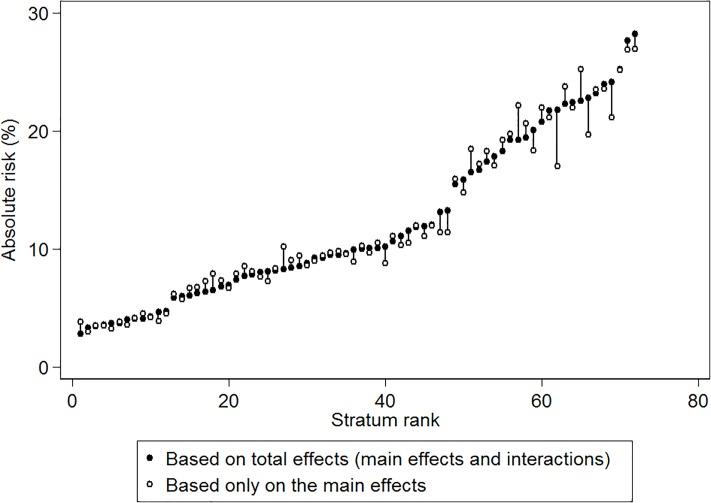
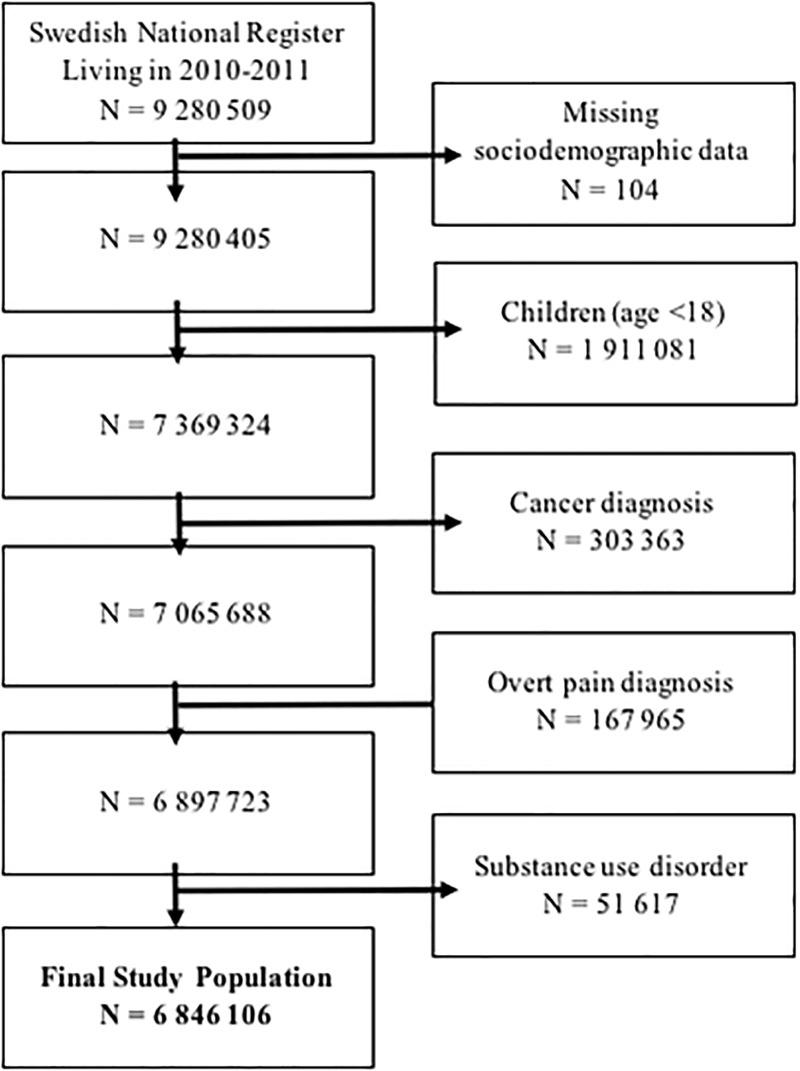
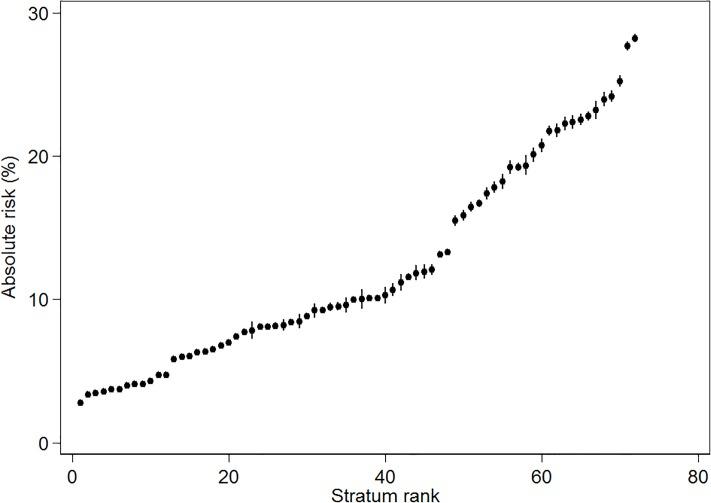
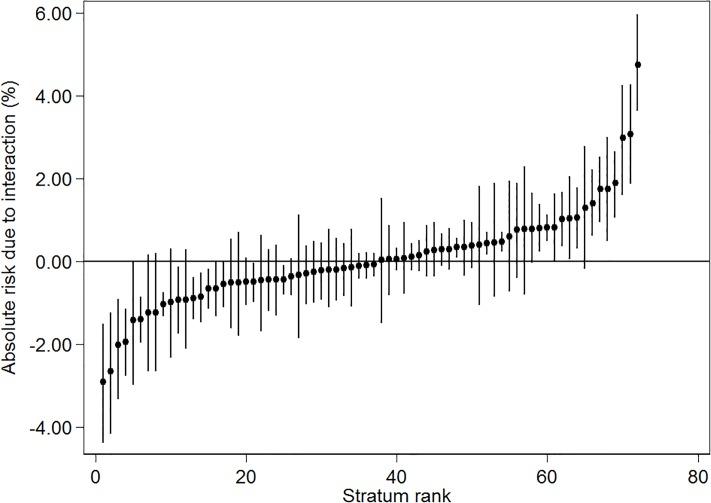
Using data from 6,846,106 residents in Sweden aged 18 and above, we constructed 72 intersectional strata from combinations of gender, age, income, cohabitation status, and presence or absence of psychological distress. We modelled the absolute risk (AR) of opioid prescription receipt in a series of multilevel logistic regression models distinguishing between additive and interaction effects. By means of the Variance Partitioning Coefficient (VPC) and the area under the receiver operating characteristic curve (AUC), we quantified the discriminatory accuracy (DA) of the intersectional strata for discerning those who received opioid prescriptions from those who did not. The AR of opioid prescription receipt ranged from 2.77% (95% CI 2.69-2.86) among low-income men aged 18-34, living alone, without psychological distress, to 28.25% (95% CI 27.95-28.56) among medium-income women aged 65 and older, living alone, with psychological distress. In a model that conflated both additive and interaction effects, the intersectional strata had a fair DA for discerning opioid users from non-users (VPC = 13.2%, AUC = 0.68). However, in the model that decomposed total effects into additive and interaction effects, the VPC was very low (0.42%) indicating the existence of small interaction effects for a number of the intersectional strata.
CONCLUSIONS
The intersectional MAIHDA approach aligns with the aims of precision public health, through improving the evidence base for health policy by increasing understanding of both health inequalities and individual heterogeneity. This approach is particularly relevant for socioeconomically conditioned outcomes such as opioid prescription receipt. We have identified intersections of social position within the Swedish population at greater risk for opioid prescription receipt.
背景
鉴于美国阿片类药物泛滥,人们越来越关注瑞典的阿片类药物使用情况,因为这可能导致药物滥用和过度使用,进而引发严重的公共卫生问题。然而,人们对于瑞典普通人群中不同人口统计学和社会经济维度的阿片类药物使用分布知之甚少。因此,我们应用交叉多水平个体异质性和判别准确性分析(MAIHDA),以更好地了解阿片类药物处方获得的风险异质性和社会经济不平等。
方法和发现
我们使用了瑞典年龄在 18 岁及以上的 6846106 名居民的数据,从性别、年龄、收入、同居状况以及是否存在心理困扰等因素的组合中构建了 72 个交叉层次。我们在一系列多水平逻辑回归模型中构建了阿片类药物处方接收的绝对风险(AR),区分了加性和交互效应。通过方差分割系数(VPC)和接收者操作特征曲线下面积(AUC),我们量化了交叉层区分接受阿片类药物处方和未接受阿片类药物处方的人群的判别准确性(DA)。阿片类药物处方接受率的范围从低收入男性(18-34 岁,独居,无心理困扰)的 2.77%(95%CI 2.69-2.86)到中收入女性(65 岁及以上,独居,有心理困扰)的 28.25%(95%CI 27.95-28.56)。在一个融合了加性和交互效应的模型中,交叉层对于区分阿片类药物使用者和非使用者具有良好的 DA(VPC=13.2%,AUC=0.68)。然而,在将总效应分解为加性和交互效应的模型中,VPC 非常低(0.42%),表明对于一些交叉层存在小的交互效应。
结论
交叉多水平个体异质性和判别准确性分析方法符合精准公共卫生的目标,通过增加对健康不平等和个体异质性的理解,为卫生政策提供了更好的证据基础。这种方法对于社会经济条件决定的结果(如阿片类药物处方获得)特别相关。我们已经确定了瑞典人群中处于更高风险的社会地位的交叉点,这些人更容易获得阿片类药物处方。

 Zotero 插件