
短期力量和平衡训练不会提高生活质量,但会改善糖尿病周围神经病变患者的功能状态:一项随机对照试验。
Short-term strength and balance training does not improve quality of life but improves functional status in individuals with diabetic peripheral neuropathy: a randomised controlled trial.
机构信息
Saw Swee Hock School of Public Health, National University of Singapore and National University Health System, Tahir Foundation Building (MD1), 12 Science Drive 2, Singapore, 117549, Republic of Singapore.
Department of Medicine, Yong Loo Lin School of Medicine, National University of Singapore and National University Health System, Singapore, Republic of Singapore.
出版信息
Diabetologia. 2019 Dec;62(12):2200-2210. doi: 10.1007/s00125-019-04979-7. Epub 2019 Aug 29.
AIMS/HYPOTHESIS: The aim of this study was to test the effectiveness of a structured strength and balance training intervention in improving health-related quality of life (HRQoL) and functional status in individuals with diabetic peripheral neuropathy (DPN).
METHODS
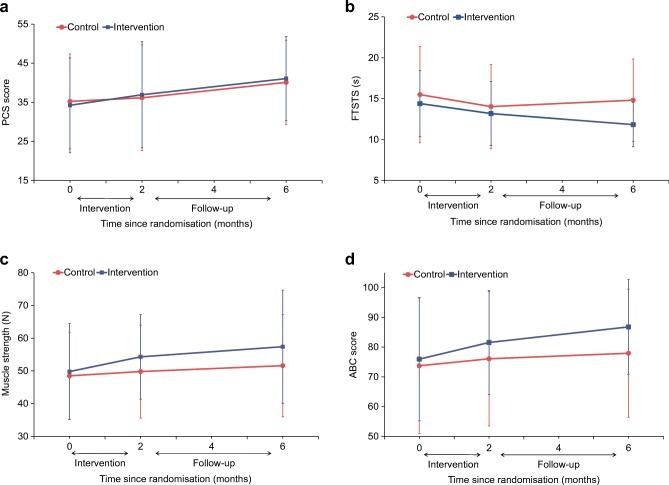
The study was a single-blind parallel-group randomised controlled trial comparing 2 months of once-weekly home-based strength and balance training against standard medical therapy. Participants were patients with physician-diagnosed type 2 diabetes and neuropathy recruited from five public sector institutions in Singapore between July 2014 and October 2017. Participants were block-randomised to intervention or control arms. Outcomes were assessed at baseline, 2 months and 6 months by a trained assessor blinded to group assignment. Primary outcomes were change in physical component summary (PCS) score of SF-36v2 (a 36-item generic HRQoL instrument that has been validated for use in Singapore) and EQ-5D-5L index score (derived from a five-item generic HRQoL instrument [EQ-5D-5L]) over 6 months. Secondary outcomes were change in functional status (timed up-and-go [TUG], five times sit-to-stand [FTSTS], functional reach, static balance, ankle muscle strength and knee range of motion) and balance confidence over 6 months. Mean differences in scores between groups were compared using mixed models.
RESULTS
Of the 143 participants randomised (intervention, n = 70; control, n = 73), 67 participants were included in each arm for the final intention-to-treat analysis. The two groups were similar, except in terms of sex. There were no significant differences between groups on the primary outcomes of PCS score (mean difference [MD] 1.56 [95% CI -1.75, 4.87]; p = 0.355) and EQ-5D-5L index score (MD 0.02 [95% CI -0.01, 0.06]; p = 0.175). There were significant improvements in TUG test performance (MD -1.14 [95% CI -2.18, -0.1] s; p = 0.032), FTSTS test performance (MD -1.31 [95% CI -2.12, -0.51] s; p = 0.001), ankle muscle strength (MD 4.18 [95% CI 0.4, 7.92] N; p = 0.031), knee range of motion (MD 6.82 [95% CI 2.87, 10.78]°; p = 0.001) and balance confidence score (MD 6.17 [95% CI 1.89, 10.44]; p = 0.005). No adverse events due to study participation or study intervention were reported.
CONCLUSIONS/INTERPRETATION: Short-term structured strength and balance training did not influence HRQoL but produced sustained improvements in functional status and balance confidence at 6 months. More intensive interventions may be needed to influence HRQoL in these individuals. However, this intervention may be a useful treatment option for individuals with DPN to reduce the risk of falls and injuries.
TRIAL REGISTRATION
ClinicalTrials.gov NCT02115932 FUNDING: This work was supported by the National Medical Research Council, Singapore.
目的/假设:本研究旨在测试结构化力量和平衡训练干预在改善糖尿病周围神经病变(DPN)患者的健康相关生活质量(HRQoL)和功能状态方面的有效性。
方法
这是一项单盲平行组随机对照试验,比较了 2 个月的每周一次家庭力量和平衡训练与标准医学治疗。参与者是 2014 年 7 月至 2017 年 10 月期间从新加坡五家公共部门机构招募的经医生诊断患有 2 型糖尿病和神经病的患者。参与者按块随机分配到干预组或对照组。由一名受过培训的评估员对参与者进行评估,评估员对组分配不知情。主要结局是在基线、2 个月和 6 个月时通过 SF-36v2 的身体成分综合评分(一种经过验证可用于新加坡的 36 项通用 HRQoL 工具)和 EQ-5D-5L 指数评分(源自五项目通用 HRQoL 工具[EQ-5D-5L])的变化。次要结局是在 6 个月时的功能状态(计时站立测试、五次坐站测试、功能性伸展、静态平衡、踝关节肌肉力量和膝关节活动度)和平衡信心的变化。使用混合模型比较组间评分的平均差异。
结果
在 143 名随机分配的参与者(干预组,n=70;对照组,n=73)中,每组有 67 名参与者纳入最终的意向治疗分析。两组相似,除了性别。两组在主要结局的 PCS 评分(MD 1.56 [95% CI -1.75, 4.87];p=0.355)和 EQ-5D-5L 指数评分(MD 0.02 [95% CI -0.01, 0.06];p=0.175)方面没有显著差异。TUG 测试表现(MD -1.14 [95% CI -2.18, -0.1] s;p=0.032)、FTSTS 测试表现(MD -1.31 [95% CI -2.12, -0.51] s;p=0.001)、踝关节肌肉力量(MD 4.18 [95% CI 0.4, 7.92] N;p=0.031)、膝关节活动度(MD 6.82 [95% CI 2.87, 10.78]°;p=0.001)和平衡信心评分(MD 6.17 [95% CI 1.89, 10.44];p=0.005)均有显著改善。没有报告因研究参与或研究干预而导致的不良事件。
结论/解释:短期的结构化力量和平衡训练并没有影响 HRQoL,但在 6 个月时产生了持续的功能状态和平衡信心的改善。可能需要更密集的干预措施来影响这些个体的 HRQoL。然而,这种干预可能是 DPN 患者降低跌倒和受伤风险的有用治疗选择。
试验注册
ClinicalTrials.gov NCT02115932 资金:这项工作得到了新加坡国家医学研究委员会的支持。
 Zotero 插件