
在不断进化的细菌种群中,毒素的产生会自发地受到局部细胞密度的调节。
Toxin production spontaneously becomes regulated by local cell density in evolving bacterial populations.
机构信息
Theoretical Biology, Department of Biology, Utrecht University, Utrecht, the Netherlands.
出版信息
PLoS Comput Biol. 2019 Aug 30;15(8):e1007333. doi: 10.1371/journal.pcbi.1007333. eCollection 2019 Aug.
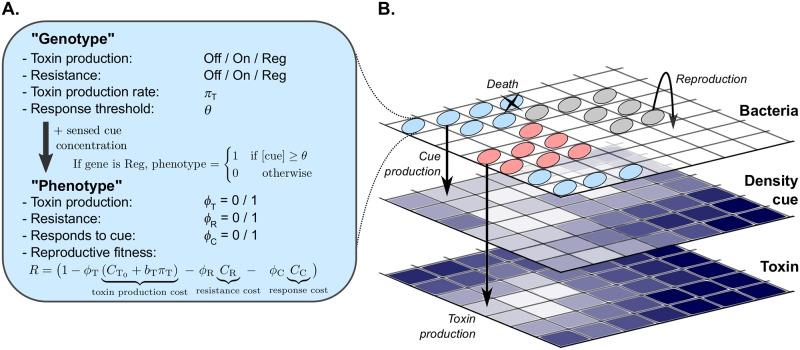
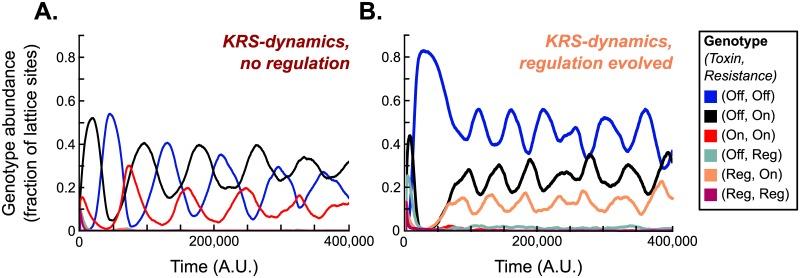
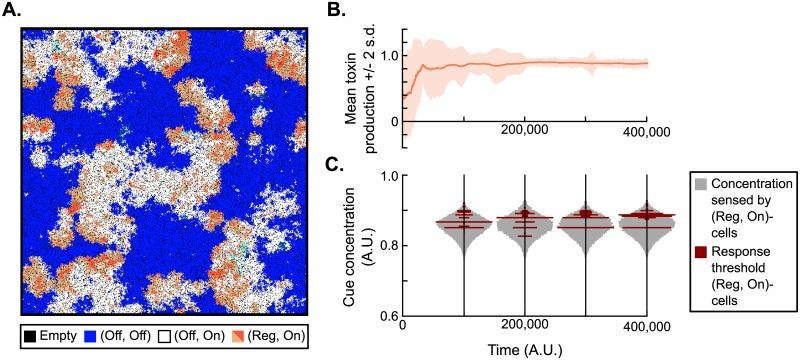
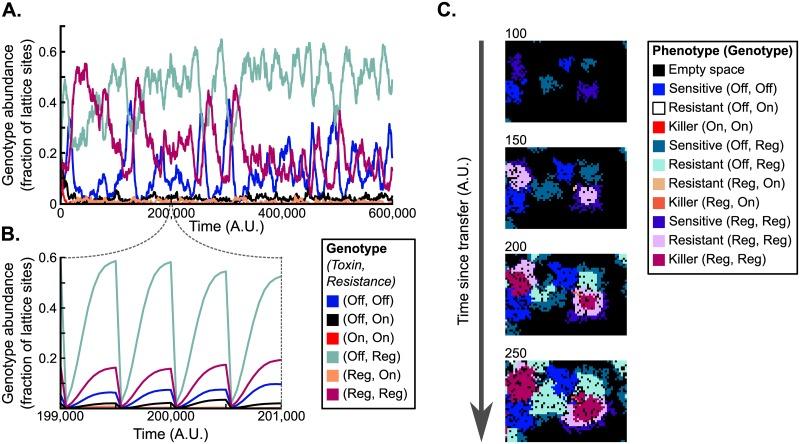
The production of anticompetitor toxins is widespread among bacteria. Because production of such toxins is costly, it is typically regulated. In particular, many toxins are produced only when the local cell density is high. It is unclear which selection pressures shaped the evolution of density-dependent regulation of toxin production. Here, we study the evolution of toxin production, resistance and the response to a cell-density cue in a model of an evolving bacterial population with spatial structure. We present results for two growth regimes: (i) an undisturbed, fixed habitat in which only small fluctuations of cell density occur, and (ii) a serial-transfer regime with large fluctuations in cell density. We find that density-dependent toxin production can evolve under both regimes. However, the selection pressures driving the evolution of regulation differ. In the fixed habitat, regulation evolves because it allows cells to produce toxin only when opportunities for reproduction are highly limited (because of a high local cell density), and the effective fitness costs of toxin production are hence low. Under serial transfers, regulation evolves because it allows cells to switch from a fast-growing non-toxic phenotype when colonising a new habitat, to a slower-growing competitive toxic phenotype when the cell density increases. Colonies of such regulating cells rapidly expand into unoccupied space because their edges consist of fast-growing, non-toxin-producing cells, but are also combative because cells at the interfaces with competing colonies do produce toxin. Because under the two growth regimes different types of regulation evolve, our results underscore the importance of growth conditions in the evolution of social behaviour in bacteria.
抗菌毒素的产生在细菌中广泛存在。由于产生这些毒素的成本很高,因此通常会受到调节。特别是,许多毒素仅在局部细胞密度高时才会产生。目前尚不清楚哪些选择压力塑造了与细胞密度相关的毒素产生调节的进化。在这里,我们在具有空间结构的进化细菌种群模型中研究了毒素产生、抗性以及对细胞密度信号的反应的进化。我们为两种生长模式提供了结果:(i)未受干扰的固定栖息地,其中仅发生细胞密度的小波动,以及(ii)具有细胞密度大波动的连续转移模式。我们发现,在这两种模式下都可以进化出依赖于密度的毒素产生。然而,驱动调节进化的选择压力是不同的。在固定栖息地中,调节进化是因为它仅允许细胞在繁殖机会受到高度限制时(由于局部细胞密度高)产生毒素,并且因此毒素产生的有效适应成本较低。在连续转移中,调节进化是因为它允许细胞在殖民新栖息地时从快速生长的非毒性表型转变为当细胞密度增加时,生长较慢的竞争性毒性表型。这种调节细胞的菌落迅速扩展到未占用的空间,因为其边缘由快速生长、非产毒细胞组成,但由于与竞争菌落的界面处的细胞确实产生毒素,因此它们也具有攻击性。由于在两种生长模式下会进化出不同类型的调节,因此我们的结果强调了生长条件在细菌社会行为进化中的重要性。


 Zotero 插件