
基于靶向 NGS 检测的肿瘤突变负荷可预测非小细胞肺癌免疫检查点抑制剂的临床获益。
Tumor mutational burden assessed by targeted NGS predicts clinical benefit from immune checkpoint inhibitors in non-small cell lung cancer.
机构信息
Department of Medical Genetics and Pathology, University Hospital Basel, Basel, Switzerland.
Laboratory of Cancer Immunology, Department of Biomedicine, University Hospital Basel, Basel, Switzerland.
出版信息
J Pathol. 2020 Jan;250(1):19-29. doi: 10.1002/path.5344. Epub 2019 Oct 24.
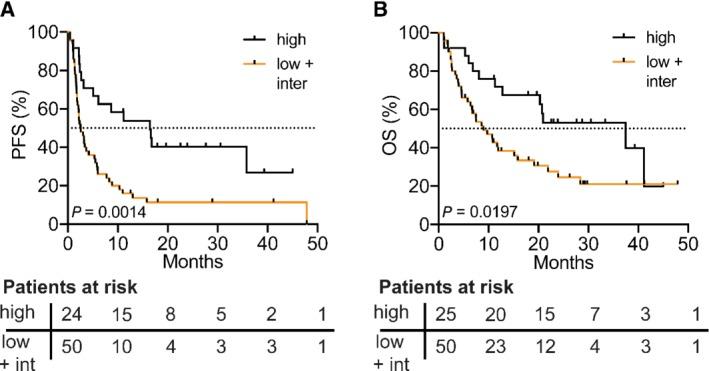
In non-small cell lung cancer (NSCLC), immune checkpoint inhibitors (ICIs) significantly improve overall survival (OS). Tumor mutational burden (TMB) has emerged as a predictive biomarker for patients treated with ICIs. Here, we evaluated the predictive power of TMB measured by the Oncomine™ Tumor Mutational Load targeted sequencing assay in 76 NSCLC patients treated with ICIs. TMB was assessed retrospectively in 76 NSCLC patients receiving ICI therapy. Clinical data (RECIST 1.1) were collected and patients were classified as having either durable clinical benefit (DCB) or no durable benefit (NDB). Additionally, genetic alterations and PD-L1 expression were assessed and compared with TMB and response rate. TMB was significantly higher in patients with DCB than in patients with NDB (median TMB = 8.5 versus 6.0 mutations/Mb, Mann-Whitney p = 0.0244). 64% of patients with high TMB (cut-off = third tertile, TMB ≥ 9) were responders (DCB) compared to 33% and 29% of patients with intermediate and low TMB, respectively (cut-off = second and first tertile, TMB = 5-9 and TMB ≤ 4, respectively). TMB-high patients showed significantly longer progression-free survival (PFS) and OS (log-rank test p = 0.0014 for PFS and 0.0197 for OS). While identifying different subgroups of patients, combining PD-L1 expression and TMB increased the predictive power (from AUC 0.63 to AUC 0.65). Our results show that the TML panel is an effective tool to stratify patients for ICI treatment. A combination of biomarkers might maximize the predictive precision for patient stratification. Our study supports TMB evaluation through targeted NGS in NSCLC patient samples as a tool to predict response to ICI therapy. We offer recommendations for a reliable and cost-effective assessment of TMB in a routine diagnostic setting. © 2019 The Authors. The Journal of Pathology published by John Wiley & Sons Ltd on behalf of Pathological Society of Great Britain and Ireland.
在非小细胞肺癌 (NSCLC) 中,免疫检查点抑制剂 (ICI) 显著改善了总生存期 (OS)。肿瘤突变负担 (TMB) 已成为接受 ICI 治疗的患者的预测生物标志物。在这里,我们评估了 76 例接受 ICI 治疗的 NSCLC 患者中使用 Oncomine™肿瘤突变负荷靶向测序检测测量的 TMB 的预测能力。在 76 例接受 ICI 治疗的 NSCLC 患者中回顾性评估 TMB。收集临床数据(RECIST 1.1),并将患者分为具有持久临床获益 (DCB) 或无持久获益 (NDB) 的患者。此外,还评估了遗传改变和 PD-L1 表达,并与 TMB 和反应率进行了比较。具有 DCB 的患者的 TMB 明显高于具有 NDB 的患者(中位数 TMB=8.5 与 6.0 突变/Mb,Mann-Whitney p=0.0244)。64%的高 TMB(截止值=第三三分位数,TMB≥9)患者为应答者(DCB),而中间和低 TMB(截止值=第二和第一三分位数,TMB=5-9 和 TMB≤4)患者的比例分别为 33%和 29%。TMB 高的患者的无进展生存期 (PFS) 和总生存期 (OS) 明显更长(PFS 的对数秩检验 p=0.0014,OS 的 p=0.0197)。虽然确定了不同的患者亚组,但结合 PD-L1 表达和 TMB 增加了预测能力(从 AUC 0.63 增加到 AUC 0.65)。我们的结果表明,TML 面板是一种有效工具,可用于对 ICI 治疗进行分层。生物标志物的组合可能最大限度地提高患者分层的预测精度。我们的研究支持通过靶向 NGS 对 NSCLC 患者样本进行 TMB 评估,作为预测 ICI 治疗反应的工具。我们为在常规诊断环境中可靠且具有成本效益的 TMB 评估提供了建议。2019 年,作者。病理学杂志由 John Wiley & Sons Ltd 代表英国和爱尔兰病理学学会出版。



 Zotero 插件