
肺清除指数检测赖氨酸氨曲南吸入在肺功能接近正常的囊性纤维化患者中的疗效:一项单中心可行性研究。
Lung clearance index to detect the efficacy of Aztreonam lysine inhalation in patients with cystic fibrosis and near normal spirometry - A single-centre feasibility study.
机构信息
Cystic Fibrosis (CF) Centre at the Medical University of Innsbruck, Innsbruck, Austria.
Clinical Research and Medical Scientific Writing, Schwerin, Germany.
出版信息
PLoS One. 2019 Sep 9;14(9):e0221673. doi: 10.1371/journal.pone.0221673. eCollection 2019.
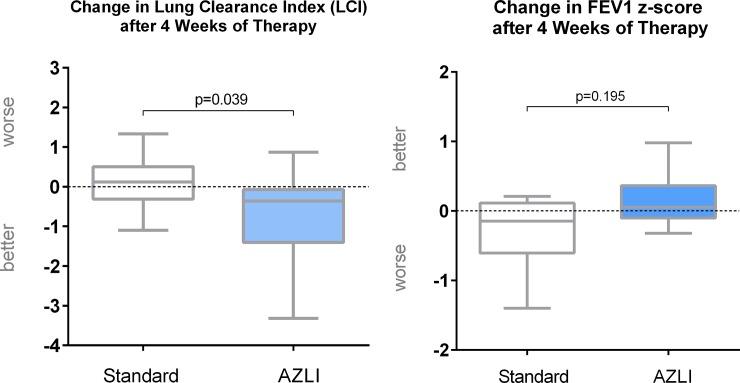
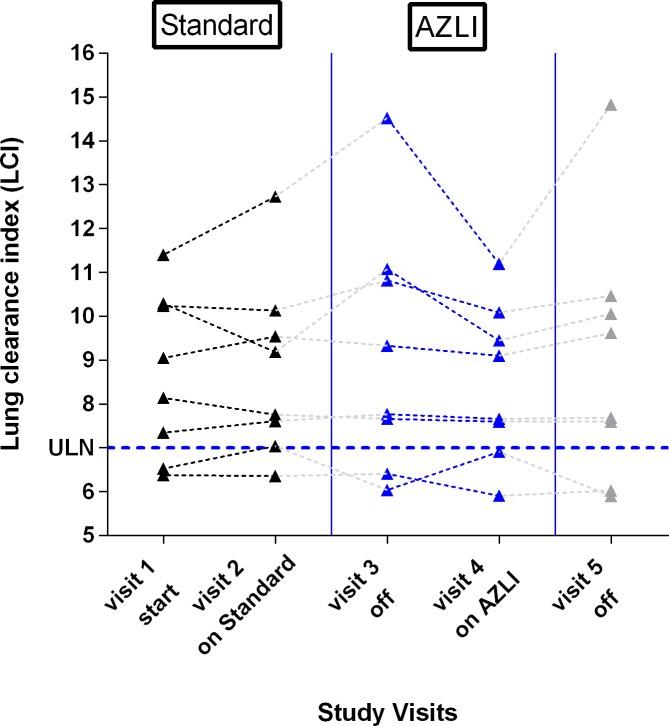
Comparing the efficacy of inhaled antibiotics can be difficult in small groups of patients with cystic fibrosis and mild lung disease. In a feasibility study we compared Aztreonam lysine for inhalation solution (AZLI; Cayston®) to standard inhaled antibiotic therapy in patients with cystic fibrosis and near normal spirometry. To detect treatment responses we used both lung clearance index (LCI) and forced expiratory volume in one second (FEV1). At baseline, median FEV1 was 87% pred. and median LCI was 8.6 (upper limit of normal: 7.0). After 4 weeks, LCI improved by -0.36 after AZLI and deteriorated by +0.12 after tobramycin treatment (p = 0.039). No significant differences between treatments (p = 0.195) were observed using FEV1. These results suggest that lung clearance index can be used to detect treatment induced changes in subjects with mild lung disease.
在患有囊性纤维化和轻度肺部疾病的小患者群体中,比较吸入性抗生素的疗效可能较为困难。在一项可行性研究中,我们比较了吸入用氨曲南溶液(AZLI;Cayston®)与标准吸入性抗生素治疗在囊性纤维化和接近正常肺功能的患者中的疗效。为了检测治疗反应,我们同时使用了肺清除指数(LCI)和一秒用力呼气量(FEV1)。基线时,中位 FEV1 为预计值的 87%,中位 LCI 为 8.6(正常值上限:7.0)。在 4 周后,AZLI 治疗后 LCI 改善了-0.36,妥布霉素治疗后恶化了+0.12(p = 0.039)。使用 FEV1 未观察到两种治疗方法之间存在显著差异(p = 0.195)。这些结果表明,肺清除指数可用于检测轻度肺部疾病患者治疗引起的变化。

 Zotero 插件