
采用二氟乙酸离子对试剂的高灵敏度 LC-MS 分析抗体药物偶联物。
High sensitivity LC-MS profiling of antibody-drug conjugates with difluoroacetic acid ion pairing.
机构信息
School of Science, University of Copenhagen , Frederiksberg , Denmark.
Chemistry Technology Center, Waters Corporation , Milford , MA , USA.
出版信息
MAbs. 2019 Nov-Dec;11(8):1358-1366. doi: 10.1080/19420862.2019.1658492. Epub 2019 Sep 10.
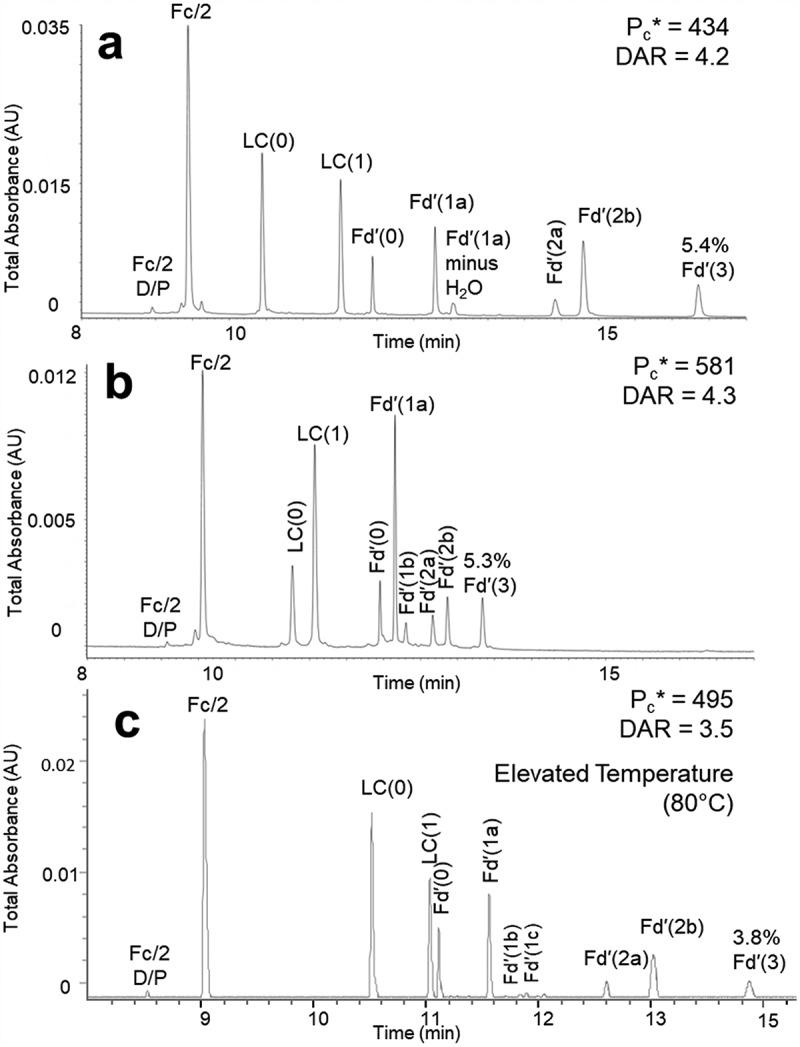
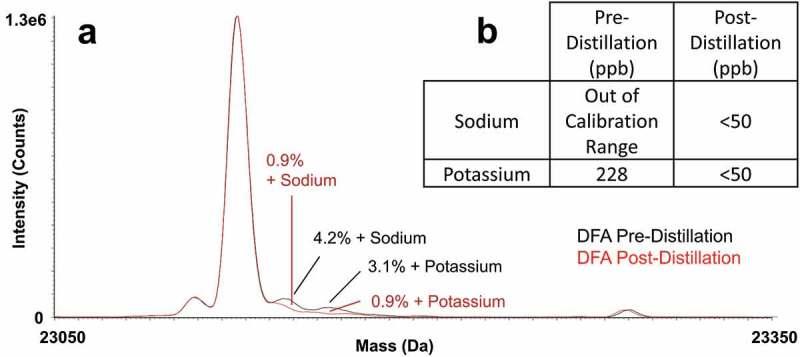
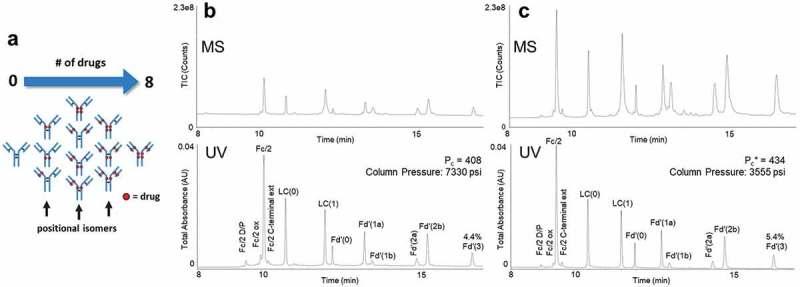
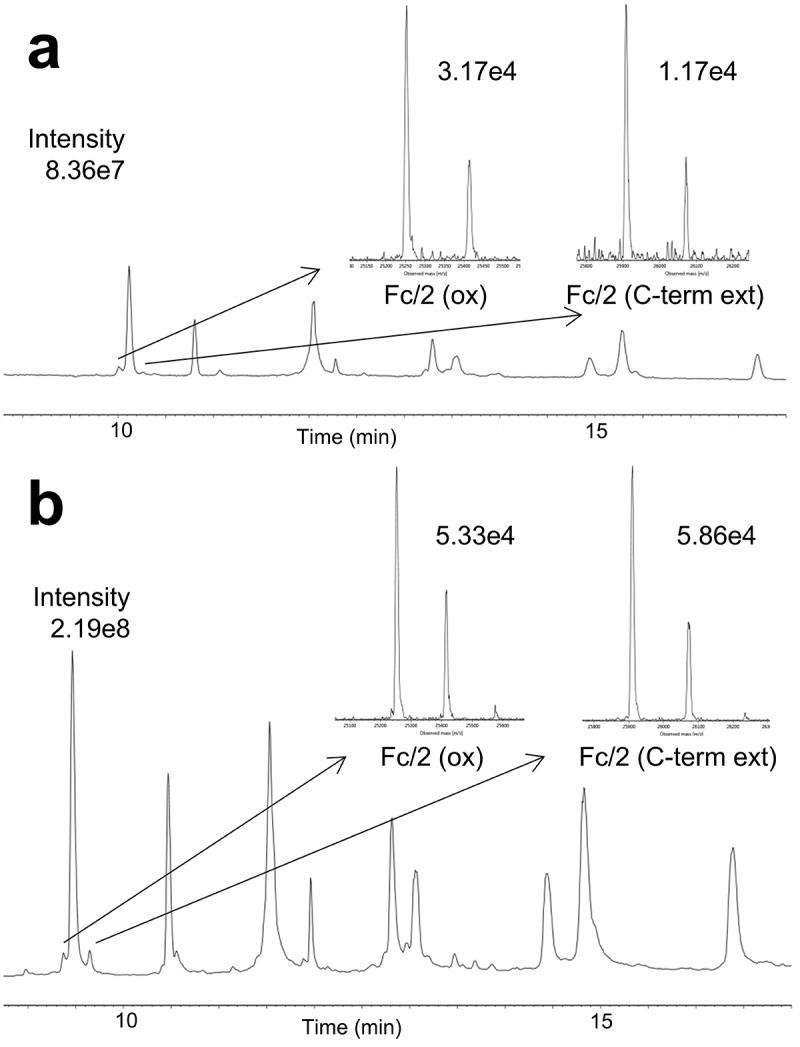
Reversed-phase liquid chromatography (RPLC) separations of proteins using optical detection generally use trifluoroacetic acid (TFA) because it is a strong, hydrophobic acid and a very effective ion-pairing agent for minimizing chromatographic secondary interactions. Conversely and in order to avoid ion suppression, analyses entailing mass spectrometry (MS) detection is often performed with a weaker ion-pairing modifier, like formic acid (FA), but resolution quality may be reduced. To gain both the chromatographic advantages of TFA and the enhanced MS sensitivity of FA, we explored the use of an alternative acid, difluoroacetic acid (DFA). This acid modifier is less acidic and less hydrophobic than TFA and is believed to advantageously affect the surface tension of electrospray droplets. Thus, it is possible to increase MS sensitivity threefold by replacing TFA with DFA. Moreover, we have observed DFA ion pairing to concomitantly produce higher chromatographic resolution than FA and even TFA. For this reason, we prepared and used MS-quality DFA in place of FA and TFA in separations involving IdeS digested, reduced NIST mAb and a proprietary antibody-drug conjugate (ADC), aiming to increase sensitivity, resolution and protein recovery. The resulting method using DFA was qualified and applied to two other ADCs and gave heightened sensitivity, resolution and protein recovery versus analyses using TFA. This new method, based on a purified, trace metal free DFA, can potentially become a state-of-the-art liquid chromatography-MS technique for the deep characterization of ADCs.
反相液相色谱(RPLC)分离蛋白质时,通常使用三氟乙酸(TFA)进行光学检测,因为它是一种强酸、疏水性酸,也是一种非常有效的离子对试剂,可最大限度地减少色谱二次相互作用。相反,为了避免离子抑制,涉及质谱(MS)检测的分析通常使用较弱的离子对试剂,如甲酸(FA),但分辨率质量可能会降低。为了获得 TFA 的色谱优势和 FA 的增强 MS 灵敏度,我们探索了使用替代酸,二氟乙酸(DFA)。这种酸改性剂的酸性和疏水性比 TFA 弱,据信有利于影响电喷雾液滴的表面张力。因此,用 DFA 代替 TFA 可以将 MS 灵敏度提高三倍。此外,我们观察到 DFA 离子对同时产生比 FA 甚至 TFA 更高的色谱分辨率。因此,我们在涉及 IdeS 消化、还原 NIST mAb 和专有抗体药物偶联物(ADC)的分离中制备并使用了 MS 质量的 DFA 代替 FA 和 TFA,旨在提高灵敏度、分辨率和蛋白质回收率。使用 DFA 的所得方法已获得资格并应用于另外两种 ADC,与使用 TFA 的分析相比,提高了灵敏度、分辨率和蛋白质回收率。这种基于纯化、痕量金属自由 DFA 的新方法,有可能成为 ADC 深度表征的最先进的液相色谱-MS 技术。

 Zotero 插件