
整合能否减少医疗服务利用中的不平等?来自中国的证据和障碍。
Can integration reduce inequity in healthcare utilization? Evidence and hurdles in China.
机构信息
Department of Social Medicine, School of Health Management, Harbin Medical University, 157 Baojian Road, Nangang District, Harbin, 150086, Heilongjiang, China.
Department of Health Management, School of Public Health, Nantong University, 9 Seyuan Road, Chongchuan District, Nantong, 226019, Jiangsu, China.
出版信息
BMC Health Serv Res. 2019 Sep 10;19(1):654. doi: 10.1186/s12913-019-4480-8.
BACKGROUND
Integration of medical insurance schemes has been prioritized as one of the key strategies to address inequity in China's health system. The first pilot attempt to integrate started in 2003 and later expanded nationwide. This study aims to assess its intended impact on inequity in inpatient service utilization and identify the main determinants contributing to its ineffectiveness.
METHODS
A total of 49,365 respondents in the pilot integrated area and 77,165 respondents in the non-integration area were extracted from the Fifth National Health Services Survey. A comparative analysis was conducted between two types of areas. We calculate a concentration index (CI) and horizontal inequity index (HI) in inpatient service utilization and decompose the two indices.
RESULTS
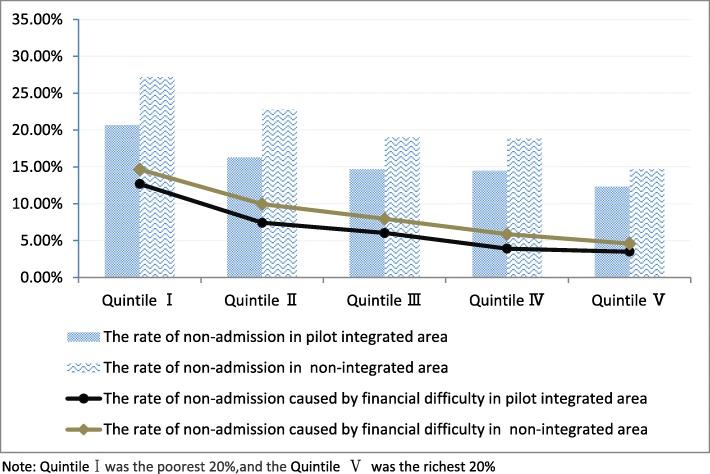
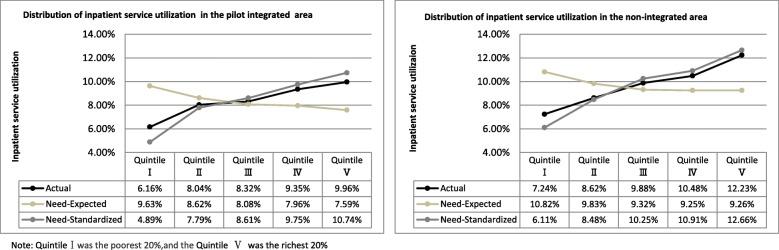
Insurance integration played a positive role in reducing inequality in inpatient service utilization to some extent. A 13.23% lower in HI, a decrease in unmet inpatient care and financial barriers to inpatient care in the pilot integrated area compared with the non-integration area; decomposition analysis showed that the Urban-Rural Residents Basic Medical Insurance, a type of integrated insurance, contributed 37.49% to reducing inequality in inpatient service utilization. However, it still could not offset the strong negative effect of income and other insurance schemes that have increased inequality.
CONCLUSIONS
The earlier pilot attempt for integrating medical insurance was not enough to counteract the influence of factors which increased the inequality in inpatient service utilization. Further efforts to address the inequality should focus on widening access to financing, upgrading the risk pool, reducing gaps within and between insurance schemes, and providing broader chronic disease benefit packages. Social policies that target the needs of the poor with coordinated efforts from various levels and agencies of the government are urgently needed.
背景
医疗保险制度整合已被优先作为解决中国卫生系统不公平问题的关键策略之一。2003 年首次尝试进行试点整合,随后在全国范围内推广。本研究旨在评估其对住院服务利用不公平的预期影响,并确定导致其无效的主要决定因素。
方法
从第五次国家卫生服务调查中提取了试点整合区的 49365 名受访者和非整合区的 77165 名受访者。对两种类型的地区进行了比较分析。我们计算了住院服务利用的集中指数(CI)和水平不公平指数(HI),并对这两个指数进行了分解。
结果
医疗保险整合在一定程度上对减少住院服务利用的不平等发挥了积极作用。与非整合区相比,试点整合区的 HI 降低了 13.23%,未满足的住院服务需求和住院服务财务障碍减少了;分解分析表明,城乡居民基本医疗保险(一种整合保险)对减少住院服务利用的不平等贡献了 37.49%。然而,它仍然无法抵消收入等增加不平等的其他保险计划的强烈负面影响。
结论
早期的医疗保险整合试点尝试还不足以抵消增加住院服务利用不平等的因素的影响。进一步解决不平等问题的努力应侧重于扩大筹资渠道、提高风险池、缩小保险计划内部和之间的差距,并提供更广泛的慢性病福利套餐。需要针对贫困人群的社会政策,由政府各级各部门协调努力。
 Zotero 插件