
危重症成年患者机械通气撤机实践的差异:一项国际前瞻性观察性研究的研究方案
Variation in the practice of discontinuing mechanical ventilation in critically ill adults: study protocol for an international prospective observational study.
作者信息
Burns Karen E A, Rizvi Leena, Cook Deborah J, Dodek Peter, Slutsky Arthur S, Jones Andrew, Villar Jesus, Kapadia Farhad N, Gattas David J, Epstein Scott K, Meade Maureen O
机构信息
Interdepartmental Division of Critical Care, University of Toronto, Toronto, Ontario, Canada
Division of Critical Care Medicine, Department of Medicine, St Michael's Hospital, Toronto, ON, Canada.
出版信息
BMJ Open. 2019 Sep 8;9(9):e031775. doi: 10.1136/bmjopen-2019-031775.
INTRODUCTION
Research supports the use of specific strategies to discontinue mechanical ventilation (MV) in critically ill patients. Little is known about how clinicians actually wean and discontinue MV in practice or the association between different discontinuation strategies and outcomes. The primary objective of this study is to describe international practices in the use of (1) daily screening for readiness to discontinue MV, (2) modes of MV used before initial discontinuation attempts, (3) weaning and spontaneous breathing trial (SBT) protocols, (4) SBT techniques and (5) sedation and mobilisation practices to facilitate weaning and discontinuation. The secondary objectives are to identify patient characteristics and time-dependent factors associated with use of selected strategies, investigate associations between SBT outcome (failure vs success) and outcomes, explore differences between patients who undergo an SBT early versus later in their intensive care unit (ICU) stay, and investigate the associations between different SBT techniques and humidification strategies on outcomes.
METHODS AND ANALYSIS
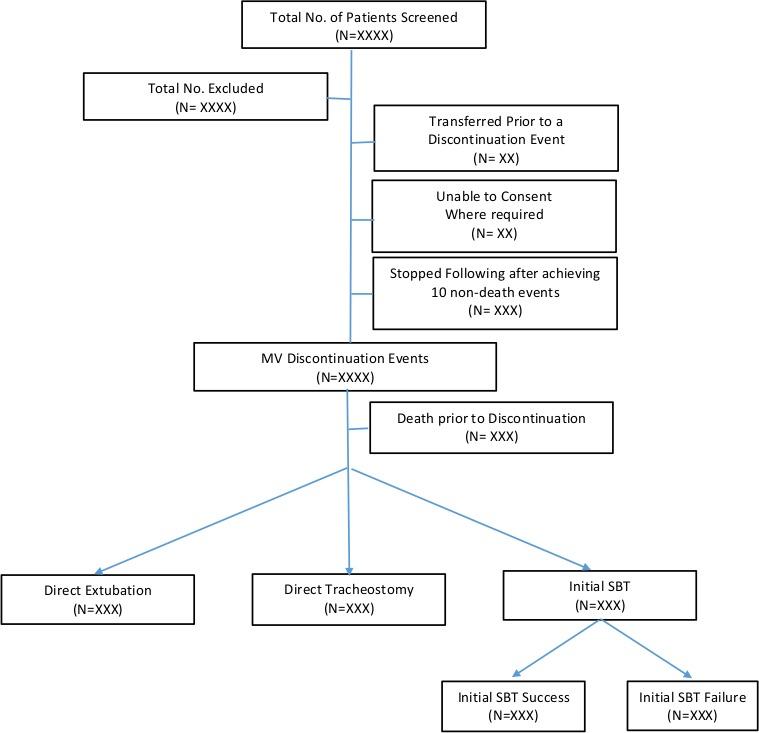
We will conduct an international, prospective, observational study of MV discontinuation practices among critically ill adults who receive invasive MV for at least 24 hours at approximately 150 ICUs in six geographic regions (Canada, USA, UK, Europe, India and Australia/New Zealand). Research personnel at participating ICUs will collect demographic data, data to characterise the initial strategy or event that facilitated discontinuation of MV (direct extubation, direct tracheostomy, initial successful SBT, initial failed SBT or death before any attempt could be made), clinical outcomes and site information. We aim to collect data on at least 10 non-death discontinuation events in each ICU (at least 1500 non-death discontinuation events).
ETHICS AND DISSEMINATION
This study received Research Ethics Approval from St. Michael's Hospital (11-024) Research ethics approval will be sought from all participating sites. The results will be disseminated through publications in peer-reviewed journals.
TRIAL REGISTRATION NUMBER
NCT03955874.
引言
研究支持采用特定策略来撤机(MV),用于危重症患者。关于临床医生在实际操作中如何撤机及停止MV,或者不同撤机策略与预后之间的关联,我们知之甚少。本研究的主要目的是描述在撤机时使用(1)每日进行撤机准备筛查,(2)首次撤机尝试前使用的MV模式,(3)撤机和自主呼吸试验(SBT)方案,(4)SBT技术,以及(5)镇静和活动方案以促进撤机和停止MV的国际实践。次要目的是确定与所选策略使用相关的患者特征和时间依赖性因素,研究SBT结果(失败与成功)与预后之间的关联,探讨在重症监护病房(ICU)住院早期与晚期接受SBT患者之间的差异,并研究不同SBT技术和湿化策略与预后之间的关联。
方法与分析
我们将在六个地理区域(加拿大、美国、英国、欧洲、印度和澳大利亚/新西兰)约150个ICU中,对接受有创MV至少24小时的成年危重症患者的MV撤机实践进行一项国际前瞻性观察研究。参与ICU的研究人员将收集人口统计学数据、用于描述促进MV撤机的初始策略或事件(直接拔管、直接气管切开术、首次成功的SBT、首次失败的SBT或在任何尝试之前死亡)的数据、临床结局和地点信息。我们的目标是在每个ICU收集至少10例非死亡撤机事件的数据(至少1500例非死亡撤机事件)。
伦理与传播
本研究已获得圣迈克尔医院的研究伦理批准(11 - 024),将向所有参与地点寻求研究伦理批准。研究结果将通过在同行评审期刊上发表进行传播。
试验注册号
NCT0
 Zotero 插件