
瞳孔测量法:心理学、生理学与功能
Pupillometry: Psychology, Physiology, and Function.
作者信息
Mathôt Sebastiaan
机构信息
Rijksuniversiteit Groningen, NL.
出版信息
J Cogn. 2018 Feb 21;1(1):16. doi: 10.5334/joc.18.
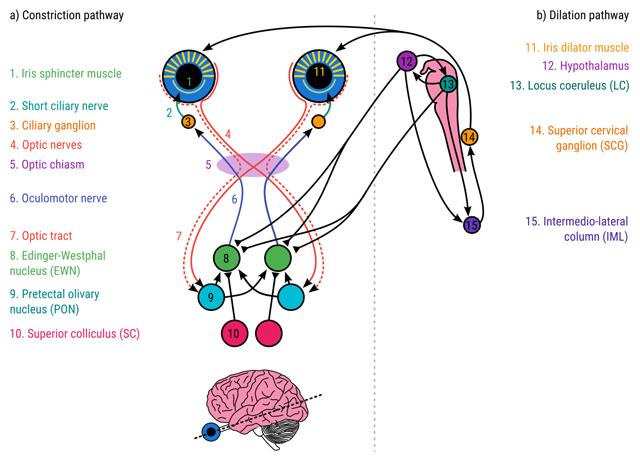
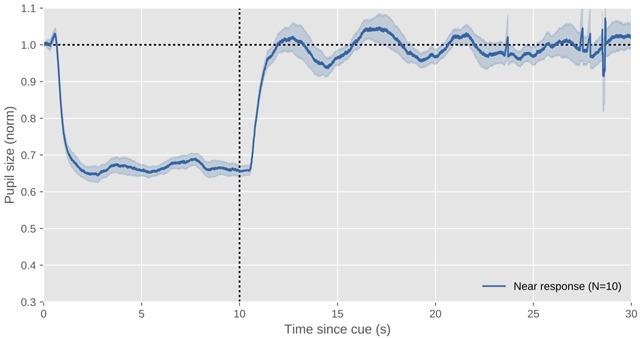
Pupils respond to three distinct kinds of stimuli: they constrict in response to brightness (the pupil light response), constrict in response to near fixation (the pupil near response), and dilate in response to increases in arousal and mental effort, either triggered by an external stimulus or spontaneously. In this review, I describe these three pupil responses, how they are related to high-level cognition, and the neural pathways that control them. I also discuss the functional relevance of pupil responses, that is, how pupil responses help us to better see the world. Although pupil responses likely serve many functions, not all of which are fully understood, one important function is to optimize vision either for acuity (small pupils see sharper) and depth of field (small pupils see sharply at a wider range of distances), or for sensitivity (large pupils are better able to detect faint stimuli); that is, pupils change their size to optimize vision for a particular situation. In many ways, pupil responses are similar to other eye movements, such as saccades and smooth pursuit: like these other eye movements, pupil responses have properties of both reflexive and voluntary action, and are part of active visual exploration.
瞳孔对三种不同类型的刺激做出反应
它们会因亮度(瞳孔对光反应)而收缩,因近距注视(瞳孔近反应)而收缩,以及因唤醒和脑力活动增加而扩张,这种增加由外部刺激引发或自发产生。在这篇综述中,我描述了这三种瞳孔反应、它们与高级认知的关系以及控制它们的神经通路。我还讨论了瞳孔反应的功能相关性,即瞳孔反应如何帮助我们更好地看清世界。尽管瞳孔反应可能具有多种功能,其中并非所有功能都被完全理解,但一个重要功能是为了优化视觉,要么提高敏锐度(小瞳孔看得更清晰)和景深(小瞳孔在更广泛的距离范围内看得清晰),要么提高敏感度(大瞳孔更能检测到微弱刺激);也就是说,瞳孔会改变其大小以针对特定情况优化视觉。在许多方面,瞳孔反应类似于其他眼球运动,如扫视和平滑跟踪:与这些其他眼球运动一样,瞳孔反应具有反射性和自主性动作的特性,并且是主动视觉探索的一部分。




 Zotero 插件