
基于英国生物库研究的全表型孟德尔随机化研究:遗传决定的维生素 D 对多种健康结局的影响。
Phenome-wide Mendelian-randomization study of genetically determined vitamin D on multiple health outcomes using the UK Biobank study.
机构信息
Centre for Global Health Research, Usher Institute of Population Health Sciences and Informatics, University of Edinburgh, Edinburgh, UK.
Colon Cancer Genetics Group and Academic Coloproctology, Institute of Genetics and Molecular Medicine, University of Edinburgh, and MRC Human Genetics Unit Western General Hospital Edinburgh, Edinburgh, UK.
出版信息
Int J Epidemiol. 2019 Oct 1;48(5):1425-1434. doi: 10.1093/ije/dyz182.
BACKGROUND
Vitamin D deficiency is highly prevalent across the globe. Existing studies suggest that a low vitamin D level is associated with more than 130 outcomes. Exploring the causal role of vitamin D in health outcomes could support or question vitamin D supplementation.
METHODS
We carried out a systematic literature review of previous Mendelian-randomization studies on vitamin D. We then implemented a Mendelian Randomization-Phenome Wide Association Study (MR-PheWAS) analysis on data from 339 256 individuals of White British origin from UK Biobank. We first ran a PheWAS analysis to test the associations between a 25(OH)D polygenic risk score and 920 disease outcomes, and then nine phenotypes (i.e. systolic blood pressure, diastolic blood pressure, risk of hypertension, T2D, ischaemic heart disease, body mass index, depression, non-vertebral fracture and all-cause mortality) that met the pre-defined inclusion criteria for further analysis were examined by multiple MR analytical approaches to explore causality.
RESULTS
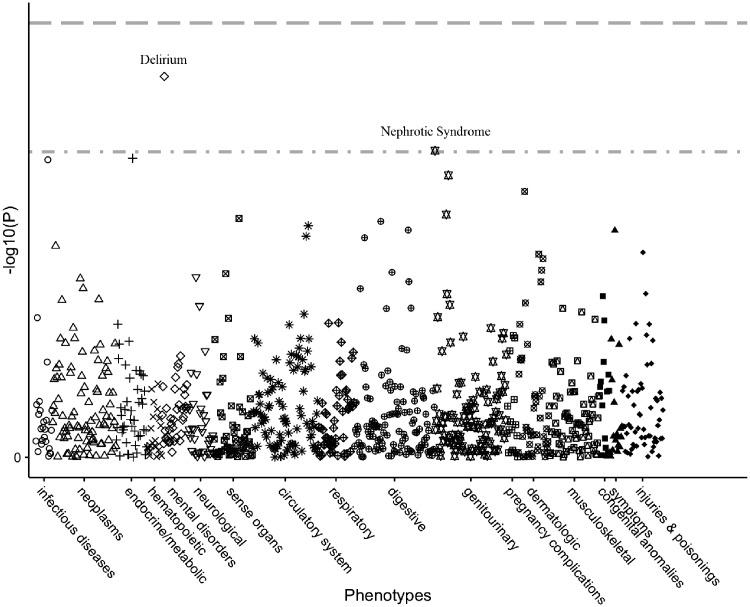
The PheWAS analysis did not identify any health outcome associated with the 25(OH)D polygenic risk score. Although a selection of nine outcomes were reported in previous Mendelian-randomization studies or umbrella reviews to be associated with vitamin D, our MR analysis, with substantial study power (>80% power to detect an association with an odds ratio >1.2 for per standard deviation increase of log-transformed 25[OH]D), was unable to support an interpretation of causal association.
CONCLUSIONS
We investigated the putative causal effects of vitamin D on multiple health outcomes in a White population. We did not support a causal effect on any of the disease outcomes tested. However, we cannot exclude small causal effects or effects on outcomes that we did not have enough power to explore due to the small number of cases.
背景
全球范围内普遍存在维生素 D 缺乏症。现有研究表明,维生素 D 水平低与 130 多种结果相关。探索维生素 D 对健康结果的因果作用可以支持或质疑维生素 D 的补充。
方法
我们对以前关于维生素 D 的孟德尔随机化研究进行了系统的文献回顾。然后,我们在来自英国生物库的 339256 名白种英国人的数据上实施了孟德尔随机化-表型全基因组关联研究 (MR-PheWAS) 分析。我们首先进行了 PheWAS 分析,以测试 25(OH)D 多基因风险评分与 920 种疾病结果之间的关联,然后检查了符合进一步分析的预先定义纳入标准的九个表型(即收缩压、舒张压、高血压风险、T2D、缺血性心脏病、体重指数、抑郁、非椎骨骨折和全因死亡率),通过多种 MR 分析方法探索因果关系。
结果
PheWAS 分析未发现与 25(OH)D 多基因风险评分相关的任何健康结果。尽管以前的孟德尔随机化研究或伞式综述报告了一些与维生素 D 相关的结果,但我们的 MR 分析具有较大的研究能力(>80%的能力来检测与每标准偏差增加的 log 转换 25[OH]D 的比值比>1.2 的关联),无法支持因果关联的解释。
结论
我们在白种人群中调查了维生素 D 对多种健康结果的潜在因果影响。我们没有支持任何测试疾病结果的因果效应。然而,由于病例数量较少,我们不能排除小的因果效应或对我们没有足够能力探索的结果的影响。

 Zotero 插件