
经典的轴突导向分子控制正确的神经桥组织形成和精确的轴突再生。
Classic axon guidance molecules control correct nerve bridge tissue formation and precise axon regeneration.
作者信息
Dun Xin-Peng, Parkinson David B
机构信息
Faculty of Medicine and Dentistry, Plymouth University, Plymouth, Devon, UK; The Co-Innovation Center of Neuroregeneration, Nantong University, Nantong, Jiangsu Province; School of Pharmacy, Hubei University of Science and Technology, Xianning, Hubei Province, China.
Faculty of Medicine and Dentistry, Plymouth University, Plymouth, Devon, UK.
出版信息
Neural Regen Res. 2020 Jan;15(1):6-9. doi: 10.4103/1673-5374.264441.
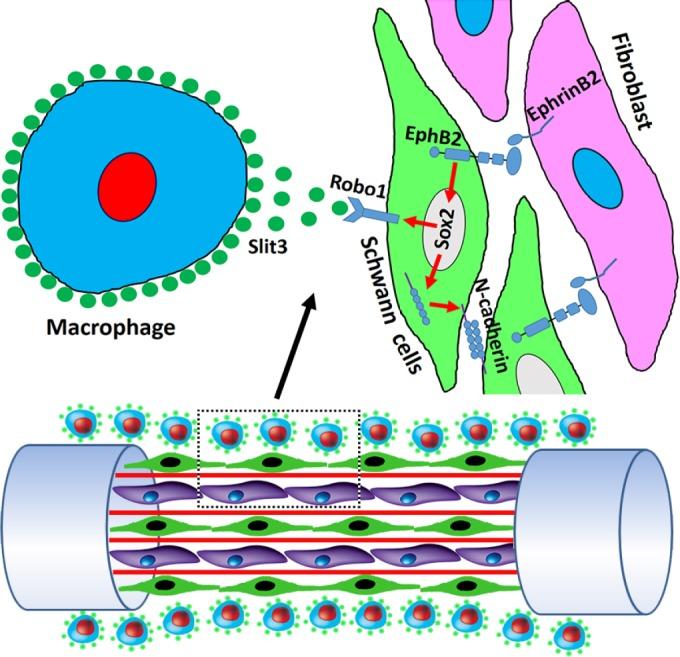
The peripheral nervous system has an astonishing ability to regenerate following a compression or crush injury; however, the potential for full repair following a transection injury is much less. Currently, the major clinical challenge for peripheral nerve repair come from long gaps between the proximal and distal nerve stumps, which prevent regenerating axons reaching the distal nerve. Precise axon targeting during nervous system development is controlled by families of axon guidance molecules including Netrins, Slits, Ephrins and Semaphorins. Several recent studies have indicated key roles of Netrin1, Slit3 and EphrinB2 signalling in controlling the formation of new nerve bridge tissue and precise axon regeneration after peripheral nerve transection injury. Inside the nerve bridge, nerve fibroblasts express EphrinB2 while migrating Schwann cells express the receptor EphB2. EphrinB2/EphB2 signalling between nerve fibroblasts and migrating Schwann cells is required for Sox2 upregulation in Schwann cells and the formation of Schwann cell cords within the nerve bridge to allow directional axon growth to the distal nerve stump. Macrophages in the outermost layer of the nerve bridge express Slit3 while migrating Schwann cells and regenerating axons express the receptor Robo1; within Schwann cells, Robo1 expression is also Sox2-dependent. Slit3/Robo1 signalling is required to keep migrating Schwann cells and regenerating axons inside the nerve bridge. In addition to the Slit3/Robo1 signalling system, migrating Schwann cells also express Netrin1 and regenerating axons express the DCC receptor. It appears that migrating Schwann cells could also use Netrin1 as a guidance cue to direct regenerating axons across the peripheral nerve gap. Engineered neural tissues have been suggested as promising alternatives for the repair of large peripheral nerve gaps. Therefore, understanding the function of classic axon guidance molecules in nerve bridge formation and their roles in axon regeneration could be highly beneficial in developing engineered neural tissue for more effective peripheral nerve repair.
周围神经系统在遭受压迫或挤压损伤后具有惊人的再生能力;然而,横断损伤后实现完全修复的可能性则小得多。目前,周围神经修复的主要临床挑战来自近端和远端神经残端之间的长间隙,这阻碍了再生轴突到达远端神经。神经系统发育过程中精确的轴突靶向是由轴突导向分子家族控制的,包括Netrins、Slits、Ephrins和Semaphorins。最近的几项研究表明,Netrin1、Slit3和EphrinB2信号在控制周围神经横断损伤后新神经桥组织的形成和精确的轴突再生中起关键作用。在神经桥内,神经成纤维细胞表达EphrinB2,而迁移的雪旺细胞表达受体EphB2。神经成纤维细胞和迁移的雪旺细胞之间的EphrinB2/EphB2信号传导是雪旺细胞中Sox2上调以及神经桥内雪旺细胞索形成所必需的,以允许轴突向远端神经残端定向生长。神经桥最外层的巨噬细胞表达Slit3,而迁移的雪旺细胞和再生轴突表达受体Robo1;在雪旺细胞内,Robo1的表达也依赖于Sox2。Slit3/Robo1信号传导是将迁移的雪旺细胞和再生轴突保持在神经桥内所必需的。除了Slit3/Robo1信号系统外,迁移的雪旺细胞还表达Netrin1,再生轴突表达DCC受体。似乎迁移的雪旺细胞也可以利用Netrin1作为导向线索,引导再生轴突穿过周围神经间隙。工程化神经组织已被认为是修复大的周围神经间隙的有前途的替代方法。因此,了解经典轴突导向分子在神经桥形成中的功能及其在轴突再生中的作用,对于开发工程化神经组织以实现更有效的周围神经修复可能非常有益。
 Zotero 插件