
循环肿瘤 DNA 的染色体不稳定性反映了晚期胃癌的治疗反应。
Chromosomal instability of circulating tumor DNA reflect therapeutic responses in advanced gastric cancer.
机构信息
Key Laboratory of Carcinogenesis and Translational Research (Ministry of Education/Beijing), Department of Gastrointestinal Oncology, Peking University Cancer Hospital and Institute, Beijing, China.
Department of Clinical Research, Yikon Genomics Co. Ltd., Shanghai, China.
出版信息
Cell Death Dis. 2019 Sep 20;10(10):697. doi: 10.1038/s41419-019-1907-4.
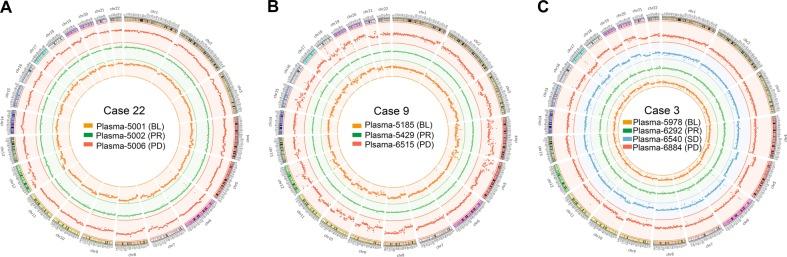
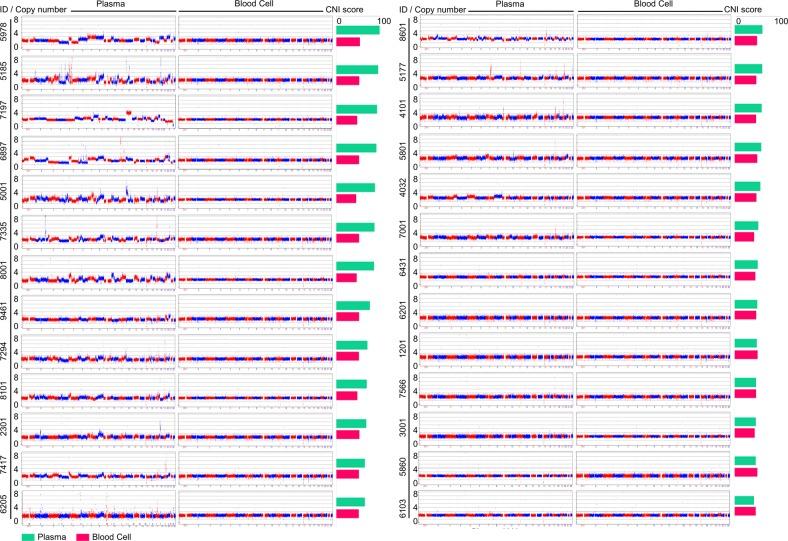
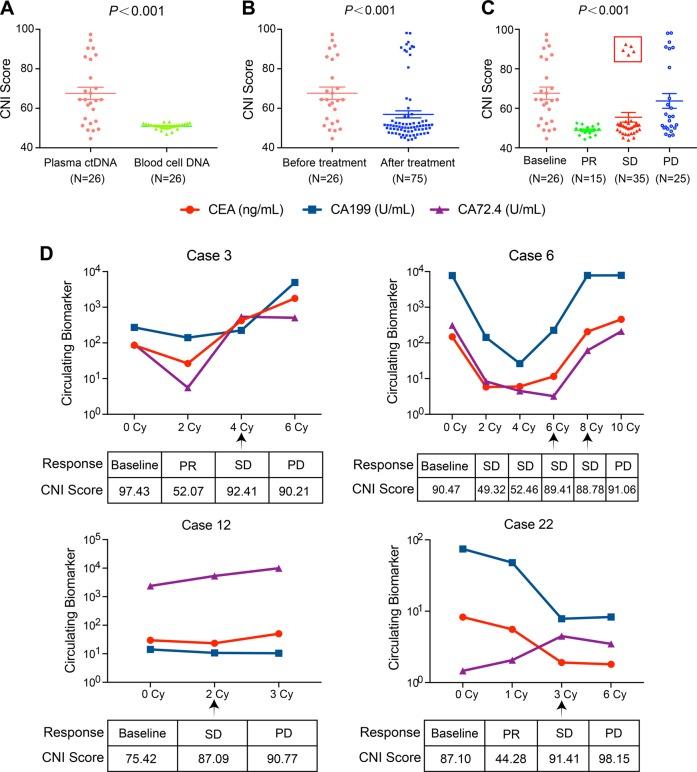
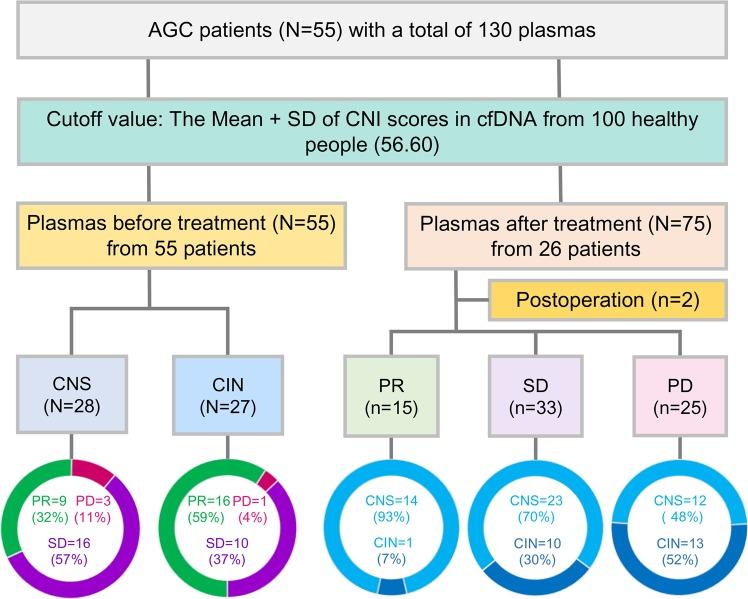
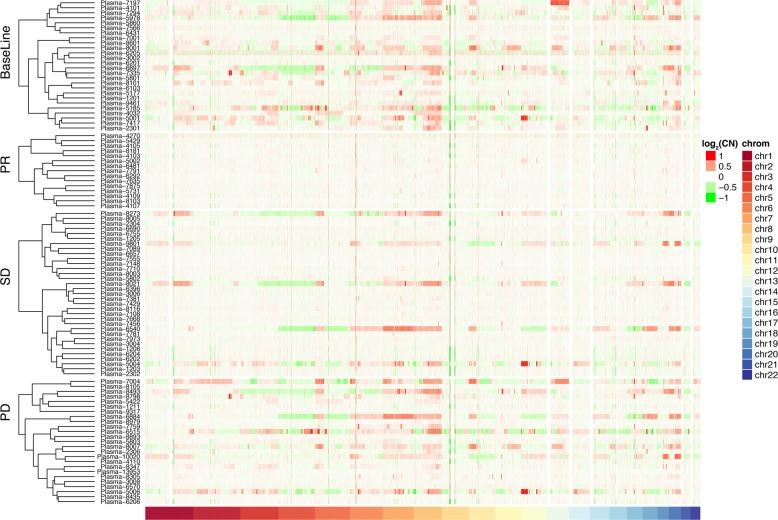
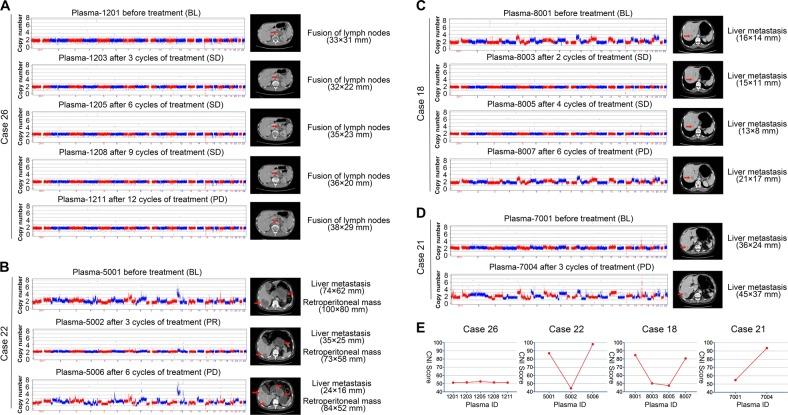
Gastric cancer is characterized by chromosomal instability. In this study, we investigated chromosomal instability quantified by copy number instability (CNI) score of circulating tumor DNA (ctDNA) during the drug treatment in advanced gastric cancer (AGC). A total of 55 pretherapeutic plasmas from 55 AGC patients and 75 plasmas during drug treatment of 26 AGC patients were collected. Plasma ctDNA was extracted and assessed by whole-genome sequencing (WGS) for somatic copy number alteration (SCNA), and according to which we calculated the CNI scores. We next assessed the correlations between chromosomal instability and therapeutic response. The cutoff value of chromosomal instability was defined as the mean + SD of the CNI scores (56.60) in cfDNA of plasmas from 100 healthy people. For 55 enrolled cases, chromosomal instability was observed in 27 (49%) prior to drug treatment, whose response rate (59%, 16/27) was higher than in 28 patients with stable chromosomes (32%, 9/28, P = 0.043). We also observed that CNI scores fluctuated during treatment in 26 patients. Specifically, the CNI scores in 93% (14/15) of patients sensitive to drug treatment reduced to the level of chromosomal stability and the CNI scores in 52% (13/25) of patients resistant to treatment elevated again. For ctDNA with developed resistance, the SCNA patterns were identical to those before treatment, whereas the CNI scores were lower than the pretherapeutic scores. We found that chromosomal instability based on ctDNA could predict and monitor therapeutic response in gastric cancer, although validation in a larger cohort will be necessary.
胃癌的特征是染色体不稳定。在这项研究中,我们研究了晚期胃癌(AGC)患者在药物治疗期间通过循环肿瘤 DNA(ctDNA)的拷贝数不稳定性(CNI)评分量化的染色体不稳定性。共收集了 55 例 AGC 患者的 55 个治疗前血浆和 26 例 AGC 患者 75 个治疗期间的血浆。提取血浆 ctDNA 并进行全基因组测序(WGS)以评估体细胞拷贝数改变(SCNA),并根据 SCNA 计算 CNI 评分。接下来,我们评估了染色体不稳定性与治疗反应之间的相关性。染色体不稳定性的截止值定义为 100 名健康人血浆 cfDNA 中 CNI 评分的平均值(56.60)加标准差。对于 55 例入组病例,在药物治疗前观察到 27 例(49%)存在染色体不稳定,其缓解率(59%,16/27)高于 28 例染色体稳定的患者(32%,9/28,P=0.043)。我们还观察到 26 例患者在治疗过程中 CNI 评分波动。具体来说,15 例对药物治疗敏感的患者中 93%(14/15)的 CNI 评分降低至染色体稳定水平,25 例对治疗耐药的患者中 52%(13/25)的 CNI 评分再次升高。对于出现耐药性的 ctDNA,SCNA 模式与治疗前相同,而 CNI 评分低于治疗前评分。我们发现基于 ctDNA 的染色体不稳定性可以预测和监测胃癌的治疗反应,尽管需要在更大的队列中进行验证。
 Zotero 插件