
法国、德国和西班牙遗传诊所中接受靶向或多基因检测前后女性的心理社会问题:一项前瞻性观察研究。
Psychosocial problems in women attending French, German and Spanish genetics clinics before and after targeted or multigene testing results: an observational prospective study.
作者信息
Brédart Anne, Kop Jean-Luc, Dick Julia, Cano Alejandra, De Pauw Antoine, Anota Amélie, Brunet Joan, Devilee Peter, Stoppa-Lyonnet Dominique, Schmutzler Rita, Dolbeault Sylvie
机构信息
Department of Supportive Care, Psycho-Oncology Unit, Institut Curie, Paris, France
Psychopathology and Health Process Laboratory, University Paris Descartes, Boulogne-Billancourt, Paris, France.
出版信息
BMJ Open. 2019 Sep 24;9(9):e029926. doi: 10.1136/bmjopen-2019-029926.
OBJECTIVES AND SETTING
Advances in multigene panel testing for cancer susceptibility has increased the complexity of counselling, requiring particular attention to counselees' psychosocial needs. Changes in psychosocial problems before and after genetic testing were prospectively compared between genetic test results in women tested for breast or ovarian cancer genetic susceptibility in French, German and Spanish clinics.
PARTICIPANTS AND MEASURES
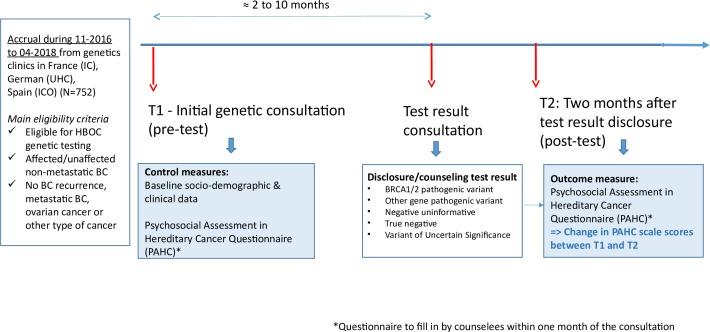
Among 752 counselees consecutively approached, 646 (86%) were assessed after the initial genetic consultation (T1), including 510 (68%) affected with breast cancer, of which 460 (61%) were assessed again after receiving the test result (T2), using questionnaires addressing genetic-specific psychosocial problems (Psychosocial Aspects of Hereditary Cancer (PAHC)-six scales). Sociodemographic and clinical data were also collected.
RESULTS
Seventy-nine (17.2%), 19 (4.1%), 259 (56.3%), 44 (9.6%) and 59 (12.8%) women received a , another high/moderate-risk pathogenic variant (PV), negative uninformative, true negative (TN) or variant of uncertain significance result (VUS), respectively. On multiple regression analyses, compared with women receiving another result, those with a VUS decreased more in psychosocial problems related to hereditary predisposition (eg, ) (ß=-0.11, p<0.05) and familial/social issues (eg, ) (ß=-0.13, p<0.05), almost independently from their problems before testing. Women with a PV presented no change in hereditary predisposition problems and, so as women with a TN result, a non-significant increase in familial/social issues. Other PAHC scales (ie, emotions, familial cancer, personal cancer and children-related issues) were not affected by genetic testing.
CONCLUSIONS
In women tested for breast or ovarian cancer genetic risk in European genetics clinics, psychosocial problems were mostly unaffected by genetic testing. Apart from women receiving a VUS result, those with another test result presented unchanged needs in counselling in particular about hereditary predisposition and familial/social issues.
目的与背景
癌症易感性多基因检测技术的进步增加了咨询的复杂性,需要特别关注咨询对象的心理社会需求。在法国、德国和西班牙的诊所,对接受乳腺癌或卵巢癌遗传易感性检测的女性,根据基因检测结果,前瞻性比较基因检测前后心理社会问题的变化。
参与者与测量方法
在连续接触的752名咨询对象中,646名(86%)在初次基因咨询后(T1)接受了评估,其中510名(68%)患有乳腺癌,其中460名(61%)在收到检测结果后再次接受评估(T2),使用针对基因特异性心理社会问题的问卷(遗传性癌症的心理社会方面(PAHC)-六个量表)。还收集了社会人口学和临床数据。
结果
分别有79名(17.2%)、19名(4.1%)、259名(56.3%)、44名(9.6%)和59名(12.8%)女性获得了 、另一个高/中度风险致病变异(PV)、阴性无信息、真阴性(TN)或意义未明变异结果(VUS)。在多元回归分析中,与获得其他结果的女性相比,获得VUS的女性在与遗传易感性相关的心理社会问题(如 )(β=-0.11,p<0.05)和家庭/社会问题(如 )(β=-0.13,p<0.05)方面下降更多,几乎与检测前的问题无关。携带PV的女性在遗传易感性问题上没有变化,携带TN结果的女性在家庭/社会问题上有不显著的增加。其他PAHC量表(即情绪、家族性癌症、个人癌症和儿童相关问题)不受基因检测影响。
结论
在欧洲基因诊所接受乳腺癌或卵巢癌遗传风险检测的女性中,心理社会问题大多不受基因检测影响。除了获得VUS结果的女性外,其他检测结果的女性在咨询方面的需求,特别是在遗传易感性和家庭/社会问题方面没有变化。
 Zotero 插件