
癌症中热休克蛋白(HSPs)的表观遗传改变。
Epigenetic Alterations of Heat Shock Proteins (HSPs) in Cancer.
机构信息
Korea Research Institute of Bioscience and Biotechnology, Daejeon 34141, Korea.
Department of Biochemistry and Cell Biology, School of Medicine, Kyungpook National University, Daegu 41944, Korea.
出版信息
Int J Mol Sci. 2019 Sep 25;20(19):4758. doi: 10.3390/ijms20194758.
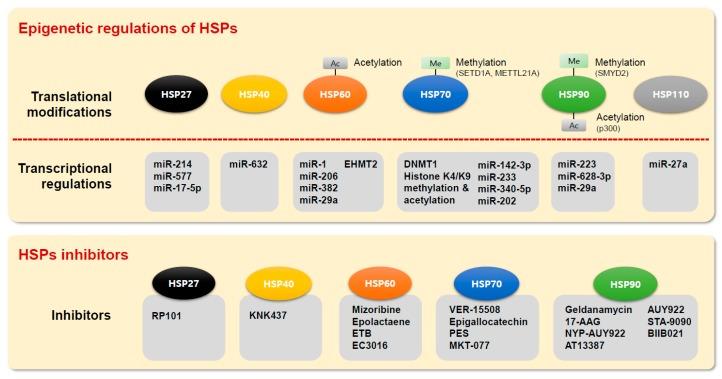
Heat shock proteins (HSPs) are associated with various physiological processes (protein refolding and degradation) involved in the responses to cellular stress, such as cytotoxic agents, high temperature, and hypoxia. HSPs are overexpressed in cancer cells and play roles in their apoptosis, invasion, proliferation, angiogenesis, and metastasis. The regulation or translational modification of HSPs is recognized as a therapeutic target for the development of anticancer drugs. Among the regulatory processes associated with HSP expression, the epigenetic machinery (miRNAs, histone modification, and DNA methylation) has key functions in cancer. Moreover, various epigenetic modifiers of HSP expression have also been reported as therapeutic targets and diagnostic markers of cancer. Thus, in this review, we describe the epigenetic alterations of HSP expression in cancer cells and suggest that HSPs be clinically applied as diagnostic and therapeutic markers in cancer therapy via controlled epigenetic modifiers.
热休克蛋白(HSPs)与多种生理过程相关,这些过程参与了细胞应激的反应,如细胞毒性剂、高温和缺氧。HSPs 在癌细胞中过度表达,并在细胞凋亡、侵袭、增殖、血管生成和转移中发挥作用。HSPs 的调节或翻译后修饰被认为是开发抗癌药物的治疗靶点。在与 HSP 表达相关的调节过程中,表观遗传机制(miRNA、组蛋白修饰和 DNA 甲基化)在癌症中具有关键作用。此外,还报道了多种 HSP 表达的表观遗传修饰剂作为癌症的治疗靶点和诊断标志物。因此,在本综述中,我们描述了 HSP 在癌细胞中的表达的表观遗传改变,并建议 HSP 通过控制表观遗传修饰剂作为癌症治疗的诊断和治疗标志物进行临床应用。
 Zotero 插件