
饮食模式和散步对老年人餐后注意力、情绪和饱腹感的急性影响:一项随机交叉试验。
Acute Impact of Dietary Pattern and Walking on Postprandial Attention, Mood, and Satiety in Older Adults: A Randomized Crossover Trial.
机构信息
Department of Nutrition and Food Sciences, Nutritional Physiology, University of Bonn, 53115 Bonn, Germany.
Department for Neurodegenerative Diseases and Geriatric Psychiatry, University Hospital Bonn, 53127 Bonn, Germany.
出版信息
Nutrients. 2019 Sep 26;11(10):2294. doi: 10.3390/nu11102294.
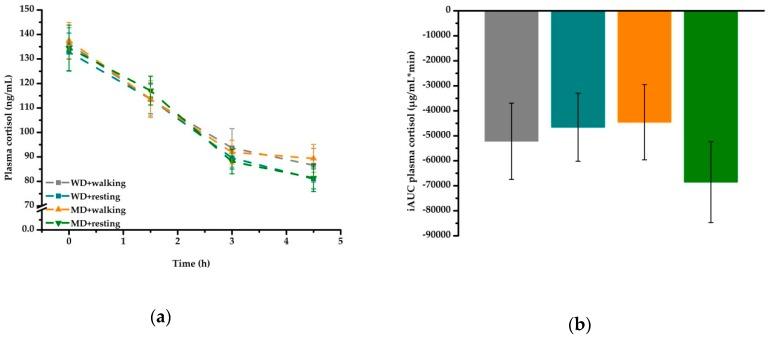
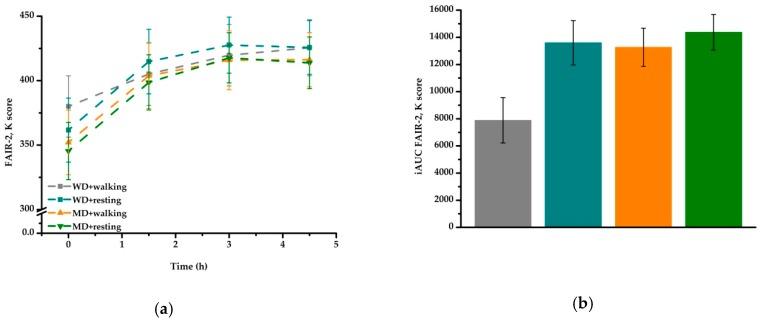
Research suggests that attention, mood, and satiety can be influenced by meal composition and postprandial activity. The present study examined whether this hypothesis applies to persons with a risk phenotype for the development of cardiovascular/neurodegenerative diseases. A randomized crossover trial was conducted in subjects with metabolic syndrome traits ( = 26, 8 female, age 70 ± 5, BMI 30.3 ± 2.3 kg/m). Each subject participated in four interventions: iso-energetic (4300 kJ) meals (Western diet high-fat, WD, and Mediterranean-type diet, MD) followed by either 30 min of moderate walking (4.6 ± 0.1 km/h) or rest. Attention, mood, satiety and plasma cortisol concentrations were measured at fasting and 1.5, 3.0, 4.5 h postprandially. Data were analyzed by linear mixed models. In all interventions, attention increased continuously in the postprandial period (time effect, < 0.001). After WD, attention was lower after walking compared to resting (meal × activity effect, < 0.05). Postprandial mood was generally "good" with no intervention effects. Postprandial satiety increased reaching maximum at 1.5 h after meal (time effect, < 0.001) and was higher after MD compared to WD (meal effect, < 0.001). In all interventions, plasma cortisol decreased similar to its diurnal variation (time effect, < 0.001). In our subjects, meal composition had no relevant impact on attention and mood. After typical WD, resting instead of walking seems to have a more beneficial effect on postprandial attention. MD leads to a strong and long-lasting feeling of satiety, possibly resulting in reduced energy intake in the further course of the day and, thus, long-term effect on weight control.
研究表明,膳食成分和餐后活动会影响注意力、情绪和饱腹感。本研究旨在检验这一假说是否适用于存在心血管/神经退行性疾病发展风险表型的人群。在具有代谢综合征特征的受试者中进行了一项随机交叉试验(n = 26,8 名女性,年龄 70 ± 5 岁,BMI 30.3 ± 2.3 kg/m²)。每位受试者参与了四种干预措施:等能量(4300 kJ)膳食(西式饮食高脂肪餐,WD 和地中海饮食,MD),随后进行 30 分钟的适度步行(4.6 ± 0.1 km/h)或休息。在空腹和餐后 1.5、3.0、4.5 小时测量注意力、情绪、饱腹感和血浆皮质醇浓度。采用线性混合模型分析数据。在所有干预措施中,注意力在餐后持续增加(时间效应,<0.001)。WD 后,与休息相比,步行后注意力较低(膳食×活动效应,<0.05)。餐后情绪通常“良好”,无干预效应。餐后饱腹感增加,在餐后 1.5 小时达到最大值(时间效应,<0.001),与 WD 相比,MD 后饱腹感更高(膳食效应,<0.001)。在所有干预措施中,血浆皮质醇的下降与昼夜变化相似(时间效应,<0.001)。在我们的受试者中,膳食成分对注意力和情绪没有明显影响。在典型的 WD 后,休息而不是散步似乎对餐后注意力有更有益的影响。MD 导致强烈而持久的饱腹感,可能导致在接下来的一天中减少能量摄入,从而对体重控制产生长期影响。


 Zotero 插件