
白大衣高血压:欧洲和加拿大全科医生的管理及对指南的遵循情况。一项横断面临床病例研究。
White-coat hypertension: management and adherence to guidelines by European and Canadian GPs. A cross-sectional clinical vignette study.
作者信息
Humbert Xavier, Fedrizzi Sophie, Touzé Emmanuel, Alexandre Joachim, Puddu Paolo-Emilio
机构信息
PhD Student, Department of General Medicine, Université Caen Normandie, Medical School, Caen, France
GP, Pharmacovigilance Regional Center, CHU Caen, Caen, France.
出版信息
BJGP Open. 2019 Oct 1;3(4). doi: 10.3399/bjgpopen19X101664.
BACKGROUND
White-coat hypertension (WCH) is also referred to as 'isolated clinic hypertension'. While it is a frequently encountered phenomenon, WCH is not systematically evoked, and its management remains unclear due to the contradictory guidelines provided by professional societies.
AIM
To examine WCH management by GPs in Europe and Canada.
DESIGN & SETTING: A clinical vignette of a possible case of WCH was created from the literature, and the responses of GPs to WCH-specific questions in a cross-sectional electronic questionnaire were compared.
METHOD
Complete electronic questionnaire responses from Europe and Canada were systematically analysed.
RESULTS
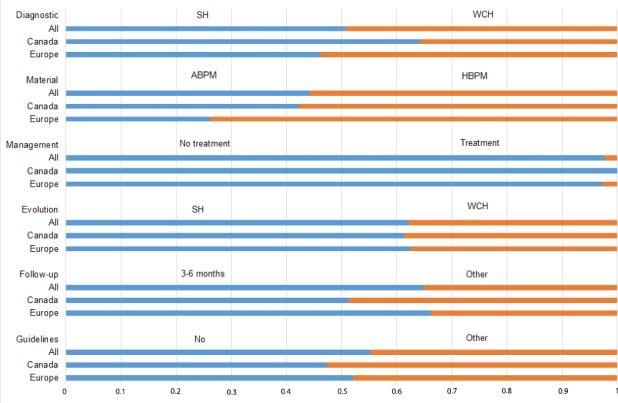
Among 770 eligible questionnaires (useful response rate: 10.6%), 43.5% were from France, 19.2% from Belgium, 7.8% from England, 19.5% from Switzerland, and 10.0% from Canada. Based on the clinical information provided in the vignette, GPs overall diagnosed hypertension and WCH equally (50.7% versus 49.3%, respectively). Canadian GPs suggested hypertension more frequently than European GPs in general (64.2% versus 46.1%, <10), and more frequently used ambulatory blood pressure monitoring ([ABPM] 42.3% versus 26.1%, = 0.01). In both groups of GPs, WCH was managed similarly (no treatment, 100% versus 97.3%, = 0.39). Generally, the GPs all followed WCH patients for 3-6 months (51.3% versus 66.2%, = 0.1), and they were not aware of the WCH guidelines (47.3% versus 52.1%, = 0.54).
CONCLUSION
Although WCH guidelines are different, WCH management by GPs is very similar except for diagnosis. Homogeneity in WCH guidelines is required and should be systematically implemented in hypertension guidelines to avoid inappropriate management of the condition.
背景
白大衣高血压(WCH)也被称为“单纯诊所高血压”。虽然这是一种常见现象,但WCH并未被系统地引发,并且由于专业协会提供的相互矛盾的指南,其管理仍不明确。
目的
研究欧洲和加拿大全科医生对白大衣高血压的管理情况。
设计与背景
根据文献创建了一个可能的白大衣高血压病例的临床 vignette,并比较了全科医生在横断面电子问卷中对白大衣高血压特定问题的回答。
方法
系统分析了来自欧洲和加拿大的完整电子问卷回复。
结果
在770份合格问卷中(有效回复率:10.6%),43.5%来自法国,19.2%来自比利时,7.8%来自英国,19.5%来自瑞士,10.0%来自加拿大。根据 vignette 中提供的临床信息,全科医生总体上诊断高血压和白大衣高血压的比例相同(分别为50.7%和49.3%)。一般来说,加拿大全科医生比欧洲全科医生更频繁地诊断高血压(64.2%对46.1%,<10),并且更频繁地使用动态血压监测([ABPM] 42.3%对26.1%,=0.01)。在两组全科医生中,对白大衣高血压的管理相似(不治疗,100%对97.3%,=0.39)。一般来说,全科医生都对白大衣高血压患者随访3至6个月(51.3%对66.2%,=0.1),并且他们不了解白大衣高血压指南(47.3%对52.1%,=0.54)。
结论
虽然白大衣高血压指南不同,但除诊断外,全科医生对白大衣高血压的管理非常相似。白大衣高血压指南需要同质化,并应在高血压指南中系统实施,以避免对该病症的不适当管理。
 Zotero 插件