
从非肌肉浸润性到高级尿路上皮癌的进展过程中的分子变化。
Molecular changes during progression from nonmuscle invasive to advanced urothelial carcinoma.
机构信息
Department of Translational Medicine, Division of Urological Research, Lund University, Lund, Sweden.
Department of Urology, Skåne University Hospital, Skåne, Sweden.
出版信息
Int J Cancer. 2020 May 1;146(9):2636-2647. doi: 10.1002/ijc.32737. Epub 2019 Nov 14.
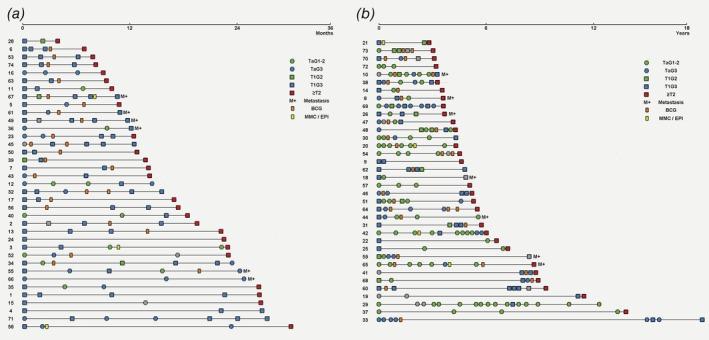
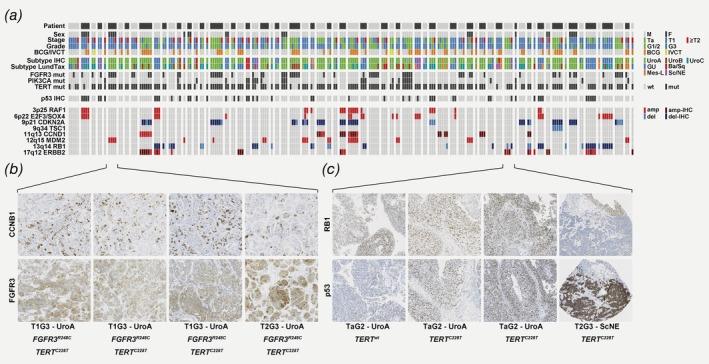
Molecular changes occurring during invasion and clinical progression of cancer are difficult to study longitudinally in patient-derived material. A unique feature of urothelial bladder cancer (UBC) is that patients frequently develop multiple nonmuscle invasive tumors, some of which may eventually progress to invade the muscle of the bladder wall. Here, we use a cohort of 73 patients that experienced a total of 357 UBC diagnoses to study the stability or change in detected molecular alterations during cancer progression. The tumors were subtyped by gene expression profiling and analyzed for hotspot mutations in FGFR3, PIK3CA and TERT, the most frequent early driver mutations in this tumor type. TP53 alterations, frequent in advanced UBC, were inferred from p53 staining pattern, and potential genomic alterations were inferred by gene expression patterns at regions harboring frequent copy number alterations. We show that early driver mutations were largely preserved in UBC recurrences. Changes in FGFR3, PIK3CA or TERT mutation status were not linked to changes in molecular subtype and aggressive behavior. Instead, changes into a more aggressive molecular subtype seem to be associated with p53 alterations. We analyze changes in gene expression from primary tumors, to recurrences and progression tumors, and identify two modes of progression: Patients for whom progression is preceded by or coincides with a radical subtype shift, and patients who progress without any systematic molecular changes. For the latter group of patients, progression may be either stochastic or depending on factors already present at primary tumor initiation.
在癌症的侵袭和临床进展过程中发生的分子变化,难以在患者来源的材料中进行纵向研究。尿路上皮膀胱癌(UBC)的一个独特特征是,患者经常会出现多个非肌肉浸润性肿瘤,其中一些肿瘤最终可能会进展为侵犯膀胱壁的肌肉。在这里,我们使用了一个包含 73 名患者的队列,这些患者总共经历了 357 次 UBC 诊断,以研究癌症进展过程中检测到的分子改变的稳定性或变化。通过基因表达谱对肿瘤进行亚型分类,并分析 FGFR3、PIK3CA 和 TERT 中的热点突变,这是该肿瘤类型中最常见的早期驱动突变。在晚期 UBC 中频繁发生的 TP53 改变,是根据 p53 染色模式推断出来的,而潜在的基因组改变则是根据含有频繁拷贝数改变的区域的基因表达模式推断出来的。我们表明,早期驱动突变在 UBC 复发中基本保留。FGFR3、PIK3CA 或 TERT 突变状态的改变与分子亚型和侵袭性行为的改变无关。相反,向更具侵袭性的分子亚型的改变似乎与 p53 改变有关。我们分析了从原发性肿瘤到复发和进展性肿瘤的基因表达变化,并确定了两种进展模式:一种是进展前或与激进亚型转变同时发生,另一种是没有任何系统性分子变化的进展。对于后者,进展可能是随机的,也可能取决于原发性肿瘤起始时已经存在的因素。



 Zotero 插件