
通过对齐基于深度神经网络的接触图来检测远程同源蛋白结构。
Detecting distant-homology protein structures by aligning deep neural-network based contact maps.
机构信息
Department of Computational Medicine and Bioinformatics, University of Michigan, Ann Arbor, MI, United States of America.
College of Mathematical Sciences and LPMC, Nankai University, Tianjin, PR China.
出版信息
PLoS Comput Biol. 2019 Oct 17;15(10):e1007411. doi: 10.1371/journal.pcbi.1007411. eCollection 2019 Oct.
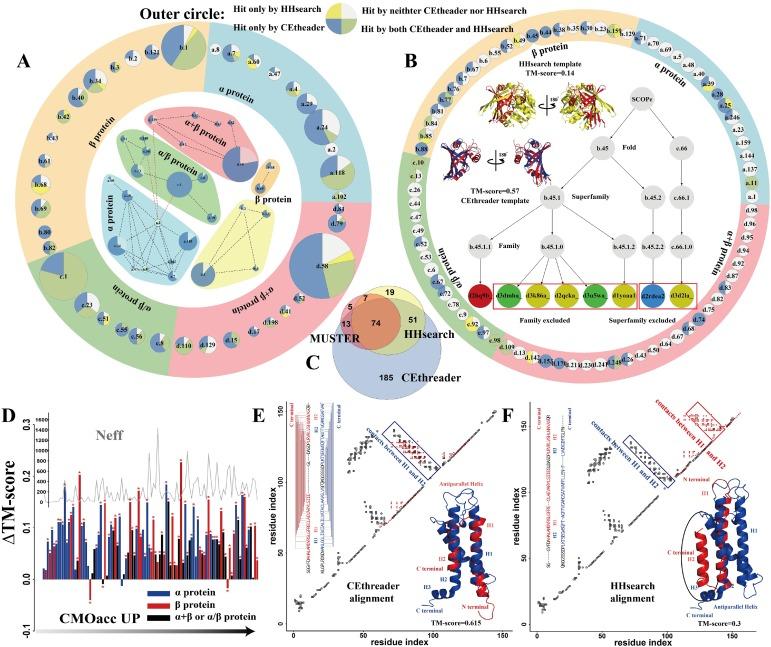
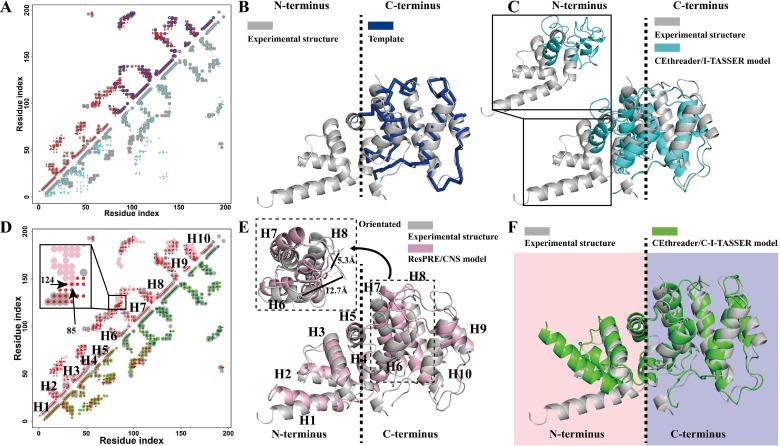
Accurate prediction of atomic-level protein structure is important for annotating the biological functions of protein molecules and for designing new compounds to regulate the functions. Template-based modeling (TBM), which aims to construct structural models by copying and refining the structural frameworks of other known proteins, remains the most accurate method for protein structure prediction. Due to the difficulty in recognizing distant-homology templates, however, the accuracy of TBM decreases rapidly when the evolutionary relationship between the query and template vanishes. In this study, we propose a new method, CEthreader, which first predicts residue-residue contacts by coupling evolutionary precision matrices with deep residual convolutional neural-networks. The predicted contact maps are then integrated with sequence profile alignments to recognize structural templates from the PDB. The method was tested on two independent benchmark sets consisting collectively of 1,153 non-homologous protein targets, where CEthreader detected 176% or 36% more correct templates with a TM-score >0.5 than the best state-of-the-art profile- or contact-based threading methods, respectively, for the Hard targets that lacked homologous templates. Moreover, CEthreader was able to identify 114% or 20% more correct templates with the same Fold as the query, after excluding structures from the same SCOPe Superfamily, than the best profile- or contact-based threading methods. Detailed analyses show that the major advantage of CEthreader lies in the efficient coupling of contact maps with profile alignments, which helps recognize global fold of protein structures when the homologous relationship between the query and template is weak. These results demonstrate an efficient new strategy to combine ab initio contact map prediction with profile alignments to significantly improve the accuracy of template-based structure prediction, especially for distant-homology proteins.
准确预测蛋白质的原子结构对于注释蛋白质分子的生物学功能和设计新的化合物来调节其功能至关重要。基于模板的建模(TBM)旨在通过复制和细化其他已知蛋白质的结构框架来构建结构模型,仍然是蛋白质结构预测最准确的方法。然而,由于难以识别远距离同源模板,当查询和模板之间的进化关系消失时,TBM 的准确性会迅速下降。在这项研究中,我们提出了一种新方法,CEthreader,它首先通过将进化精度矩阵与深度残差卷积神经网络相结合来预测残基-残基接触。然后,预测的接触图与序列轮廓比对相结合,从 PDB 中识别结构模板。该方法在两个独立的基准数据集上进行了测试,这两个数据集总共包含 1153 个非同源蛋白质靶标,对于缺乏同源模板的 Hard 目标,CEthreader 检测到的正确模板比最好的基于轮廓或基于接触的线程方法分别多 176%或 36%,TM 得分>0.5。此外,在排除与 SCOPe 超家族相同的结构后,CEthreader 能够识别与查询相同 Fold 的正确模板的数量比最好的基于轮廓或基于接触的线程方法多 114%或 20%。详细分析表明,CEthreader 的主要优势在于有效地将接触图与轮廓比对相结合,这有助于在查询和模板之间的同源关系较弱时识别蛋白质结构的全局折叠。这些结果表明,结合从头开始的接触图预测和轮廓比对是一种有效的新策略,可以显著提高基于模板的结构预测的准确性,特别是对于远距离同源蛋白质。


 Zotero 插件