
踝臂指数对急性冠状动脉综合征患者长期预后的影响。
Impact of Cardio-Ankle Vascular Index on Long-Term Outcome in Patients with Acute Coronary Syndrome.
机构信息
Division of Cardiology, Yokohama City University Medical Center.
Department of Medical Science and Cardiorenal Medicine, Yokohama City University Graduate School of Medicine.
出版信息
J Atheroscler Thromb. 2020 Jul 1;27(7):657-668. doi: 10.5551/jat.51409. Epub 2019 Oct 18.
AIM
The purpose of this study is to investigate the impact of arterial stiffness assessed using Cardio-ankle Vascular Index (CAVI) on long-term outcome after acute coronary syndrome (ACS).
METHODS
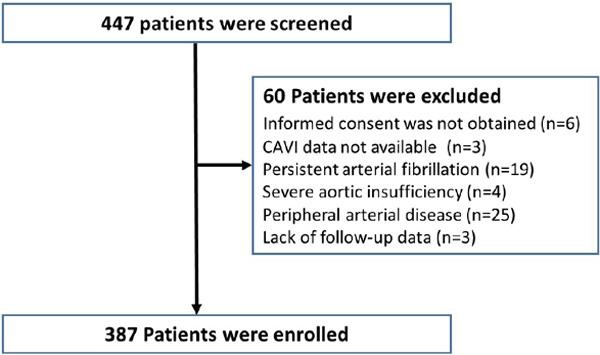
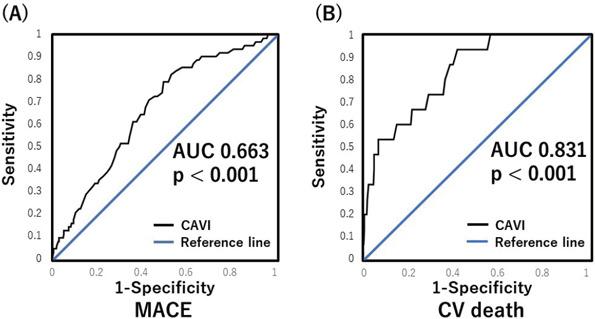
A total of 387 consecutive patients (324 males; age, 64±11 years) with ACS were enrolled. We examined CAVI and brachial-ankle pulse wave velocity (ba PWV) as the parameters of arterial stiffness. The patients were divided into two groups according to the cut-off value of CAVI determined using the receiver operating characteristic curve for the prediction of major adverse cardiovascular events (MACE): low-CAVI group, 177 patients with CAVI <8.35; high-CAVI group, 210 patients with CAVI ≥ 8.35. The primary endpoint was the incidence of MACE (cardiovascular death, recurrence of ACS, heart failure requiring hospitalization, or stroke).
RESULTS
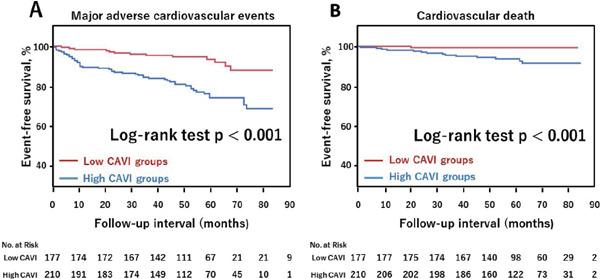
A total of 62 patients had MACE. Kaplan-Meier analysis demonstrated a significantly higher probability of MACE in the high-CAVI group than in the low-CAVI group (median follow-up: 62 months; log-rank, p<0.001). Multivariate analysis suggested that CAVI was an independent predictor of MACE (hazard ratio [HR], 1.496; p=0.02) and cardiovascular death (HR, 2.204; p=0.025), but ba PWV was not. We investigated the incremental predictive value of adding CAVI to the GRACE score (GRS), a validated scoring system for risk assessment in ACS. Stratified by CAVI and GRS, a significantly higher rate of MACE was seen in patients with both higher CAVI and higher GRS than the other groups (p<0.001). Furthermore, the addition of CAVI to GRS enhanced net reclassification improvement (NRI) and integrated discrimination improvement (IDI) (NRI, 0.337, p=0.034; and IDI, 0.028, p=0.004).
CONCLUSION
CAVI was an independent long-term predictor of MACE, especially cardiovascular death, adding incremental clinical significance for risk stratification in patients with ACS.
目的
本研究旨在探讨使用心血管-踝血管指数(CAVI)评估的动脉僵硬度对急性冠状动脉综合征(ACS)后长期预后的影响。
方法
共纳入 387 例连续 ACS 患者(324 例男性;年龄 64±11 岁)。我们检测了 CAVI 和肱踝脉搏波速度(baPWV)作为动脉僵硬度的参数。根据 CAVI 预测主要不良心血管事件(MACE)的受试者工作特征曲线确定的截断值,将患者分为两组:CAVI<8.35 的低 CAVI 组,共 177 例;CAVI≥8.35 的高 CAVI 组,共 210 例。主要终点为 MACE(心血管死亡、ACS 复发、需要住院的心衰或卒中)的发生率。
结果
共有 62 例患者发生 MACE。Kaplan-Meier 分析显示,高 CAVI 组的 MACE 发生率明显高于低 CAVI 组(中位随访时间:62 个月;对数秩检验,p<0.001)。多变量分析表明,CAVI 是 MACE(危险比 [HR],1.496;p=0.02)和心血管死亡(HR,2.204;p=0.025)的独立预测因素,而 baPWV 则不是。我们研究了将 CAVI 添加到 GRACE 评分(GRS)中对 ACS 风险评估的增量预测价值。按 CAVI 和 GRS 分层,与其他组相比,CAVI 和 GRS 均较高的患者的 MACE 发生率显著更高(p<0.001)。此外,将 CAVI 添加到 GRS 中提高了净重新分类改善(NRI)和综合判别改善(IDI)(NRI,0.337,p=0.034;IDI,0.028,p=0.004)。
结论
CAVI 是 MACE,特别是心血管死亡的独立长期预测因素,为 ACS 患者的风险分层增加了额外的临床意义。

 Zotero 插件