
miR-15a-5p、miR-15b-5p 和 miR-16-5p 通过直接靶向神经母细胞瘤中的 MYCN 抑制肿瘤进展。
miR-15a-5p, miR-15b-5p, and miR-16-5p inhibit tumor progression by directly targeting MYCN in neuroblastoma.
机构信息
Department of Biochemistry and Molecular Biology & the Fred and Pamela Buffett Cancer Center, University of Nebraska Medical Center, Omaha, NE, USA.
Childhood Cancer Repository, Texas Tech University Health Sciences Center, Lubbock, TX, USA.
出版信息
Mol Oncol. 2020 Jan;14(1):180-196. doi: 10.1002/1878-0261.12588. Epub 2019 Nov 29.
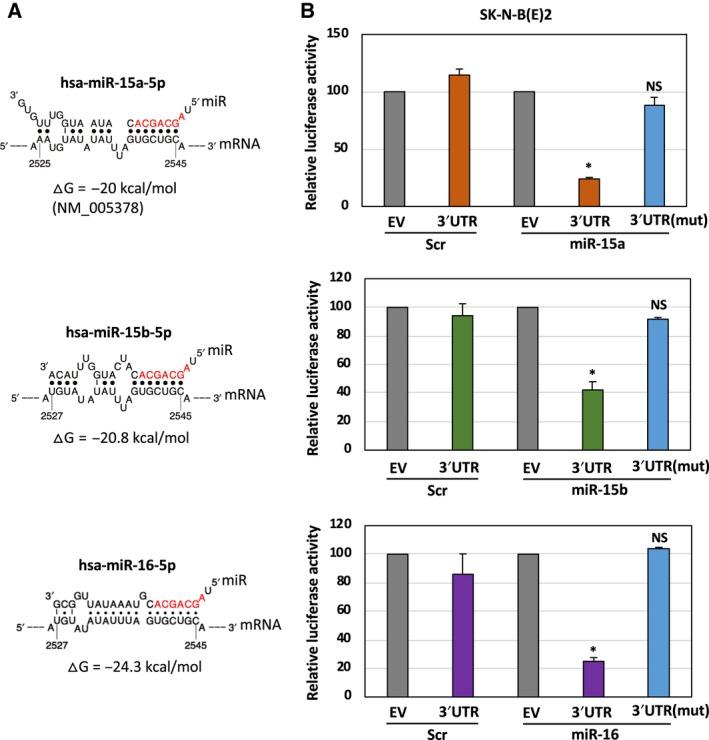
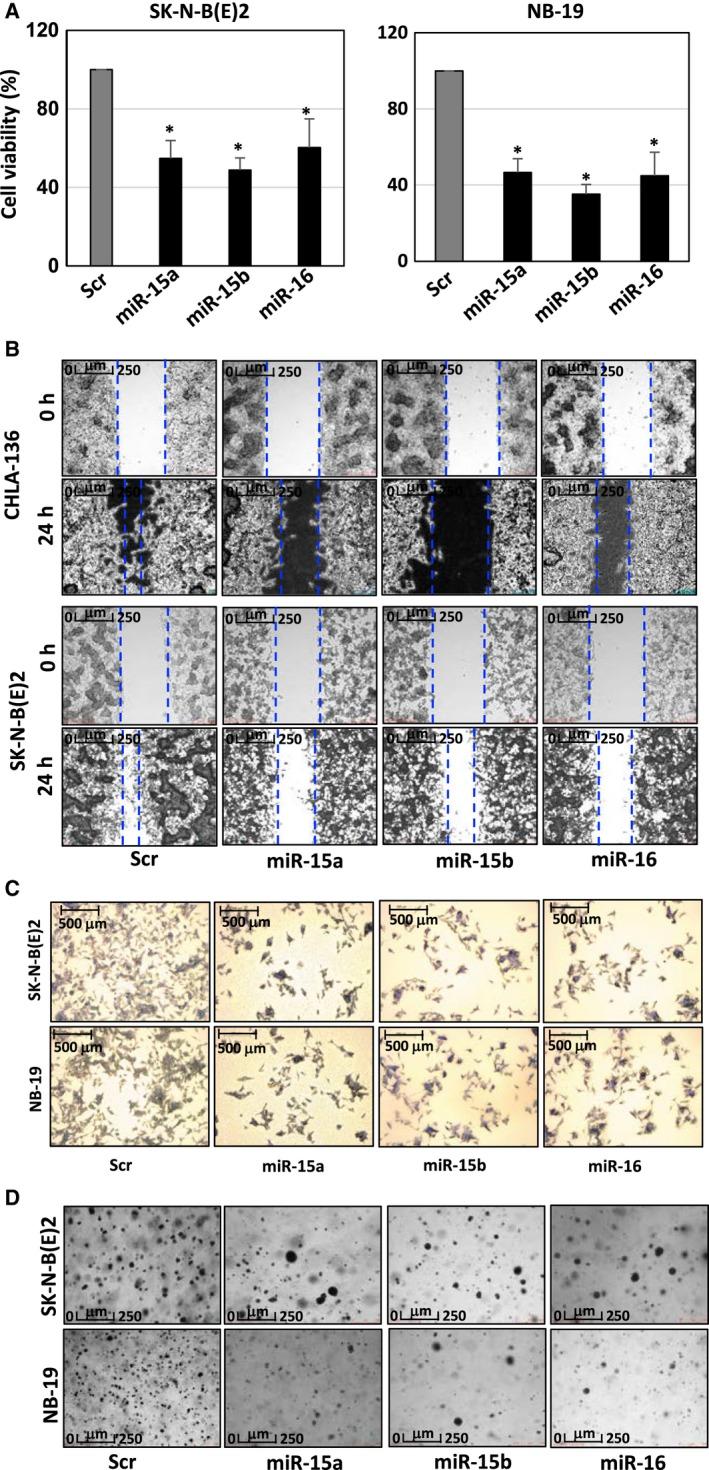
Neuroblastoma (NB) is the most common extracranial solid malignancy in children. Despite current aggressive treatment regimens, the prognosis for high-risk NB patients remains poor, with the survival of less than 40%. Amplification/stabilization of MYCN oncogene, in NB is associated with a high risk of recurrence. Thus, there is an urgent need for novel therapeutics. The deregulated expression of microRNA (miR) is reported in NB; nonetheless, its effect on MYCN regulation is poorly understood. First, we identified that miR-15a-5p, miR-15b-5p, and miR-16-5p (hereafter miR-15a, miR-15b or miR-16) were down-regulated in patient-derived xenografts (PDX) with high MYCN expression. MiR targeting sequences on MYCN mRNA were predicted using online databases such as TargetScan and miR database. The R2 database, containing 105 NB patients, showed an inverse correlation between MYCN mRNA and deleted in lymphocytic leukemia (DLEU) 2, a host gene of miR-15. Moreover, overexpression of miR-15a, miR-15b or miR-16 significantly reduced the levels of MYCN mRNA and N-Myc protein. Conversely, inhibiting miR dramatically enhanced MYCN mRNA and N-Myc protein levels, as well as increasing mRNA half-life in NB cells. By performing immunoprecipitation assays of argonaute-2 (Ago2), a core component of the RNA-induced silencing complex, we showed that miR-15a, miR-15b and miR-16 interact with MYCN mRNA. Luciferase reporter assays showed that miR-15a, miR-15b and miR-16 bind with 3'UTR of MYCN mRNA, resulting in MYCN suppression. Moreover, induced expression of miR-15a, miR-15b and miR-16 significantly reduced the proliferation, migration, and invasion of NB cells. Finally, transplanting miR-15a-, miR-15b- and miR-16-expressing NB cells into NSG mice repressed tumor formation and MYCN expression. These data suggest that miR-15a, miR-15b and miR-16 exert a tumor-suppressive function in NB by targeting MYCN. Therefore, these miRs could be considered as potential targets for NB treatment.
神经母细胞瘤(NB)是儿童中最常见的颅外实体恶性肿瘤。尽管目前采用了积极的治疗方案,但高危 NB 患者的预后仍然较差,存活率低于 40%。NB 中 MYCN 癌基因的扩增/稳定与复发风险增加有关。因此,迫切需要新的治疗方法。已有报道称,miRNA(miR)的表达失调与 NB 有关;然而,其对 MYCN 调节的影响尚不清楚。首先,我们发现 miR-15a-5p、miR-15b-5p 和 miR-16-5p(以下简称 miR-15a、miR-15b 或 miR-16)在 MYCN 表达较高的患者来源异种移植物(PDX)中下调。使用在线数据库(如 TargetScan 和 miR 数据库)预测 MYCN mRNA 上的 miR 靶向序列。包含 105 名 NB 患者的 R2 数据库显示,MYCN mRNA 与淋巴细胞白血病缺失基因 2(DLEU2)呈负相关,DLEU2 是 miR-15 的宿主基因。此外,miR-15a、miR-15b 或 miR-16 的过表达显著降低了 MYCN mRNA 和 N-Myc 蛋白的水平。相反,抑制 miR 则显著增强了 MYCN mRNA 和 N-Myc 蛋白水平,并延长了 NB 细胞中的 mRNA 半衰期。通过进行 Argonaute-2(Ago2)免疫沉淀测定,Ago2 是 RNA 诱导沉默复合物的核心成分,我们表明 miR-15a、miR-15b 和 miR-16 与 MYCN mRNA 相互作用。荧光素酶报告基因检测表明,miR-15a、miR-15b 和 miR-16 结合 MYCN mRNA 的 3'UTR,导致 MYCN 抑制。此外,miR-15a、miR-15b 和 miR-16 的诱导表达显著降低了 NB 细胞的增殖、迁移和侵袭能力。最后,将表达 miR-15a、miR-15b 和 miR-16 的 NB 细胞移植到 NSG 小鼠中,抑制了肿瘤形成和 MYCN 表达。这些数据表明,miR-15a、miR-15b 和 miR-16 通过靶向 MYCN 在 NB 中发挥肿瘤抑制功能。因此,这些 miRs 可被视为 NB 治疗的潜在靶点。


 Zotero 插件