
基于读长比对和从头拼接融合转录本的融合转录本检测准确性评估。
Accuracy assessment of fusion transcript detection via read-mapping and de novo fusion transcript assembly-based methods.
机构信息
Broad Institute of MIT and Harvard, Cambridge, MA, 02142, USA.
Cold Spring Harbor Laboratory, Cold Spring Harbor, NY, 11724, USA.
出版信息
Genome Biol. 2019 Oct 21;20(1):213. doi: 10.1186/s13059-019-1842-9.
BACKGROUND
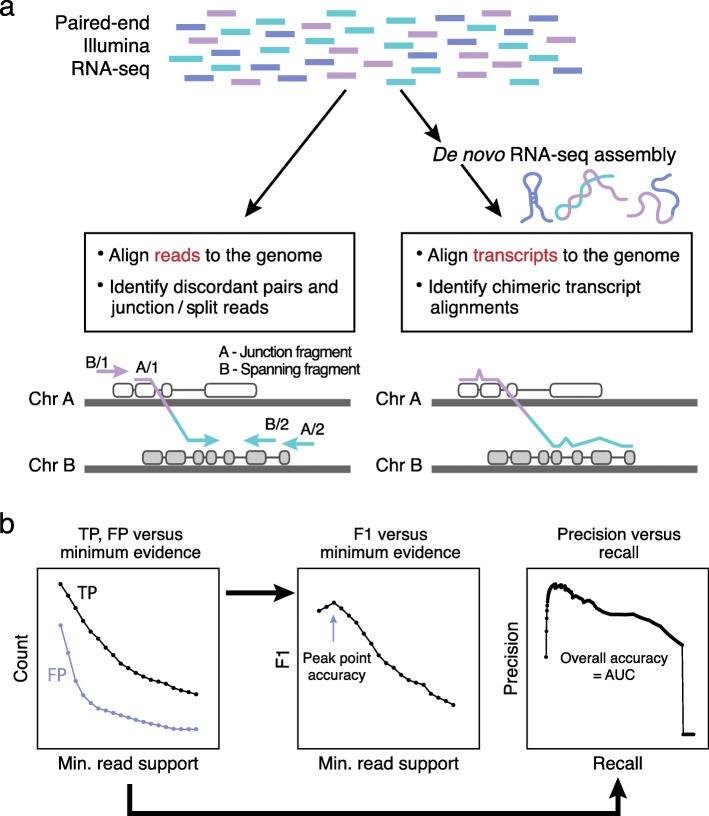
Accurate fusion transcript detection is essential for comprehensive characterization of cancer transcriptomes. Over the last decade, multiple bioinformatic tools have been developed to predict fusions from RNA-seq, based on either read mapping or de novo fusion transcript assembly.
RESULTS
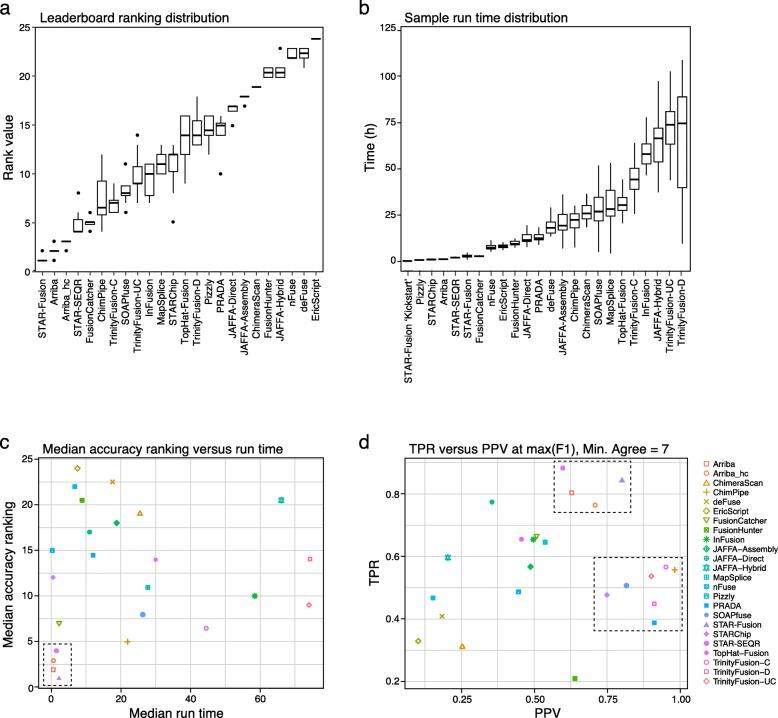
We benchmark 23 different methods including applications we develop, STAR-Fusion and TrinityFusion, leveraging both simulated and real RNA-seq. Overall, STAR-Fusion, Arriba, and STAR-SEQR are the most accurate and fastest for fusion detection on cancer transcriptomes.
CONCLUSION
The lower accuracy of de novo assembly-based methods notwithstanding, they are useful for reconstructing fusion isoforms and tumor viruses, both of which are important in cancer research.
背景
准确的融合转录本检测对于全面描述癌症转录组至关重要。在过去的十年中,已经开发出多种基于 RNA-seq 的生物信息学工具,通过读段比对或从头拼接融合转录本进行融合预测。
结果
我们利用模拟和真实的 RNA-seq 数据,对包括我们自主开发的应用程序在内的 23 种不同方法进行了基准测试,包括 STAR-Fusion 和 TrinityFusion。总体而言,STAR-Fusion、Arriba 和 STAR-SEQR 在癌症转录组融合检测方面具有最高的准确性和最快的速度。
结论
尽管基于从头拼接的方法准确性较低,但它们对于重建融合异构体和肿瘤病毒仍然有用,这两者在癌症研究中都很重要。

 Zotero 插件