
基于韩国全国人群队列研究的 2 型糖尿病患者性别差异与结直肠癌风险。
Colorectal Cancer Risks According to Sex Differences in Patients With Type II Diabetes Mellitus: A Korean Nationwide Population-Based Cohort Study.
机构信息
Department of Internal Medicine, St. Vincent's Hospital, College of Medicine, the Catholic University of Korea, Seoul, Korea.
Department of Biostatistics, College of Medicine, the Catholic University of Korea, Seoul, Korea.
出版信息
Clin Transl Gastroenterol. 2019 Oct;10(10):e00090. doi: 10.14309/ctg.0000000000000090.
INTRODUCTION
Developing colorectal cancer (CRC) poses challenges for patients with type II diabetes mellitus (T2DM). We investigated CRC risk factors in patients with T2DM.
METHODS
We retrospectively collected data from the National Health Insurance Corporation database, comprising approximately 97% of the Korean population. T2DM and CRC were defined according to International Classification of Disease codes (10th Revision) and claims data. Obesity was defined using body mass index (BMI); abdominal obesity was defined according to waist circumference. Other variables were defined using demographic, anthropometric, and laboratory data.
RESULTS
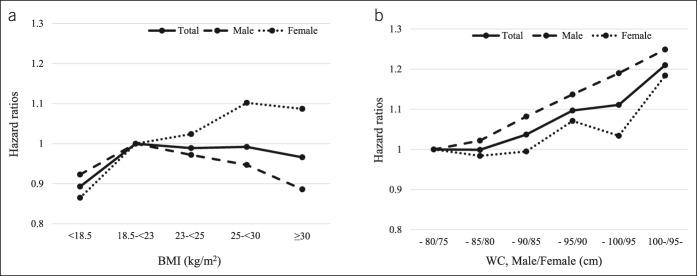
Overall, 2,591,149 patients with T2DM were analyzed. During the follow-up period (median, 5.4 years), 24,236 CRC cases were identified. Aging (≥70 years), male sex, smoking, alcohol consumption, hypertension, and insulin and/or sulfonylurea use were significant risk factors for CRC. In males, smoking and alcohol consumption were more likely to lead to CRC, whereas a BMI increase was a more significant risk factor in females. Females with a BMI ≥ 25 kg/m and abdominal obesity were associated with an 18% increased risk of CRC compared with patients with normal weight and normal waist circumference (hazard ratio = 1.184, 95% confidence interval 1.123-1.25), whereas male patients with a BMI ≥ 25 kg/m and abdominal obesity were associated with an 8% increased risk (hazard ratio = 1.087, 95% confidence interval 1.049-1.127).
DISCUSSION
Patients had CRC risk factors that differed according to sex. Smoking and heavy alcohol consumption were risks of CRC in males. Female patients with a BMI ≥ 25 kg/m and abdominal obesity were at a higher risk of developing CRC than males.
简介
患有 2 型糖尿病(T2DM)的患者罹患结直肠癌(CRC)面临挑战。我们研究了 T2DM 患者的 CRC 风险因素。
方法
我们从国家健康保险公司数据库中回顾性地收集数据,该数据库包含约 97%的韩国人口。T2DM 和 CRC 根据国际疾病分类代码(第 10 版)和索赔数据进行定义。肥胖使用体重指数(BMI)定义;腹部肥胖根据腰围定义。其他变量使用人口统计学、人体测量学和实验室数据定义。
结果
共分析了 2591149 例患有 T2DM 的患者。在随访期间(中位数为 5.4 年),共确定了 24236 例 CRC 病例。年龄(≥70 岁)、男性、吸烟、饮酒、高血压以及胰岛素和/或磺脲类药物的使用是 CRC 的显著危险因素。在男性中,吸烟和饮酒更可能导致 CRC,而女性 BMI 增加是 CRC 的更重要危险因素。与体重正常和腰围正常的患者相比,BMI≥25kg/m 和腹部肥胖的女性 CRC 风险增加 18%(风险比=1.184,95%置信区间 1.123-1.25),而 BMI≥25kg/m 和腹部肥胖的男性患者 CRC 风险增加 8%(风险比=1.087,95%置信区间 1.049-1.127)。
讨论
患者的 CRC 风险因素因性别而异。吸烟和大量饮酒是男性 CRC 的危险因素。BMI≥25kg/m 和腹部肥胖的女性患者比男性患者发生 CRC 的风险更高。

 Zotero 插件